Due terzi compiuti

Pensieri e esperienze di un’anatra selvaggia di ottanta e un anni.

Avram Miller by the sea
EN | IT

587 post pubblicati dal 2006

Tag: Microsoft

  • Driving the Creation of Residential Broadband

    I am resending this because there was an issue in the link to the chapter in my book about broadband. Sorry about this.

    Driving the creation of residential broadband was unquestionably the highlight of my career. Many others played important roles: developing the technology (Broadcom, 3Com), creating cable and DSL modems (General Instrument, LANcity, Texas Instruments), providing broadband services (@Home, Covad), enabling streaming media (Launch Media, Broadcast.com), interactive services (AOL, Yahoo), browsers (Netscape, Microsoft), and, of course, the cable and telephone companies that became broadband service providers (Comcast, Bell Atlantic).

    It Began with a Phone Call

    It all started with a phone call in 1992 between Bill Gates and Andy Grove. Les Vadasz and I had recently started what became Intel Capital, and I had decided to make the home computer market a key focus. Grove thought I was foolish for wanting to do this. He said the market for home computers would never be significant. But he also told me that if I wanted to waste my time on it, it was my choice.

    Then one day, Gates called Grove and said Microsoft wanted to work on the home computer market. Since no one at Intel seemed interested, Gates suggested he might work with AMD, Intel’s primary competitor. Of course, Bill said this to get Andy’s attention, knowing he wouldn’t want Microsoft partnering with AMD. Grove quickly responded that Intel was indeed interested in the home market—“after all, one of his vice presidents, Avram Miller, was devoting himself to it.”

    Bill, whom I had first met a decade earlier during my time at Digital Equipment, replied, “Great! Have Avram come up to Redmond and meet with Rob Glaser, who’s leading our consumer activities.” We started a project to create an interactive set-top box and brought in General Instrument, which at the time was led by Don Rumsfeld. There I met GI’s CTO, Matt Miller (no relation), who later played an important role in creating residential broadband over cable.

    “Bill believed that the top of the TV set (and TVs did have ‘tops’ back then) was the most important real estate in the home.”

    Like many others, he believed interactivity would happen through the television. I did not share that view.

    Grove called me and told me my real job was to keep Microsoft away from AMD. He still thought there was no real home market for personal computers; he only cared about the business market. History would prove otherwise. But for me, this gave the opening I needed.

    (altro…)
  • Driving the Creation of Residential Broadband

    Driving the creation of residential broadband was unquestionably the highlight of my career. Many others played important roles: developing the technology (Broadcom, 3Com), creating cable and DSL modems (General Instrument, LANcity, Texas Instruments), providing broadband services (@Home, Covad), enabling streaming media (Launch Media, Broadcast.com), interactive services (AOL, Yahoo), browsers (Netscape, Microsoft), and, of course, the cable and telephone companies that became broadband service providers (Comcast, Bell Atlantic).

    It Began with a Phone Call

    It all started with a phone call in 1992 between Bill Gates and Andy Grove. Les Vadasz and I had recently started what became Intel Capital, and I had decided to make the home computer market a key focus. Grove thought I was foolish for wanting to do this. He said the market for home computers would never be significant. But he also told me that if I wanted to waste my time on it, it was my choice.

    Then one day, Gates called Grove and said Microsoft wanted to work on the home computer market. Since no one at Intel seemed interested, Gates suggested he might work with AMD, Intel’s primary competitor. Of course, Bill said this to get Andy’s attention, knowing he wouldn’t want Microsoft partnering with AMD. Grove quickly responded that Intel was indeed interested in the home market—“after all, one of his vice presidents, Avram Miller, was devoting himself to it.”

    Bill, whom I had first met a decade earlier during my time at Digital Equipment, replied, “Great! Have Avram come up to Redmond and meet with Rob Glaser, who’s leading our consumer activities.” We started a project to create an interactive set-top box and brought in General Instrument, which at the time was led by Don Rumsfeld. There I met GI’s CTO, Matt Miller (no relation), who later played an important role in creating residential broadband over cable.

    “Bill believed that the top of the TV set (and TVs did have ‘tops’ back then) was the most important real estate in the home.”

    Like many others, he believed interactivity would happen through the television. I did not share that view.

    Grove called me and told me my real job was to keep Microsoft away from AMD. He still thought there was no real home market for personal computers; he only cared about the business market. History would prove otherwise. But for me, this gave the opening I needed.

    (altro…)
  • The Microsoft CEO Transition and the NBA

    The succession of a CEO is one of the most important events in a corporation and unfortunately, it is often a step downward, in Microsoft’s case, there is a not a lot of room to descend.

    My former company, Intel did pretty well with its first three CEOs, Bob Noyce, Gordon Moore and Andy Grove, but then the slide slowly began with Craig Barrett followed by Paul Otellini.  It is too early to judge Brian Krzanich, although that will probably not stop me.

    In my  recent blog post, Why  Corporate Boards Suck, I cover some of the reasons for this.


    bill and paul

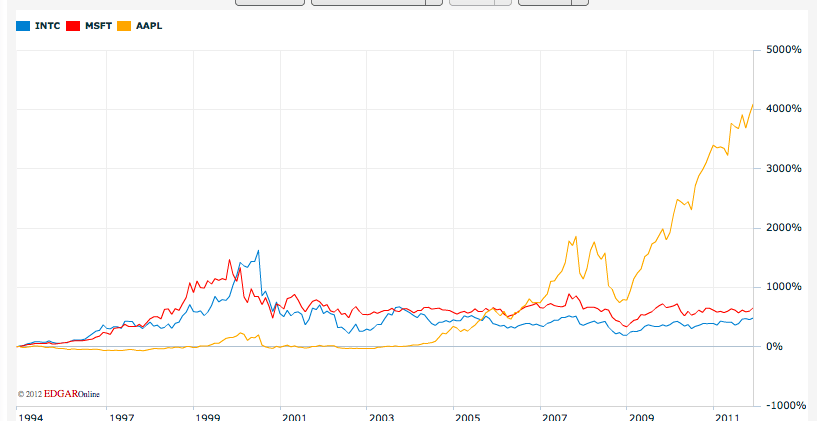
    Microsoft was not so lucky. Steve Ballmer has proven himself to be one of the worst CEOs ever.  With a weak board that he could bully, he stayed way beyond his expiration date.  Bill Gates was the only one that could have stood up to him, but I guess he was afraid that he might have to come back to the company as CEO, and then the certain future failures of the company would happen on his watch.  So instead, he sold most of his shares in Microsoft since Ballmer has been CEO. In fact, I expect that Ballmer will soon become the largest individual owner of Microsoft stock.  Good thing for Bill, since the average return of Microsoft shares has been less than 3% a year (and negative when taking into consideration inflation and tax). On the other hand, Apple averaged 38%  a year over the same period.

    Alan Mulally, CEO of Ford would rather stay in Detroit

    It appears that no one external to Microsoft who was worthwhile wanted the job as CEO for a good reason, Bill Gates and Steve Ballmer.  John Thompson who was running the CEO Search Committee ended up appointing Satya Nadel, someone that has had very little experience outside of Microsoft to the post, when what they needed the most was an outsider without attachment.  It’s like Dick Cheney who, when tasked with finding a VP candidate for George Bush ended up proposing himself, John Thompson ended up as Executive Chairman of Microsoft.  Somehow Bill agreed to give up the position as Chair, but remains on the board.  Ballmer will also remain on the board.  The cover for Bill giving up the Chair is that he will spend a few days as week as the Technical Advisor to the new CEO.  This is not good.  Bill was never really technical or if he was, he was no longer technical by the time he was 30 years old.  He certainly never understood networking, and I can state that from many personal interactions.  Bill’s genius was in how to use Microsoft’s power to get even more power.  Bill Gates was a man of vision  when he started but his vision did not evolve with the times, unlike Steve Jobs.  One thing is clear, Bill certainly did not understand succession planning.


    It is the Enterprise Stupid(s)

    My friend Bob Cringely wrote a very good post on the Microsoft transition.  I agree with much of it, but disagree about Xbox.  I think xbox should be spun out.  Maybe Amazon would buy it which would make sense. Or maybe they can sell it to Ballmer and finally get rid of the guy.  The focus of Microsoft should be on creating shareholder value not in maintaining  the old Microsoft.  Microsoft  should focus on enterprise.  It could potentially merge with IBM  (for someone that was active in the computer industry in the 80s, that sure seems like a crazy idea).  They should use their strong balance sheet of more than $50 billion in cash to buy up companies that can service the enterprise market.  They must give up their own mobile aspirations and  incorporate both the IOS and Android world providing value adds such as increased security.


    John Thompson to the rescue

    I don’t know Thompson, but he is clearly a clever dude.  He has some real world experience.  He was a Vice President of IBM where he worked in a number of senior positions over a 28 year career there. This included sales and marketing.  Then he was CEO of Symantec the leading computer security company.  He managed to get out of there before the company went into decline and made a lot of money.  So I suspect that it will not be long before Thompson adds the tittle “Executive”  to Board Chairman and starts calling the shots.  Nadella will function as COO/CTO.  Bill will find a way to declare victory and reduce his hours as Technical Advisor.   Ballmer will get mad as hell (not a pretty picture as anyone that knows him can testify) but he will hang around until he figures out what he can do.  Here is a suggestion:  He can become the CEO of Yahoo!


    steveballmerNBA and the future of Microsoft

    Thompson, owns 20% of a basket ball team, The Golden State Warriors.  Steve Ballmer has been trying to buy an NBA team ( Sacramento Kings) so it imaybe this is really a basketball game with Satya Nadella as the ball.  By thew way, Paul Allen the co-founder of Microsoft owns the Seattle Trail Blazzers.

    In full disclosure, I have never been to a Basketball game nor do I plan to ever attend one.


  • Why Corporate Boards Suck

    I have served on a number of Boards of publicly traded companies, both in the USA and Internationally.  I have also served on many private company Boards as well as the Boards of several non-profit organizations.  I like to joke that the difference between serving on the Board of a public company and serving on the Board of a non-profit is that the public company pays you a lot of money to ignore your advice and you pay the nonprofit a lot of money to ignore your advice. But, frankly, there is a lot of truth to this.  Over the years, I have resigned all my Board positions. Recently though, I became the Vice Chair of the Board of a private medical device company in which I am also a larger investor.

    The main function of the Board is to represent the Stockholders.  They have a fiduciary responsibility to make sure the company follows all regulations and in particular is honest in their reporting.  The Board represents the Shareholders in dealing with management and, in particular, on  compensation issues.  But the most important role of the Board is to fire the CEO and hire the new one.  And this is exactly where Boards perform very badly.

    I have thought about why this is and have come to some conclusions I will share with you. Companies do best when they have a strong CEO with a vision and the drive to implement it.  Some examples in the world of tech are Steve Jobs and Jeff Bezos. But strong CEO’s don’t want to have strong Boards.  The Boards they put together are more of a cheering squad than a review body.  Because the strong CEO is doing well for the Shareholders,  and most Board members are getting significant stock compensation, no one wants to rock the boat and no one wants to be thrown overboard. So things go well during this phase just ask Al Gore.

    Then the strong CEO gets too old or gets sick or even dies.  Now the Board has to find a replacement.  In the case of a Bill Gates or an Andy Grove, the former CEO lobbies for one of his managers to take his position and also stays on the Board.  This is a recipe for failure in my opinion.  Strong CEOs do not surround themselves with people that can take their positions because they do not want challengers.  The person they recommend may be at best, a compliment to their skill set and in the worst case, just a yes person.  So you get Steve Balmer (Microsoft) and Craig Barrett followed by a Paul Otellini (Intel).   The former CEO of these companies stays on the Board and  has a undue amount of influence on the Board and on the new CEO.

    If in the case of Apple, or now in the case of Microsoft, the Board has to find a new CEO. They do not want to pick someone that will be really strong because that person will want to come in and create a new Board with people that will owe their positions to him or her.  Of course this is not always true, but I have seen it too often.

    The most important thing that a Board can do is to fire a CEO that is not performing.  But, as an example, look at how long it took for that to happen at Microsoft and Intel.

    Now look at how difficult a time Microsoft is having in finding a new CEO, because both Balmer and Gates want to stay on the board.  They should both get off. Only a fool would want to be the CEO of Microsoft if either one or both of them stay on.  I wonder which fool will be accepting the job.

  • The Resurrection of Wintel Part 2

    Unfortunately, I have to announce that this blog post will have more than two parts.  This part will deal with some important concepts that will inform some of the conclusions I will make later.

    First a recap of Part 1.

    Part 1 mostly dealt with the departure of Paul Otellini, the former CEO. I thought my post on this topic would be my last post about Intel but then I got the idea for the Resurrection of Intel and wrote a bit about the death of Wintel.  Wintel was the very successful informal alliance between Intel and Microsoft that was the driving force of the PC era.

    Computer Technology 101

    The first concept is Moore’s law which was first described by Gordon Moore, one of the founders of Intel, in a paper in 1965.  He said the number of components in integrated circuits would double every  year. He altered that in 1975 to a doubling every two years.  Most people think that Moorse’s law refers to the power/performance of such things as microprocessors and computer memory.  Clearly there is a strong correlation.

    When I was at Intel (1984-1999), we use to say we could either double the performance for the same dollars or offer the same performance for half the dollars.  Both are exponential functions.  If we are very conservative about the rate of doubling, we can say that the performance will increase by 20 times in ten years for the same dollars and will cost about about a 1/20th for the same performance.  Of course, there can be all kinds of combinations of cost/performance in between.   The actual  improvements have been greater than this for more than the last twenty years.  Moore’s law is expected to continue for at least another decade. It is really the fuel of the engine of change, not only in the computer industry, but any activity which is sensitive to the cost of computing.

    Not all factors that effect computers follow Moore’s Law.  For instance, the speed of our access to the Internet has improved very slowly over time.  This is partly due to the nature of communication technology which often requires human beings to dig up streets or erect towers.  It also has to do with the objectives of the industries that control our access to the Internet.  Some have referred to this as Moron’s law.  Just look at the size of your desk top monitor, laptop, tablet or phone and number of pixels they contain.  Clearly  monitors have not and cannot follow Moore’s law. Otherwise we would go from a 27 inch monitor on our desk to one that was 22 feet with the same number of pixels per inch square or the same size as now with 100 times the number of pixels per inch (something we could not see) or have the same product sold at a ten dollar price.

    One of the key factors that results from Moore’s law is the increase in device density, i.e. the amount of components in a given amount of space. This comes from the reduction in size to create elements like transistors.  This is often referred to as miniaturization.   This is most evident when we see devices like the iPhone.  Things that have to fit in our pockets and purses have limited size.  So the choice is really to provide more capabilities for the same price or the same capabilities for a high price. Companies like Apple choose the former strategy to keep their revenues and profits up.  Newer entrants like Samsung will choose to offer a product at a lower price to target customers that cannot  afford the Apple product or who would be attracted by price to change vendors.  Apple’s strategy can only work as long as they can keep adding capabilities to justify their higher price (there are also non performance considerations like brand, integration and service).  But eventually, it will become harder and harder to add capabilities to take advantage of the additional power.  For instance, given the form factor of a phone, it is hard to add more pixels once you have as many pixels as the eye can see. Companies like Apple can end up being primarily in a replacement business as customers replace their products with something only slightly better in order to avoid switching out costs.

    The Art of Partition

    Another very important factor in the design of computing devices is what I will call partitioning.  The engineers put different things together to create a product.  For instance, a processor, communications chips, battery, power supply, and display.  The architecture may not take into consideration the rate of change of all these different elements.  I think it is easiest to understand if we reference a desktop computer.  I think that an all in one approach is not good value.  Take an iMac.  The processor technology will follow Moore’s law but the display will not.  So two years later you are buying a new system even though you have a perfectly fine display.  That is why I have a mac mini, wireless keyboard, mouse and a Cinema Display.  I actually upgrade my mac mini every year.  I upgrade my display maybe every three years.

    We can also observe this phenomena when looking at flat panel displays.  Many consumer electronics companies are offering Flat Panel Displays with Internet abilities.  You can get youtube, Netflix, Hulu etc.  But the display is something you might keep 5-8 years.  Clearly, the internet function of the Display will not keep up with the changes and new options of the rapidly advancing Internet. I have an AppleTV connected to my big Display.  It is the third generation of Apple TV that I have bought  for under $100 but I have had the same display the whole time.

    Computing moves to the Cloud 

    Ok, why am I going through all this?  It is because of the change from client-based computing to cloud-based computing which as been enabled by broadband internet access that has reached a critical point in speed, responsiveness and reliability.  At the same time we are going from one device  such as a desk top computer, to multiple devices including our phone, TV, and even our appliances greatly increasing the complexity of our personal computing environment.   Since computing in the cloud is not constrained by form factor it can follow Moore’s law.  Voice on mobile devices is a great demonstration of this.  The voice recognition for  Apple’s Siri and Google’s Now happen in the cloud.  Voice is a very computational and data driven process.  It would be hard to achieve a high degree of accuracy in today’s smart phone, so the Smart Phone just collects the voice and sends it to the Cloud.  That means that as the software in the cloud processes my voice it will learn and improve.  Now when I go to another device such as my TV, I can use my voice.  I believe over time more and more of computing will happen in the cloud.

    What will that mean to our devices?  Form factor will be dictated by their use.  A phone has to fit into our pocket (or at least what we think is a phone today).  A electronic book, game device and tablet have certain constraints.  Our TV’s have others.  But if the computing moves to the cloud, the capabilities of the devices will not be able to increase fast enough to follow Moore’s Law.  That means they will be come cheaper.  They will become so cheap that every form factor from a watch to a refrigerator will become intelligent gateway to the cloud. Also the size of devices will reduce.  Phones will be come thinner, TV’s will become flatter, and new devices like smart watches will appear.  This results from  the increased density of components. We are seeing a major movement on mobile devices to Apps.  I think that we will continue to see Apps but in reality they will just be simple front ends to Cloud based applications.

    But it is Cloudy 

    But there is not just one cloud.  Google has their cloud as does Apple, Microsoft and even Facebook.

    Apple understands that truly open systems collapse from complexity.  Apple is trying to create an ecosystem where all the devices can connect to their cloud and live in harmony.  They problem is that Apple has no idea about what to do in the cloud.  Siri is their only example of Cloud computing that I know of.  Steve Jobs thought of the cloud as a place where data lives.  He apparently did not understand that the cloud is where computing will take place.  Since his death, there has been no indication that his successor, Tim Cook, understands this any better.

    Google, gets the cloud much better and has a good chance to be the leader in the next generation of computing  but their implementations are often poor and mediocre (although I have just started using Google Hangout and it is pretty impressive). Google is not really in charge of the design of most  devices using their Android OS which results is a very fragmented market.  Google will most likely extend their direct presence in hardware but if GoogleTV is any indication, they will not do very well. The Google Glass thing is a big fake out in my opinion although it was probably the best way for Larry to get Sergy our of his hair. Googles deployment of fiber optic broadband networks could create a major disruption but it would take a decade to build out national fiber network in the USA for instance.

    Part 3 

    In Part 3 I will discuss what Microsoft and Intel can do to Resurrect Wintel and dominate the next phase of computing.

  • The Resurrection of Wintel Part 1.

    I never imagined I would be writing this post.  I was planing on writing what I thought would be my last post about Intel. It was to deal with the departure of Paul Otellini the former CEO  and a recent article about him published by the Atlantic.  I will do an abbreviated comment on that and then begin to get into the meat  of the Wintel Resurrection.

    Paul Otellini Regrets
    The Atlantic Monthly had a major article on the retirement of Paul Otellini the former CEO of Intel. Frankly, I think the article was very kind to Paul. Paul probably did a very good job of being the caretaker of the strategy that his predecessors Barrett and Grove had established.  We called that, The PC is iT strategy.  But the world changed from the 90s when we realized the power of the PC and Intel did not change.  While  Intel’s business grew significantly, it stock price pretty much stayed flat during Paul’s eight years as CEO.  Wall street evidently felt that Intel was not in a position to take advantage of the growth of the Internet and especially of new devices such as the iPhone and they have been largely correct in that assessment.  Paul showed no leadership in this area which is a bit strange since he served on the board of Google since 2004.  He of course profited from the options he received as a board member.  Too bad he did not influence Google to consider quality control as an important attribute of a successful company.
    I should probably say that for many years, I considered Paul a friend.  We first met up when he was the Technical Assistant to Andy Grove.  This was a very important position in terms of advancement in the company because it provided the opportunity to learn how the CEO actually operated. But most of the work really had to do with creating presentations.  Paul would refer to himself as “Andy’s foil slave” (this was before powerpoint and we used overhead projectors).  Paul and I would often have lunch together.  My personal experience with Paul until I left Intel was very good. He is really a nice person, fair and dedicated. But was not a risk taker at a time when risks were needed.  I still like him and feel bit bad about making a few negative comments about Pau over the years.  I hope now that he has left Intel he will use his skills and significant wealth to make the world a better place.
    So in the article, Paul laments about not getting the design win for the iPhone.  According to the article Intel lost the order because of price.  Frankly, while price may have something to do with it, power requirements may have also played a role.  Paul says that his gut told him that Intel should do what ever it took to get the design win but the data argued the opposite.  Intel believed that  the market for smart phones was about 1/1,000th of its current size.  Had they gotten the “Design Win”, they would have been able to ramp up their manufacturing capability to the point that they could have made money on the chips but maybe not “PC money” which continues to be Intel’s problem in pursuing  new markets.
    I know first hand what Paul is saying. In my early years at Intel, I would get beaten down with “data”.  I learned never to say “my gut tells me we should do this” even though it was my intuition that drove me.  After a while, I would make up data and/or get reports at major newspapers to say what I could not say at Intel and then I could reference their reports.  Paul’s background was in Finance and Sales. My background was more in technology, marketing and science.  During Paul’s tenure, the few intuitive people left or were driven out.  Now they have a CEO who came from manufacturing.  Paul was worked for Intel for 40 years.  The new CEO Brian Krzanich joined Intel in 1982 and worked in manufacturing until he became COO in 2012. His first job at Intel was in Process Control. In that position he was responsible for making sure nothing changed.  How about that for a visionary CEO?  This last remark may not be fair since I never meet Kranich even though he was at the company the whole time I worked there.
    I spoke about the importance of intuition to FastCompany Magazine in 1999.  Here is some of the things I said that might have changed Intel had Paul read and acted on the article.

    “Today, when Intel builds a new factory, it’s investing $2 billion in products it hasn’t yet designed for markets that don’t yet exist. This is hard for American businessmen, and I say “men” because in order to do this, you have to give up control — and giving up control makes guys really miserable. Control is an illusion. I don’t think that it ever existed, but now even the illusion is gone. As a result, we’re experiencing the rebirth of intuition.

    In our society, we often don’t want to admit that we know something if we don’t know why we know it. At Intel, I used to have a horrible problem. I’d go into a meeting, and I’d be very convinced about something, and people would say, “What evidence do you have for it?” And I’d say, “I don’t have any evidence.” They’d expect me to be analytical about it, and I wouldn’t be. Over the years, I learned to make up some bullshit story to convince them, but it had nothing to do with why I thought it would work. I just knew.

    In Hollywood, you’re expected to be intuitive. In the entertainment industry, you have people who have intuition and people who imitate. Nobody there analyzes. But for the most part, in our society, if you know and you don’t know why you know, then obviously whatever you know doesn’t matter — which is stupid. If you have been right about things for 20 years, then you should be able to say, “I don’t know why I know, but I know.” If I’m hiring people, I don’t want to know how they know, I just want to know that they have a good record of being right.

    So I had pretty much written off Intel until yesterday.  Yesterday, I went for a walk with a former colleague at Intel who is both a mentor and friend to me.  We spoke of Intel, Apple, Google and Microsoft.  Out that conversation came the rest of this blog post.

    The resurrection of Wintel
    The death of Wintel
    For over ten years, Intel and Microsoft have been drifting.  While their revenues increase, their stock prices stayed flat.  It seemed that both companies had missed the next generation of the internet.  With the exception of the Xbox, both companies revenues came from the PC industry.  The  Informal”  alliance that Microsoft and Intel had  which the Industry called by the somewhat derisive term, “Wintel”  was no more.  It had become irreverent and especially after Intel embraced  Apple and went from being Microsoft bitch to being Apple’s bitch.  But both companies are still incredibly strong.   Both have significant cash, Microsoft way more than Intel, and technical resources.  What they have been missing is a strategy.
    For Wintel to resurrect, the world of computing has to change once again and in ways that create disadvantages for companies such as Apple and Google and advantages for Intel and Microsoft.  I will explore that next.
    I should also say that I am not impressed with Larry/ Sergy or Mark (does using their first name make me hip?).  Google may be more mediocre than Microsoft ever was.  Facebook is the DOS of social networks.  But these are the guys who got started on the new cycle while the old guys tried to keep the old cycle going (always a losing strategy).  Jeff Bezos is the only one that has made the transition.  I think he is brilliant, but thankfully I never had to work with him.
    Multiple Devices meet Multiple Clouds
    We are going through a major transition in personal computing (I did not say personal computers).  Many of us have multiple devices- a smart phone, a tablet, desktops or notebooks, game machines, and DVRs etc.  We are also begining to see what is called the internet of things which really means special purpose devices like lights, appliances, autos, etc that communicate with us and other systems via the internet  This has necessitated the movement to the cloud which in a way creates a hierarchical architecture.  It is just too hard for each device to communicate directly with each device so rather, we have devices communicating with the cloud and an synchronizing with data that way.  But there is not just one cloud there is a storm.  Apple has one, Google has one, Microsoft has one just to name a few.
    Capabilities are increasing dramatically but so is complexity.   Application development is also increasing in complexity to deal with multiple eco systems.  The power of “The PC is It” was that there was a homogenious environment for developers and users.  It also had it inherent problems. Microsoft tried to develop an operating system that could scale from the smallest device to the largest computer.  It was a very difficult task and they failed at it a number of times.  The only thing that is harder is to try to support multiple operating systems. Apple is struggling with that with OSX and iOS.
    This model of computing has a very limited life span.  In my next blog, I will discuss what I think might be the next generation of computing and why it is even possible that it will be lead by Wintel.
    To be Continued
  • How I got the iPad right in 1994 but was wrong about the Information Furnace

    Today is the 5th anniversary of the announcement iPhone by the late Steve Jobs.  It is hard to imagine that it was just such a short time ago. Something seem to happen so quickly in technology while other things  seem to take a very long time.

    I recently came across an article written in June of 1994 (almost 18 years ago). You can find the article at the end of this post or you can go to this link.    It talks about the evolution of computing in the home and in particular discusses something called “The information Furnace”  a term, I believe I created, to describe a Home Server. In 1994, most homes did not have even a single computer.  Typically the computers in the home of early adopters were used for productivity applications like Personal Finance such as Quicken or for hobbies.  Probably less than a million homes were connected to on-line services like Prodigy, CompuServe and AOL – which was less than 1% of the nation. They used dial up modems.   Broadband connectivity was just starting to be tested.

    Of course the number of homes that had more than one computer was extremely small.  Home networking as we now know it did not really exist.  The floppy disk was the way information would be moved from one computer in the home to another.  This was called sneaker net many years later.  This was also before the development of what we now cal WiFi.  That meant that early networking within the home required running Ethernet cables.

    I was  convinced that  computers would dominate home interactivity. Many at the time thought it would be the interactive set top box. Because I was so involved with the creation of residential broadband technologies in my role as Vice President, Business Development at Intel,  I knew we were creating the technical foundation of a new medium.  A medium  that would impact all aspects of our lives from the way we communicated, learned, shopped, were entertained and informed. The article mentioned above was written about a year before Amazon was established.  A few months after it was published, I was quoted in Fortune Magazine as saying “that the killer app for the Internet would be advertising.”  Google was started about four years later and started selling advertising a few years after that.

    Now before you think this post is all about how insightful I was, and I was, it is really about how things turned out differently than I thought and wanted.  It really is about a failure to implement a vision and an exploration of the possibility that things could have ended up differently.

    In that very same article (again 1994), I coined the term i-pad (see the Article).  Sixteen years later, Apple announced the iPad on Jan. 27th, 2010. Coincidentally, it happened to be my  65th birthday.

    So now back to the story.  I envisioned  pervasive computing throughout the house.  At that time most computers were desktop devices and rather expensive. So I thought there would be one central computer in the home that would have the broadband connection.  Then there would be devices around the home that would provide access to this central computer
    (remember I am old enough to have lived through the time sharing days).  The central computer would have the main storage for the home.  For instance it could maintain a family calendar, home files,  etc.   I also felt that this would reduce the complexity of managing information since all information (including  media) would be located in just one place (of course it would be automatically backed-up).

    At that time, I was engaged with a number of engineers in the Intel Architecture Lab (IAL).  I was funding a number of programs within the Lab then licensing the resulting technology for equity in early stage companies.  So I am pretty sure that that I discussed these concepts with members of IAL and probably they had a major impact on my thinking.

    The problem was that Intel was a chip company and we had a very strong strategic relationship with Microsoft.   We actually had many software designers but every time we got close to some area that Bill Gates considered  Microsoft’s birthright there would be a major battle and Intel would give in.

    Microsoft was actually slow to understand how the home computing would develop.  They believed that intelligent set top’s would be the way along with game machines and various appliances.  After working with Microsoft and General Instruments  (the leader in cable boxes at the time) on the development of an Interactive Set Top Box, I became convinced that this was not the way things would develop. This view was also held by Matt Miller (no relation) who was the CTO of General Instruments.  Together, Matt and I persuaded  GI and Intel decided to develop residential broadband technologies and to do it without Microsoft.  Microsoft spent a lot of effort to develop Set Top Box software and made various deals with cable companies including investing a billion dollars into Comcast in 1997.

    However, I was not able to get executive management at Intel or Microsoft to understand the need for a home-server.  Andy Grove never really bought into my vision of how computers would be used in the home and invested a great deal of money into a flawed scheme to use ISDN to do video conferencing in the home.  Microsoft would not announce a home-server until 2007.

    So computing evolved in the home with more and more homes having multiple computers and eventually sharing a home network.  This network had at its center a router which allowed the devices in the home to easily share one broadband connection. This was one of the tasks that I thought the Information Furnace would do.  But complexity of sharing information in the home increased.  This provided an opportunity  for Apple, to address this need by creating software to synchronize information between computers and devices (iTunes/ iPod is an example). At the same time Web service companies (like Yahoo) dealt with the complexity of email, calendars and contacts by storing them on the Net. Microsoft even bought HotMail in 1997 and started up MSN.

    Now most of the functions that I had envisioned for the Information Furnace will be provided by Apple’s iCloud.  Other companies will create similar capabilities.

    In away, it is a better solution that the Information Furnace since these capabilities can be professionally managed and maintained. They can be improved without consumer involvement.  But it has taken a long time in coming, and we’re still not there.

    Of course the way it played out had a major impact on the companies involved.
    Image

    AP Article

    PCs Evolving Into Information Furnaces :
    Technology: Experts predict computers
    are evolving into control centers, linking
    the telephone, TV, thermostat and other
    household electronic devices.

    June 30, 1994 | EVAN RAMSTAD | ASSOCIATED PRESS
    NEW YORK — In the metaphor-mad world of technology, there’s a new phrase making the rounds, one that experts believe describes the direction that personal computers are taking. After 20 years as an independent box, the PC is evolving into a control center that ties together the
    phone, TV, thermostat and other electronic devices in every room in the house. An information furnace, they call it.

    “It’s equivalent to central heating,” said Avram Miller, Intel’s vice president of corporate business development. “This analogy with power is very good. If you look at electricity, electricity was designed to do only one thing–lighting. Clearly, there’s a lot more to it than that now.” Like a furnace, the PC of the future could be hidden from view, in the basement, a closet or drawer. The devices it links would take different shapes depending on their use and location. A unit in the den might have a keyboard and screen while one in the living room might be a big screen with stereo speakers and a
    player for programs on compact disc. The incorporation of telephone-answering machines into consumer PCs last summer was an early
    example of this trend, which will be a key topic at the annual PC Expo this week at New York’s Jacob Javits Convention Center.

    Intel CEO Andrew Grove has titled his keynote speech for the show “The Ubiquitous Information Appliance.”
    The acceleration of the trend is important for Intel to drive demand for advances in its key product–the microprocessor or “brain” of a PC.
    Packard Bell Inc. earlier this month rolled out PCs with built-in TV and radio receivers as well as phone answering and fax capabilities. With them, a technician played a Bach compact disc, the radio and TV and worked on a word-processing program simultaneously.
    It’s not just today’s electronic items that could be hooked up but those on the drawing board of technologists and inventors. Last week, Timex Corp. and Microsoft Corp. even demonstrated a watch that can take in messages from a computer. “One of the devices that’s interesting, we call it an I-pad, an information pad,” Miller said. “It would be a device that has a flat-panel screen. You can write on it, touch it. You might be able to speak into it and it might speak back. It would be wireless, cheap and have different forms in the house.”  Some early forms of an “I-pad” are Apple Computer Inc.’s Newton, Motorola Inc.’s Envoy and IBM’s
    Simon devices, which have both computing and communication features.
    “You will see all kinds of combinations be possible,” said Safi Qureshey, chief executive of AST Research
    Inc. in Irvine. “We want to provide the glue so the user can go in between all of these different access mechanisms.”

    The concept of a computer network in the home is rooted in the workplace. Portable computers, for instance, linked to the main one in an office are allowing more people to work at home or on the road. “The same technologies are going to be used in the home environment,” said Alan Soucy, vice president of mobile computers at Zenith Data Systems. “They’re going to be repackaged, more specific, more like an appliance.”
    The vision isn’t just Intel’s or the computer industry’s. At a cable TV trade show last month, General Instrument Corp., the leading maker of set-top channel controls, described a plan for “component” TVs built around a computer-like box. The monitor–which in time will be a flat panel screen–and game player, video recorder or telephone would all be separate pieces.
    “Exactly how much it all gets centralized in one place, I’m a little hard pressed to predict right now,” said Jeff Roman, vice president of technology and new business development for General Instrument.
    The first personal computer sold to the general public, the Altair 8800, appeared in Popular Electronics magazine in December, 1974. It was a box of circuits and lights that cost about $250 but had no software
    or screen and required 50 commands, executed by flipping switches, just to get started. Today, the most popular PCs take just a few minutes to set up, have dozens of megabytes of software
    already installed, and can link through a phone line to millions of others worldwide.

    Very few people anticipated the computers of today in 1974. Even fewer know what to expect in another
    two decades. Something as futuristic as an information furnace, while still vague, is probably only a decade away. There is certainty in the industry only about the next year or two.
    “It’s not possible to conceive 20 years from now,” said Intel’s Miller. “The computers of 20 years from now will probably be 10,000 times more powerful than they are today”

  • The Idea Man by Paul Allen

    Just read the Idea Man by Paul Allen.  I don’t usually review books and certainly not here on my blog.  And this post is not really a review as much as it is a commentary.

    The first 50% of the book deals mostly with Paul’s experiences with Bill Gates including the formation of Microsoft and the first  seven years of it’s  existence until  Paul left Microsoft (although he stayed on the boad until 2000).  I am eight yeas older than Paul and ten year older than Bill but our computer careers started about the same time (the second half of the 60s),  so I can relate very much to many of the experiences that Paul discussed about that time. I enjoyed Paul reminiscing about his feelings when he saw a transistor for the first time or what it was like to use a ASR-33 teletype for programing.  So the early part of the book was like “home week” for me..

    Paul’s description of his relationship with Bill Gates rang true as did his description of Bill himself.   I meet Bill the first time in 1981 when I was at Digital Equipment Corp.  Bill was 26 by then. IBM had brought out the IBM PC and Microsoft was marketing  MS DOS.  We interacted  a few time  over  the next several years. From about 1992 to the time I left Intel in 1999, I had much more contact with him.  I meet Paul Allen during the 90s.  I certainly had a lot less interaction  with him and he did not impress me. I use to call him the richest 80 thousand-dollar-a-year programer in the world.

    The book is an attempt to demonstrate that Paul actually played an imporant role in creating Microsoft i.e. he was the “idea man” and Bill was the “implementor” and therefore he played an  important role in creating the computer industry.  I think this  is probably true from what I read but Paul tries to demonstrate that the relationship was balanced and he contributed as much to Microsoft as  Bill.  This I doubt. There could have been many Paul Allen’s but there is only one Bill Gates (thank god).

    Then there is the part of his story that deals with his first diagnoise of Cancer ( Hodgkin’s lymphoma).  I could easily relate to that having my own bout with cancer (although at a much later stage of my life). Later, he discusses his second cancer ( non-Hodgkin’s lymphoma). Paul also suffers from heart problems and has a pacemaker.

    There is a lot about his investments in the second part of the book.  I have to say that during the 90s Paul was considered “dumb money” by many in the venture business.  He describes his investments and I think is pretty open about what went well and what went badly but you can tell that while Paul had a pretty good insight into what would happen in the future,  his  judgment about timing was pretty bad.  Also, I don’t think he was a good judge of people. Most importantly, he was spread way to thin.  Paul does not explain why he made these investments.  He was/is extremely rich.  Did he do this for money or to influence  the future?   I thought he was very honest about his investment in Interval. I had a lot of dealings with Interval.  There was a lot of value in the concept but the implementation was problem.  Again, Paul was not on top of what was happening.

    I skipped over his discussion of investing in sport teams.  I have no interest in sports.  He discusses his involvement in entertainment. I was glad to see that he now realizes that he was “taken”  by SKG Dreamworks although I am surprised that he actually made money on his investment.

    There was a lot about his philanthropic efforts.  Again, you can see he is all over the map.  It is interesting to compare the Gates Foundation with the Allen Foundation.

    There is little about his personal life as  an adult.  He mentions two girl friends in the book.  This link  has some speculations.  When I was active in “Hollywood” in the 90s, I heard some stories but who knows if they are true.   Then again, there are some interesting stories about Bill and show girls. I always thought of Paul as a pretty lonely guy.  I remember that once I was in Portofino, maybe around 1997,   with the woman in my life at that time.  Paul showed up in one of his Yacht’s –  the  Méduse.  He was by himself.  I thought about saying hello but was afriad he would ask us to join him on his Yacht.  Paul was rich but in my opinion not very interesting.  We walked the other way.

    Then there is Paul the consumer. The way he spends money is distasteful.  He appears to live like I imagine Donald Trump would like to live.  And sadly, I think there are a lot of hangers-on.   I once stood next to Paul at an Allen Conference (Herb Allen who is not a relation to Paul)  and listen to Paul discuss Yacht building with a woman I did not know.  The woman asked if he had a Helicopter Port on his boat.  Paul looked at her as if she was from Mars and said ” where else could you put your Helicopter?”.  He then told her that his boat had two. I wanted to puke.

    Paul clearly wrote this book to demonstrate that he was and is relevant.  He was of course, and after reading this book, I raised his salarly.  He is now the richest 100 thousand-dollar-a-year programer in the world.

  • Why companies fail to make transitions

    Here  is a pretty interesting link to an article on the future of Microsoft.  Frankly, the only thing that surprises me about the prediction that Microsoft will decline into insignificance is that it will take this long.  I have seen this movie before and I will probably see it again.
    I have personally watch and participated in  the first two of the major waves of computing which I describe below.
    • The first one was proprietary   vertical  computing represented by mainframe companies like IBM and mini Computer Companies like Digital Equipment.  These companies did everything themselves (hardware and system software and some application software).  Apple is the only contemporary company that resembles this structure.  IBM is still around but mainly a systems integrator.  Digital was acquired by Compaq in 1998.
    • The second one was the age of the personal computer.  It was a horizontal structure where a few companies dominated the various hardware and software layers (Intel had more than 80% of the microprocessor business and close to 100% of the profits while Microsoft had about the same in the OS and dominated some of the application layers with their office products.  At one time both Intel and Microsoft were the most valuable companies in the world. Now Wintel, once the most feared force in computing is no longer relevant.
    • The third one is network computing and is led by Google although we have to deal with Apple a bit later.  In this wave, the value has moved to the network and expanded encroach on the media industries.  Much of the value is created by the consumers themselves.  Advertising plays a key part in the monetization of this wave.
    • The fourth wave will surly come even if I for one can not yet imagine what it is (although I try).  And Google and the other companies riding the crest of the networking world will suffer the same faith as their predecessors.
    Apple is amazing in that it has survived the first two waves and is dealing extremely well in the third wave.  I will write more about Apple another time.
    So why can companies not make it through these transitions?  It is pretty simple:  They would have to take the lead in destroying their own business.  And if they were successful, they would see a reduction in profits at least at first.  I know that if you give an CEO  two choices, 1) continue as is with the knowledge that eventually your business will decline significantly and even fail or 2) take a hit now with the possibility that your business will recover in the long-term, they will choose 3) continue as it is and believe that you will figure out  how to maintain the business. In other words they can not accept the future as it will be.  This is not only true for businesses but also sadly for countries.  The USA is  Microsoft I am afraid (but further along in its decline).

    a

  • The Road Behind

    The Road Ahead

    There is an interesting review of Bill Gate’s pedictions from his book “The Road Ahead”.

    Bill Gates was never very good at seeing the technology future.  Frankly, I was not impressed with his understanding of technology. And what I found scary was that he believed that he was a technology visionary.  While I meet him in 1980, it was not until 1993 until 1999 that I interacted with him often.  He definitely did not have a good sense of the consumer market and was especially poor at understanding networking.
    What Microsoft was good at  was copying other companies ideas (some would say selling and in some cases that would be true).  This pretty much came to a halt with the government investigation of Microsoft for anti trust,
    Bill’s greatest error was thinking that people (the government) that were not as smart as he was could control what he did with his company.

    In 2000 Bill stepped down as CEO giving that position to Steve Balmer who definitely is not a visionary.  Bill must have realized that it was not going to be as much fun anymore.  He was so right about that.  And to Bill’s great credit, he and his wife Melinda started the Gates foundation.  He continued to play a strategy and technology role until her finally left all together in July of 2008.

    He did leave behind a cash generating machine which continues to make enormous amounts of money by selling products it either copied or bought and buy successfully locking in customers.

    Now, I am not sure there were other CEOs of Bill’s vintage that were better at making prediction about the future.  I certainly do not think at Steve Jobs was better.  What Steve did better was invent the future which is more important that predicting it.

    I wish I had written down my prediction fifteen years ago.  I am find them in various speeches, article and interviews and it looks like I was pretty good but probably everyone one that thinks of themselves as some kind of “futurist” has selective memory   What I was not good at doing was influencing my former company, Intel, to take advantage of the changes that I correctly saw.

    Predicting the future is meaningless if it does not effect change which means influencing the future.

    I use to say when I was an executive at Intel,  “the future is to important to be left to chance” but I was mostly talking to myself.

    Maybe I will write down my predictions for the next 15 years.  I will be eighty when I can see how well I did.