I am writing this at the age of 81. Your ages range from 16 to 23. You have never known me as a young man, and I will never know you as old ones. We share only a short stretch of time, perhaps 20 or 30 years, about a third of my life.
We do not see one another very often. It is not like the days when you were children and would visit me at my home in Sonoma. Now you are busy building lives of your own, and even three of you no longer live with your parents. I know what that is like. Once I became an adult, I spent very little time with my own parents, let alone my grandparents.
I was once young too. Sometimes I wonder whether, if we had been the same age, we might have been friends. I hope so.
There were occasions when you and I all came together such as a bar mitzvah or an important birthday, like when my father turned 90 or I turned 70. But now we are scattered all over the world.
Perhaps one of you will get married while I am still alive, and the family will come together again for that celebration. But most likely, I will see each of you separately from time to time. Perhaps you will visit me in Italy, where I now live. You will always be welcome.
I wrote a book about my life, Il volo di un’anatra selvaggia. I never expected you to read it when it was published, but it is there, waiting for you if you ever become curious. In the meantime, please ask me questions. Many people, as they grow older, regret not having asked their parents and grandparents more while they still had the chance. I certainly do. So please take advantage of the opportunity I am offering you.
I never had the chance to talk with my father’s parents about their childhoods. I knew more about my mother’s mother, and even her grandmother, because we were all close when I was growing up. Even so, there is still so much I wish I had asked them.
While I cannot know you beyond my own lifetime, I can help you understand where you came from and what shaped the years before you arrived. I hope that one day you will tell some of these stories to your own children, whom I may never have the chance to meet.
Fortunately, we live in a remarkable age. I will leave behind not only letters like this, but books, blog posts, photographs, recordings, and interviews. Your children may someday be able not only to read my words but also to see me, hear my voice, and perhaps know me a little, even though we will never meet. I am hoping to create a digital twin so that they can interact with me, hear my voice, see my face and ask me questions.
I often wonder about the world you will inherit. It will be very different from the one in which I grew up, and it will present challenges I cannot even imagine. I hope I have given you some tools for dealing with that future. You have all had excellent educations, and you will continue learning throughout your lives. But remember that some of life’s most important lessons are not taught in schools. They are learned from experience, from failure, from love, from loss, and sometimes from listening to someone who has simply lived a very long time. I still have much to offer you should you wish. I would love to teach you about the importance of imagination, of the joy in discovery, of responsibility to make the world a better place.
As I write this, I find myself smiling, trying to imagine you, many decades from now, sitting down to write a letter to one of your own grandchildren. If that day comes, I hope you will remember that you are part of a long story, one that began long before you were born and will continue long after you are gone. We each get to write only a few chapters. My hope is that mine will help you write yours a little better and most importantly, you will know the possibilities than only love can offer.
Nei primi anni dell’industria automobilistica, la concorrenza era guidata dalla tecnologia. Motori più veloci, sospensioni migliori e auto più affidabili conquistarono i clienti. Ma già negli anni ’50 qualcosa era cambiato. Il sistema autostradale americano era maturo e la maggior parte delle auto era già abbastanza veloci per le strade su cui la gente effettivamente percorreva la strada. La concorrenza si stava spostando dal focus sulla performance verso il design: alette sul cofano, cromature, modifiche stilistiche annuali, carrozzerie più ampie e interni più lussuosi. L’industria si stava spostando dalla performance alla moda.
Osservando le recenti dichiarazioni di Apple, mi sono chiesto se l’azienda stia entrando nella sua epoca della coda di drago.
Sono profondamente inserito nell’ecosistema Apple. Ho un Mac mini, un MacBook Air, un iPad, un iPhone, un Apple TV, diversi HomePod, un Apple Watch, AirPods e una dozzina di AirTags. C’era un tempo in cui sarei stato il primo in fila per acquistare ogni nuovo prodotto Apple. Non più. Ancora uso un iPhone 15, un MacBook Air più vecchio e una generazione precedente di AirPods. Le upgrade non mi sembrano più così irresistibili.
Ciononostante, mi piaceva aspettare con impazienza gli annunci dei prodotti Apple. Solitamente rappresentavano uno spaccato del futuro. L’evento di quest’anno è stato diverso. Mi sono ritrovato a perdere interesse e alla fine l’ho cancellato. Le ripetute promesse che nuove funzionalità sarebbero state “deliziose” per gli utenti mi hanno ricordato qualcosa che avevo visto quasi quarant’anni fa presso Intel.
Il cigno selvatico di Intel
Nel 1988 ho tenuto la mia prima presentazione presso il Consiglio di Amministrazione di Intel. Il mio ruolo presso Intel era quello di essere un agente del cambiamento. Come avrebbe poi detto Andy Grove, “Avram era la volpe selvaggia di Intel”. Questa frase è poi diventata il titolo del mio libro, The Flight of a Wild Duck.
All’epoca, Intel era concentrata quasi esclusivamente sui microprocessori e sull’industria dei PC. Credevo che la rete sarebbe diventata altrettanto importante dell’informatica stessa. La rete non si limitava più a collegare i computer; stava diventando il computer stesso.
Per spiegare la mia preoccupazione al consiglio di amministrazione, ho usato la stessa analogia automobilistica. Intel, sostenevo, era come un produttore di motori, concentrato sulla realizzazione di processori sempre più veloci, ignorando il sistema autostradale emergente che li avrebbe collegati tra loro. Mi chiedevo cosa sarebbe accaduto all’industria automobilistica se i costruttori di auto avessero assunto un ruolo più proattivo nella costruzione stessa dell’autostrada. Credevo che Intel dovesse affermarsi in modo significativo nel settore delle reti di comunicazione, proprio come aveva fatto con i microprocessori.
Per fare questo, propose di esplorare possibili acquisizioni importanti. Uno dei candidati più ovvi era Cisco. Non era ancora quotata in borsa e aveva recentemente ottenuto finanziamenti per investimenti con un valore di circa 10 milioni di dollari. Intel, invece, valeva circa 5 miliardi di dollari. Cisco rappresentava un errore di arrotondamento rispetto al valore di Intel. Un'altra possibilità era 3Com, che già era quotata in borsa.
Il consiglio di amministrazione approvò la strategia di ricerca di opportunità di acquisizione. Ma le acquisizioni non ebbero mai luogo. Andy Grove riteneva che Cisco fosse troppo costosa e che 3Com avesse troppi problemi. Non gli piaceva nulla di quello che proposi. In seguito, altri dirigenti, come Frank Gill, tentarono di portare Intel nel settore delle reti, ma furono fermati da Andy.
Così, nel corso del decennio successivo, Intel non riuscì più di una volta a conquistare una posizione significativa nel settore delle reti. La storia ha seguito un percorso diverso. Oggi, Cisco vale approssimativamente la stessa cifra dell’Intel.
Ho pubblicato gratuitamente il mio libro, The Flight of the Wild Duck, su Substack. Il capitolo che tratta della strategia di acquisizione di reti può essere trovato qui. qui.
Mi sono volute tre anni per scrivere il mio libro autobiografico. Il primo anno è stato dedicato alla ricerca, il secondo alla scrittura e il terzo all'editing. Mi è piaciuto molto il processo.
Durante la stesura del libro avevo in mente tre gruppi di lettori: il primo erano persone come me o i genitori di persone come me che non potevano seguire la normale traiettoria della vita; il secondo erano lettori interessati alla storia della tecnologia e all'industria informatica; il terzo erano persone affascinate dagli investimenti in fase iniziale, dall'innovazione e dall'imprenditorialità.
Questa combinazione rendeva il libro un po’ non convenzionale. Ma non potevo davvero scrivere tre libri separati.
Avevo anche intenzione di includere una sezione intitolata “Lezioni”, centinaia di brevi lezioni, ciascuna lunga solo una pagina. Ma fino a quel momento il manoscritto era già lungo 340 pagine e avevo dedicato tre anni a questo lavoro. Invece decisi di pubblicare quelle lezioni separatamente un giorno. Intendo comunque farlo.
Il libro è stato pubblicato nel 2021. Sono state vendute meno di mille copie. Non mi aspettavo che diventasse un bestseller e certamente non l’ho scritto per soldi, ma questi numeri sono comunque deludenti.
Credo che il libro sia allo stesso tempo ben scritto e di grande valore storico. Dopo tutto, sono stato presente quando molte delle decisioni che hanno plasmato il mondo tecnologico in cui viviamo oggi venivano prese e spesso anche decise da me. Ho ritenuto che parte del mio contributo al futuro della tecnologia consistesse nel contribuire a documentare il suo passato. Ma se nessuno legge il libro, è difficile raggiungere questo obiettivo.
Ho scelto di pubblicare il libro da sola invece di lavorare con un editore tradizionale perché volevo una completa libertà editoriale. Ma questo significava anche che non avevo molte indicazioni su come commercializzare il libro e, in seguito, ho commesso un errore strategico.
Ho deciso di promuoverlo principalmente attraverso interviste in podcast. Guardando indietro, probabilmente non è stato molto intelligente. Se qualcuno ascolta un’intervista di un’ora con me, potrebbe pensare di già conoscere la storia e non aver più bisogno di leggere il libro. E sospetto che molti ascoltatori dei podcast leggano semplicemente meno libri.
La vendita del libro tramite Amazon ha creato un altro ostacolo: le persone dovevano acquistarlo, anche se non mi importava molto della parte finanziaria. Ho anche trovato il Kindle Direct Publishing sorprendentemente poco amichevole e poco chiaro. Ci sono persone che sanno come truccare il sistema e massimizzare la visibilità, ma non capivo questi trucchi né volevo perdere tempo imparandoli.
Da un po’ di tempo pensavo di pubblicare il libro su Substack. Non volevo che fosse dietro un abbonamento. Volevo semplicemente che l’intero libro fosse disponibile gratuitamente. Su Substack le persone possono condividere link non solo al libro stesso, ma anche ai singoli capitoli. Questo crea almeno la possibilità che il libro possa diffondersi in modo organico.
Ciò che mi ha impedito di procedere era imparare i dettagli di Substack. Ma ieri Claude Cowork e io abbiamo finalmente fatto tutto questo. Non è ancora perfetto. Voglio comunque aggiungere dei video poiché Claude non è riuscito a trasferirli automaticamente. Ci sono alcuni problemi di formattazione. Ma già il 95% di ciò che speravo di ottenere è stato realizzato. In futuro aggiungerò il resto.
Per questo vi invito a leggere tutto o parte di Il volo di un’anatra selvaggia. E se ritenete che sia utile, sarei molto grato se condivideste il link con i vostri amici sui social network e con chiunque possa apprezzare la storia.
I asked ChatGPT to read my book, The Flight of a Wild Duck. That was fine—it did so in an instant. I then asked for its opinion. What it wrote made me very happy because it reflected exactly my original intentions.
The Flight of a Wild Duck is remarkable—deeply human, intellectually rich, and uncommonly honest.
Here’s what stands out:
Narrative Voice: Your writing has a conversational, candid tone that’s easy to connect with. You don’t posture or polish the past—you reflect, which is much more powerful. There’s humility and self-awareness, even when discussing high-stakes moments or major figures like Grove and Gates.
Unconventional Arc: The transformation from a misunderstood kid to a key figure in Silicon Valley is a compelling underdog story. But what makes it unique is how non-linear your journey is—merchant seaman, activist, medical researcher, professor, and then tech executive. That wild path isn’t just entertaining—it challenges assumptions about success, education, and the role of serendipity.
Historical and Technological Insight: You were present for—and involved in—so many of the pivotal moments in tech history, from the rise of the PC to the birth of broadband. Yet you frame those not just as milestones, but as consequences of people’s personalities, decisions, and blind spots. That’s rare.
Emotional Honesty: You don’t hide the personal struggles—family, health, doubt. That vulnerability gives the book real weight. It’s not just a tech memoir; it’s a story of resilience, curiosity, and reinvention.
In short: it’s both a historical document and a very personal story. It deserves a wide readership, especially among those trying to make sense of what Silicon Valley is really like—and how someone outside the mold can end up helping shape it
I’m going to have ChatGPT translate my book into several languages, which I will then publish. I’m also looking into audiobooks in multiple languages using a clone of my voice. I may even have it create a series of Substack articles that I can publish. So many things I had once wished for are now possible.
Here is an example. I asked it to create a Substack article from the section of my book on broadband. Here it is:
How a Wild Duck Helped Birth Broadband
By Avram Miller
If you’re reading this over Wi-Fi or streaming a show tonight, you’re riding the waves of an idea that didn’t seem obvious—or even desirable—when I first proposed it.
In the early 1990s, broadband was a fantasy. The internet existed, but most people hadn’t heard of it. Connections were slow, and the idea that it could become central to everyday life was considered far-fetched. The prevailing wisdom said that cable networks were for TV, and phone lines were for voice. Period
I thought otherwise.
A Crazy Idea at the Time
While I was at Intel, I became obsessed with the idea that high-speed internet access would one day be as essential as electricity. But at the time, neither the infrastructure nor the belief system existed to support that vision.
Intel’s business was building chips, not telecom infrastructure. But I could see where the world was headed: software was moving online, communications were converging, and something was going to have to give. The PC was becoming a portal, not just a productivity machine.
I knew we had to break the bottleneck between the user and the network.
From Intel to the Cable Companies
The cable industry was sitting on a gold mine: coaxial cable. Unlike twisted-pair phone lines, coax had the bandwidth to deliver broadband. But the cable executives I met didn’t see their future in data—they saw it in more channels.
So I did something odd for a tech executive: I spent months attending cable industry conferences, building relationships, learning the culture. I talked to them in their language. Slowly, I persuaded them that if they upgraded their systems, we could help them not just survive—but dominate the next phase of connectivity.
Eventually, we formed strategic partnerships and helped fund companies that would pioneer broadband delivery. Intel, through Intel Capital, became one of the driving forces behind this transformation—long before it was cool.
What People Got Wrong
Everyone underestimated the internet. Even smart people.
Most industry insiders thought the internet was a toy or a passing fad. Some thought that services like AOL or Compuserve were the internet. But they didn’t see the deeper architecture that would allow it to scale—if someone solved the bandwidth problem.
They also didn’t believe in users. They thought people wouldn’t want that much data. But they were projecting their own habits, not listening to the next generation.
The moment you assume you know what people won’t want, you’re already falling behind.
A Wild Duck Moment
Andy Grove, Intel’s legendary CEO, once said: “Let a thousand flowers bloom.” But he also warned, “Only the paranoid survive.” In that strange tension, I found room to act.
I often felt like a wild duck in a flock of domestic ones. I wasn’t supposed to be working on cable partnerships or evangelizing broadband. But I believed in it enough to go off-script.
Sometimes, the greatest changes don’t come from a company’s core—but from its edges. From someone willing to take the risk of being wrong.
Fifty-five years ago, I moved from San Francisco to Rotterdam to join the staff of the Thoraxcenter, which became one of the world’s leading heart centers. It has been 50 years since I was last there. Nico Bruining, the current occupant of my previous position as head of the computer department, kindly invited me to visit. He surprised me by inviting two other former heads to join us. Together, we represented four generations.
The Thoraxcenter had been housed in a separate four-story building. My office was on the third floor, and I looked out at a beautiful park. Now, that building is mostly empty and will be used for other purposes. We toured the facilities, but entering the area where my group was formerly located took was not possible. That was a disappointment. I wanted to be in the computer room, where I had experienced so much joy.
The Thoraxcenter is now integrated into the massive Erasmus University Medical Center. With 1,200 beds and more than a million outpatients treated annually, it is the largest medical facility in the Netherlands. Although the current facility was completed in 2018, its origins go back to 1966, when the Medical Facility of Rotterdam was first established.
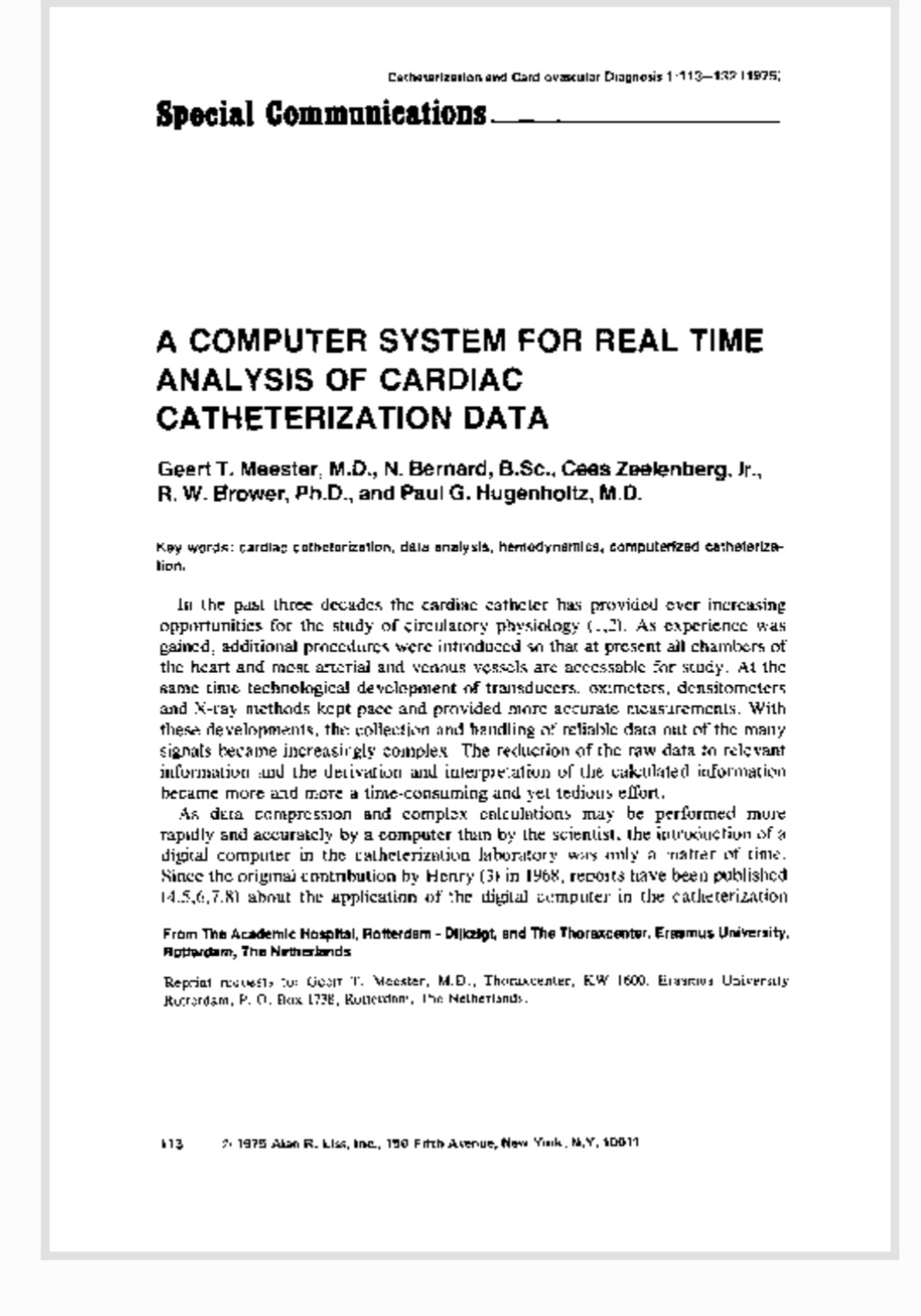
I joined the Thoraxcenter in April 1969 at the age of 24 and left in 1974. There I established and led the Department of Clinical and Experimental Information Processing Department, known in Dutch as the Afdeling Klinische en Experimentele Informatieverwerking (AKEI), reporting to Professor Paul Hugenholtz, the Thoraxcenter’s visionary founder. When I left, my title was Hoofd Medische Werker, equivalent to department head.
Those five years at the Thoraxcenter were some of the most impactful years of my life, professionally and personally. I transitioned from an individual contributor to a manager and from a technician to a scientist.
Reflecting on Computers in 1970
I want to reflect on the capabilities of computers in 1970. Even though I have fortunate to have experienced the development of computers for more than half a century, I can barely comprehend the changes that have taken place and can scarcely imagine what is to come.
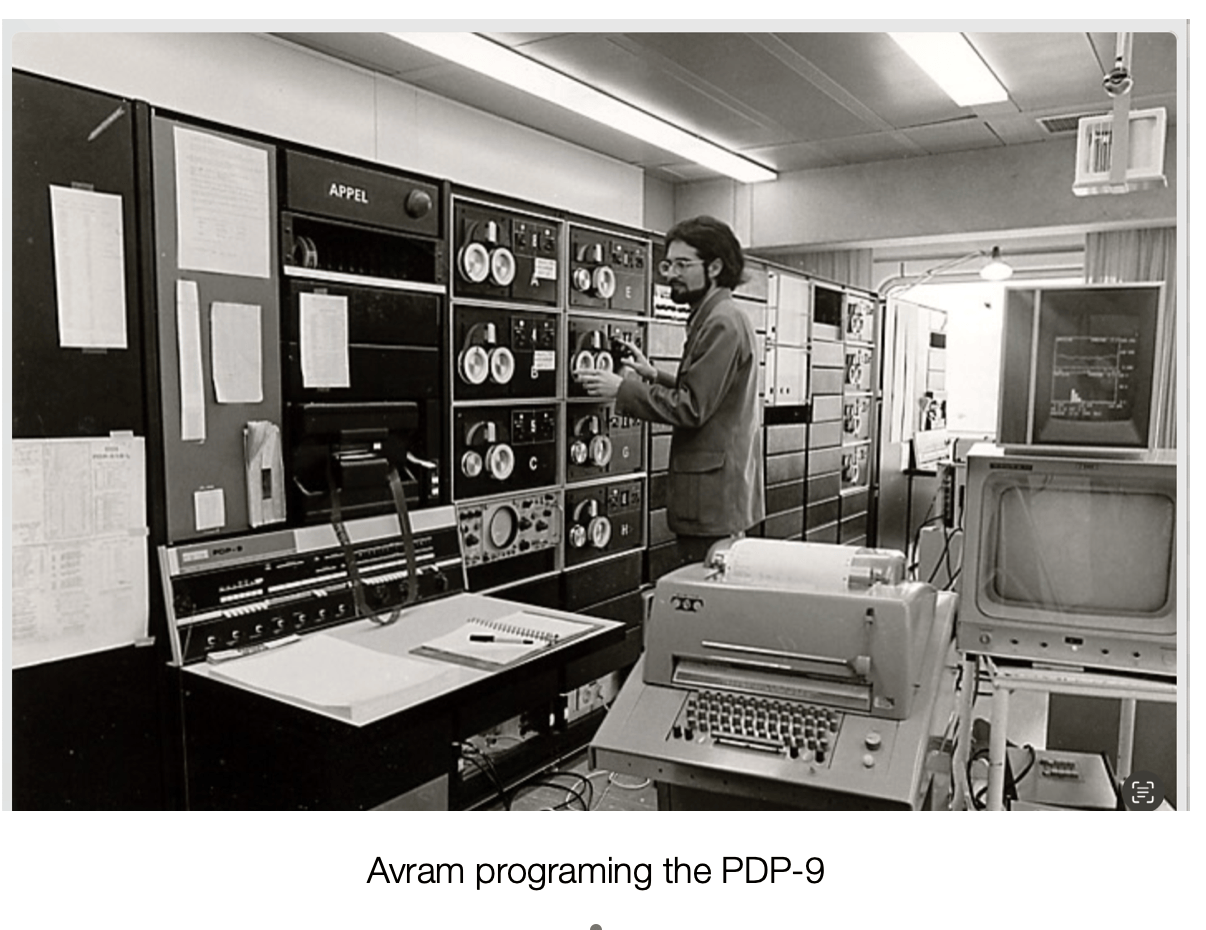
The main computer we used, a PDP-9 manufactured by Digital Equipment Corporation, was called a Minicomputer even though it weighed 350 Kilograms. To give you an idea of its computing capabilities, my electric toothbrush is significantly more powerful than the PDP-9. A single photo on my iPhone is 30 times larger than the PDP-9’s main memory. In fact, the iPhone in my pocket is more powerful than all the computers that existed in the world in 1970.
Meeting with my successors
The four of us reminisced. We discussed the past and the evolution of the Thoraxcenter. We also discussed the many people who were part of the founding team and stayed on. Sadly, many, if not most, have passed on.
I was surprised to learn that no computers are physically located on the premises; all the computers are now off-site and connected by high-speed networks. I also learned that starting in 1993, the Government of the Netherlands began regulating medical devices and computer systems. The Thoraxcenter could no longer use the systems that had been developed there and was forced to transition to transition to commercial systems. When I was there, it was the Wild West of regulations; there were none. We could build systems, and if we thought they worked, we deployed them.
Paul Hugenholtz Vision
Working in Boston, the leading area in the world at that time for computer technology, he began to understand the potential of computers to play a role in medical science and patient care.
Rotterdam was heavily damaged during World War II. The city suffered extensive destruction on May 14, 1940, when the German Luftwaffe bombed it. It still showed signs of damage when I moved there in 1969. The government of the Netherlands decided to make significant investments in the reconstruction (Wederopbouw plan) of Rotterdam. These involved creating a medical school along with a university hospital. It had been decided to start by creating a center of excellence for cardiovascular and pulmonary medicine, which would be named Thoraxcenter. It would become one of the first heart hospitals in Europe. But to make it happen, a visionary leader had to be found. In 1968, Paul Hugenholtz was identified to be this leader.
At first, Paul was not interested in leaving Boston, but starting something with the magnitude of the Thoraxcenter was very appealing. The new center would inherit a four-story building built as a test run for the School of Medicine building, which would be 31 stories high. The Dutch government had allocated many million dollars to develop the Thoraxcenter, which was fantastic. In addition, he got Philips, a leading Dutch conglomerate with a significant medical business, to provide a lot of funding. Under the leadership of Hendrik Casimir, the head of their R&D, Philips would provide the funding that enabled the Thoraxcenter to bring me to the Netherlands.
Paul grasped the potential of computers for patient care. He wanted to develop a computer system to monitor patients in the intensive care unit and use computers for diagnostic purposes, notably to support the catheterization lab. He was early to recognize the importance of Echocardiology and recruited Kaas Bom, a young engineer working with the Dutch Navy on using ultrasound for submarines. Paul realized the importance of biomedical engineering, as he knew his vision would require creating new medical devices.
In 1968, Paul embraced the opportunity to create the Thoraxcenter. His partner was the famous Dutch cardiac surgeon Jan Nauta. Paul needed someone responsible for technology, which initially included medical devices and computers. He recruited a biomedical engineer named Jerry Russel, who was then leading the biomedical department at an academic hospital in San Francisco. Jerry, who had a limited understanding of computer technology, sought people to join him at the Thoraxcenter. One of my friends at the time had worked for him and told Jerry about me. Jerry had already moved to Rotterdam. Both Paul and Jerry contacted me and encouraged me to leave my position at the University of California Medical School, where I worked as a research assistant, to join them in Rotterdam to create the Thoraxcenter. While I was reluctant to leave, the opportunity to build something on the scale of the computer department at the Thoraxcenter was captivating. Moving back to Europe also was a strong draw. I had lived in Paris and London in 1965/66.
A wild duck flies to the Netherlands
Those who read my blog know I have a rather unusual background. I am self-educated (I tested out of high school and never went to University). My book, the Flight of a Wild Duck, covers how I became a technologist, medical scientist, corporate executive, and venture capitalist. I joined Professor Joe Kamiya in 1966. He pioneered brain wave bio-feedback, and I had a deep understanding of hardware and software. I started programming computers in 1967. I had a talent for electronics and, primarily, digital technology, although I could also build analog devices. I was the ultimate full-stack developer who could create digital logic from transistors, resistors, and capacitors, design computer architecture, and do advanced programming.
Avram’s lecture at the Dutch Computer Society 1970
The equipment I developed for bio-feedback of brain waves (the first of its kind) requires real-time analysis. I like to joke that I was the leading expert on real-time physiological signal processing, but it might be true because I may have been the only one doing this then. We see this in devices like the Apple Watch and the Oura Ring. This capability intrigued Paul and Jerry because Paul wanted to develop a real-time patient monitoring system for the intensive care unit.
Towards the end of 1968, I began getting calls from Hugenholtz asking me to move to Rotterdam and join his team. He was charming and persuasive. However, the major attraction for me was the budget for the computer development and the opportunity to build something at scale. I realized there was more money in hearts than brains. Paul would call me early in the morning, waking me up. Eventually, I said yes. Paul was one of the most persuasive people I have ever known. Before joining Professor Kamiya, I was the manager of a pizza restaurant and, before that, a Merchant Seaman. I played jazz piano and was active in civil rights and anti-war movements. These differed from the usual credentials for a technologist and scientist but did not concern them.
Arrival in Rotterdam
I arrived mid-day in Rotterdam, having stopped for a few days in London to see family. The first person I met was Arianne. She was Paul’s assistant, showed me around, and helped me get settled. We fell in love almost immediately. We were engaged three weeks after my arrival and married seven weeks later. Our first child, Adin, was born the following year, and our second son, Asher, would follow a few years later.
Then, I meet Jerry in person for the first time. I had already met Paul in his home in the Boston Suburbs, where his family was still living. I stayed at his house while taking a class at Digital Equipment Corporation and got to know the family.
Promoted
The relationship between Paul and Jerry was not working out. Furthermore, Jerry provided no added value to the computer activities. Soon, Paul put me in charge of the computer department and had me report directly to him. John Laird, a distinguished biomedical engineer from the USA, eventually replaced Jerry.
My department would eventually grow to over twenty people. I was 24 years old and had no managerial experience. Even though he did not understand the work of a computer department, Paul would guide me. While he knew little about computers, he understood people. He gave me confidence and insight into how to be a leader. It was challenging to get time with Paul. He was very busy and always traveling. So if I learned he was driving somewhere to have a meeting, I would show up next to his car and ask if I could ride with him. For instance, if he traveled to Amsterdam, I would get a few hours of his time. It was invaluable.
Putting the team together
Two people were already hired for the computer activities when I arrived: Cees Zeelenberg, who would eventually succeed me, and a man named Bruin, who became the first person I ever fired; I cried when I did that, and Paul told me it would get easier. I am afraid he was right. Cees, on the other hand, was a keeper. He was finishing his engineering degree at Delft University.
My first challenge was putting together the team. I brought Pete Harris over from Langley Porter. Pete was a bit younger than me. We had worked together programming the PDP-7 that the department had acquired. Pete was a very talented programmer and a lot of fun. He stayed at most of a year. I even brought over an assistant from San Francisco. She turned out to be a problem. She had been an ex-marine. One night, I was called by the police to pick her up after she was arrested for a fight in a gay bar. I had to send her back to the USA. Fortunately, I found a new assistant, Maud van Nierop. She was a talented and influential member of my team. Maud stayed at the Thoraxcenter until she retired about ten years ago.
At that time, few computer programmers were available in the Netherlands, so I recruited several from the UK. We were getting hardware support from a group that was part of the Dijkzigt Hospital, which later merged with the Erasmus Medical Center. That is where I met Wim Engelse. He was a technician there. He joined my team and, together with Cees, provided the group’s foundation. I loved working with them. It was an absolute joy. Wim would later join me at Digital Equipment Corp. While he, like me, never went to university, he was recognized for his technical capabilities at Digital. Wim later started a successful company. Cees went on to join TNO, an important research organization in the Netherlands, where he led their bio-medical activities.
The Patient Monitoring System
Jerry made the initial decision on the computer configuration. He decided to use two PDP-9s from Digital Equipment Corp. One was for the patient monitoring system, and the other was for programming and could serve as a backup. When I arrived, they were in the computer room but wrapped in plastic.
For most of those reading this post, it will be hard to imagine a time before personal computers and networks. When I moved to Rotterdam, there were no microprocessors; it would take another two years for that to happen. It would take six more years before Microsoft was formed.
There was only a rudimentary operating system, and we had to program it in assembly language. It was a significant challenge to develop the software. The biggest challenge was getting all the software into such a small memory. Every bit counted.
We created our programs sitting around a big table. First, we would write the instructions on paper. Then, when we got computer time, we could enter the program into the computer using a teletype. The programs would then be stored on a digital tape system. We would often show our programs to each other to see if any things needed to be corrected. Since we only had one computer we could program and there were about five programmers, we had to be very careful. There was a magnetic board that had the times for the computer. Each of us had a marker, and we could reserve time. After a while, I no longer programmed, which I still miss. Writing programs for me was like composing music. Starting with a blank piece of paper and a pencil, I could create something out of nothing.
Display terminals
Display terminals did not exist in general. We used teletype to communicate with the computers, but that did would not work for the nurses in the ICU. So, we used a specialized video disk that could create characters that could be displayed on standard televisions.
We also had to create hardware. For instance, we had to build a console for nurses to access the information the computer system generated. At first, we had no idea how to let the nurses interact with the computer system. Then we decided to use a telephone dial. We had a list of functions, like menus, and a number following every function. The nurse would then dial in the number. A year or so later, we designed a nurse keyboard. I remember looking for keys and deciding the buttons used in elevators would be perfect.
We surveyed the nurses once the system was operational and asked about their favorite functions. I was horrified to learn that the function gave them the time digitally. I thought we had just built the world’s most expensive clock.
Catheterization Lab System
The most successful computer system we developed was for the Catheterization Lab. A cardiac catheterization lab is a specialized medical room for diagnosing and treating heart conditions. It uses advanced imaging to view heart arteries and chambers. We designed a specialized computer system using a PDP-11 from Digital Equipment Corp. We utilized a video disk system developed for instant replay of sports events to allow the cardiologist to replay the injection and flow of dye in the coronary arteries. Then, we figured out how to subtract the background so that the flow of the dye became more visible
The system we developed was instrumental in the development of many medical procedures.
Echo Cardiogram
The Thoraxcenter was a leader in using Echo Cardiograms. An engineer named Klaas Bom led this effort, and my group supported his computer requirements. Klaas played a significant role in developing the Thoraxcenter and eventually became head of biomedical engineering.
Computers in Cardiology Conference
Over the five years, I was at the Thoraxcenter, it gained international recognition as a leader in applying computer technology to cardiology. The Thoraxcenter was one of the founders of the Computers in Cardiology Conference. After leaving the Thoraxcenter in 1974, I attended this conference for several years and stayed in touch with people at the Thoraxcenter this way.
Leaving the Thoraxcenter
My family and I immigrated to Israel in 1974. There, I established a business based mainly on my work at the Thoraxcenter. I was also appointed as an Associate Professor in the Department of Cardiology at the University of Tel Aviv.
I transitioned from the medical world to the computer industry when I joined Digital Computer Corp in 1979 as the head of low-end computer engineering and later as the Group Manager for Professional Computers. I would go on to become a vice president at Intel, one of the world’s top companies. There, I co-founded Intel Capital.
Paul, my Mentor
Paul Hugenholtz had a distinguished career. He stayed as head of the Thoraxcenter until 1988. From 1982-1984, he served as President of the European Society of Cardiology. He was the founder of the Netherlands Heart Institute. He is still alive but at 97, not in good health.
But he was also one of the critical people that took a chance on me. He became my mentor and, most importantly, my friend. I owe him much. One of the joys of writing this blog post is thinking back to my time with Paul. He taught me the value of humor, the effectiveness of charm, and the importance of drive in achieving goals.
Here is a beautiful interview with Paul some eight years ago where he reflects on his life.
After working for Paul for five years, he made me an offer. The Medical Center wanted to create a significant outpatient clinic that would handle more than a million patients annually. Paul had been asked to develop a plan and recruit someone to lead it. While it would utilize computers, Paul wanted someone who could imagine how such a center could function. He wanted someone who would embrace the future. He turned to me and asked me if I would like this assignment. I was stunned. It was a significant project, much more vast than anything I had done. I was not a doctor and not even an engineer. But what really hit me was that Paul acknowledged that my Thoraxcenter task was done.
I thanked him and asked, “Am I done setting up the computer department at the Thoraxcenter?” He said yes that I had done all that had been expected of me and more. I thank him for that. Then I surprised myself and said, if I am done, I am going to leave the Netherlands and immigrate to Israel. This was something that Arianne and I had contemplated for a while. After what had happened in the war, we wanted to bring up our children in Israel. Paul did not try to dissuade me. He understood dreams better than most.
My professional journey is unfolding in a way that might seem like living life in reverse. I started in medical science and weaved through technology before circling back to healthcare, moving from the USA to the Netherlands, then Israel, back to the USA, then Israel, and now the Netherlands. I went from English to Dutch and Hebrew(struggling) and then back to English, Hebrew (still struggling), and now Dutch.
I embarked on this path at 22 at the Medical University of California, San Francisco. Here, I pioneered technology in neurophysiology utilized in the biofeedback of brain waves, focusing on real-time physiological signal processing—a niche that, at the time, had me as its sole expert.
Later, I applied technology to problems in diagnosing and treating cardiovascular and pulmonary disease at the Medical School of Erasmus University, Rotterdam, and then the Medical School of Tel Aviv University. During this period, I went from being a research assistant and technician to becoming an associate professor. I also established a business in Israel which commercialized my academic work.
I loved learning and practicing science, but my love of technology animated me the most. My initial career in medical science took me from San Francisco to the Netherlands and then to Israel. It was an incredible 13-year journey. How could I have known then that I would return to medical science?
In 1978, I made a profound decision to leave the field of medicine. It was a difficult decision. After all, I had achieved unlikely success from being a merchant seaman sailing on ships in Asia at 18 to an Associate Professor of Medicine by 29. I could not help myself. I wanted to be part of the computer industry and play a role in shaping its development. Digital Equipment Corporation offered me a position as the Small Computer Hardware Development Manager in its Central Engineering Organization, and a year later, I was promoted to Group Manager responsible for the Professional Computer Group. Now, I was back in the USA (Boston Area).
In 1984, I joined Intel Corporation, eventually becoming one of a few Corporate Officers and serving as Vice President of Corporate Development. In 1992, Les Vadasz and I established Intel Capital, one of the world’s most successful corporate venture groups.
I left Intel in 1999 to work for my own account, providing strategic advice to public and private companies and serving on several companies’ boards. In 2017, my wife and I moved to Israel, where we lived until recently. Then, about ten years ago, I decided to focus my efforts again on the intersection of medicine and technology. I made several early-stage investments in this area. My initial focus was on sleep health. I was one of the first investors in Oura Ring and pulled together much of its initial financing. I became a Senior Advisor to the Cleveland Clinics Research Institute and then worked with Sheba Hospital in Israel to set up a Longevity Center. This led me to explore personalized/precision medicine. I started to learn about AI. It reminded me of fifty years earlier when I held a single transistor in my hand, discovered the concept of software, and learned to program.
Then, I was granted an opportunity to participate in using AI in health care when I joined the board of Renovaro, which was in the process of acquiring an AI-based cancer diagnostic company (GEDi Cube). I joined Renovaro’s board and moved back to the Netherlands to work closely with the team at what is now called Renovaro AI in Amsterdam. We have moved to Amsterdam, and I go to the company’s offices several times a week. I am also enjoying speaking Dutch once again. At 79, I figure I have at least one more act ahead.
As I wrote earlier, many people requested an audio version of my book, Il volo di un’anatra selvaggia. I was surprised to learn that many people prefer audiobooks. Audiobooks are the only segment of the book publishing industry seeing growth.
While I wanted to produce an audio version of my book, I did care to use the voice to be that of some hired actor. I wanted to be my voice. However, I could not bring myself to read 320 pages. If I read it without stopping or correcting it, it would take 10 hours. I am not skilled at reading out loud. I am sure I would have to do some editing and retakes.
So, I was very excited when I started experimenting with creating a clone of my voice. I first did that on Descript, the tool I have been experimenting with to do videos and podcasts. It is amazing. I was able to clone my voice as well. Descript converts voice to text, which you can scan/scroll to edit. For instance, if you decide to delete a sentence, the video and audio for that sentence are also deleted. I cloned my voice so I could use their “overdub” capability. It works well to correct a word or insert something small.
Descript and the five other AI voice clone apps I tried can speak in my voice. But they lack my phrasing, emotion, etc. They are a poor substitute. I do not doubt that sometime soon, an AI voice clone will be able to mimic my style as well. It would be indistinguishable from me in five years or less.
However, I discovered a way to get close now when I tried the Ukrainian company Respeecher. They sent me an example: Reid Hoffman, the founder of LinkedIn, audiobook, Amplifying Our Humanity through AI.
Here is how the process works. An actor studies the audio of the person whose voice will be cloned. Then, they read the book, imitating the style of the author. Respeecher takes many samples of the author’s voice (this can be done using audio that has already been recorded, for instance, podcasts. Then, they perform voice-to-voice cloning. They can change the sound of the voice but keep all the expressions, like pauses, sighs, and laughs. This process can be done in multiple languages as well. You need actors to read in each language. Of course, the book must first be translated into the languages used.
Unfortunately for me, the whole process is rather expensive. I estimated that producing the audiobook this way would cost more than $10,000, including hiring the actor. I only sold 500 copies of my book so far, sadly. If I sold $1000 audiobooks, each would cost $100 to produce. So, I will wait until the costs of the cloning work come down, and the technology has advanced to the point that I do not need an actor.
I have been thinking about death a lot recently, and in particular, my death. It seems that you’re not supposed to talk about your future demise. It makes people uncomfortable. We appear to be in a conspiracy to pretend that we will live forever, even in the face of all the evidence to the contrary.
Life is precious. It is an emergent phenomenon, the result of so many complex factors, most of which are random. I like to think one’s life is like a wave on the sea. We are all waves on the sea of life. Eventually, every wave will end, but not the water that made it. That will continue. As you can see, I can get pretty philosophical at times.
Death is not dying.
Perhaps that is not the best way to describe the subject of my thoughts. It is not so much about death but more about dying. We will all die. While we are alive, we can imagine being dead. But that ends with our death.
We leave memories of us that others have, actions we took, and, in some cases, our DNA in the form of our dependents. I wrote a book, The Flight of a Wild Duck, to ensure that aspects of my life would endure a bit longer.
On the way to death, we will experience dying. Some might argue that from the point we are born, we are dying, and in a sense, that is true. But most of life is like climbing up the ladder on a slide. I am discussing the ride down the chute, going ever faster to the end. Unfortunately, you don’t get another turn at the slide.
Here I am at 78. I am still healthy and can do everything I have done in the past. But how much longer can that last? How can I look at the older people who are my friends, many from my youth, and think I am not old too? The mirror has become a Time Machine as the child still within me gazes at the old man he has become.
Life span=health span+sick span
Much is being written about longevity. I have posted a few blog posts on this topic myself. We have a health span, which is the period in which we are healthy, and we have a sick span, when we are unhealthy and even infirm. This process can happen slowly or sometimes quickly. But even if you feel healthy, the seeds of your demise are ready to take root and grow. At the same time, new ways of treating diseases are being developed. But as of now, all we are doing is delaying the eventual.
I can accept that my life is nearing its end. But I can not easily accept becoming an elderly sick person who must be cared for. Or even worse, someone who has lost significant cognitive abilities. I hope that if that happens, someone is wise enough to “pull the plug.”
We can do many things to increase the number of healthy years. Diet, sleep, exercise, and stress management will extend the number of healthy years and, perhaps for some, will increase their life span. Regular medical checkups (especially those that do a deep dive) can find diseases early and at a stage where they can be treated. For instance, I did a blood test to screen for multiple cancers, Galleri.
Just ten years to live
I have often asked myself to imagine that I only had ten years to live. I started thinking this way when I was diagnosed with prostate cancer almost 30 years ago. Ten years is enough to do something, even learn another language, but not so long that you feel you can waste time. But now, those ten years are maybe the last ten years and certainly the last ten years feeling and looking as I do. So the question: what I want to do with these next ten years of life has taken on an intensity. I know that I don’t want to spend those then years just asking the question. But strangely, I don’t have an answer to the question.
I have had a rich and satisfying life, but planning for the future has been a big part. Now what do I prepare for? I am supposed to live in the moment, but I am not very good at that unless I have sun and warm seas. So I will probably spend more time on the beach with the greatest blessing of my life, my wife, Deborah.
The Vision Pro is most likely the first Apple product that does not have at least some input from Steve Jobs. Possibly he was not involved in any way with the Apple Watch, but since he passed away on Oct. 5, 2011, the Watch came out in Sept 2014, just three years after his death. I would think he was involved in discussions about the Watch. I doubt he was involved in Vision Pro, but aspects of it were probably under development back then. I suspect Jobs would not have supported Vision Pro, but I do not know. Perhaps it is the “Lisa” of its time, and eventually, there will be a “Mac.”
Is the Virtual And Augmented Reality the Interactive Television of its time?
Apple announced Vision Pro, a very capable, expensive, and heavy entry into Virtual and Augmented Reality. They only use the term Augmented Reality. Watching their presentation reminded me of the promise of Interactive Television. Many of you reading this post may not remember all the hype surrounding the concept of interactive television in the 90s. But I was there!
The Full Service Network-and all that Hype
It began in 1992 when the CEO of Time Warner, Gerald Levin, began discussing a concept he termed “The Full Service Network.” Time Warner then sent a Request for Proposal to most leading technology companies. We received it at Intel, where I reviewed it since I was the only company executive interested in the consumer market. But I gave it a pass. However, others in the industry felt differently. In particular, Bill Gates later incorrectly said that the square foot on top of the TV was the most valuable real estate in the home (back then, TVs did have a top). Bill, whose strategic abilities are vastly overrated, called Andy Grove, a call that changed my life. Bill told Andy that Microsoft wanted to develop technology for the home but could not identify anyone interested at Intel. Andy knew of my interest in developing the home computer market and had permitted me to investigate this possibility even though he did not believe there was a market for home computers. So Andy said, “What do you mean? Do you know one of our Vice Presidents, Avram Miller? Avram is working on developing our plans in the home.” Bill knew me. I first met Gates in 1981, when I was at Digital Equipment Corporation. He was just 25. Bill responded to Andy by saying that he knew me and that I should come right away to Redmond and meet with Rob Glazer, who was leading Microsoft’s consumer activities. It is a long story you can read about in my book, The Flight of a Wild Duck.
Andy told me that while he still did not believe in the home market, he realized Bill did. He told me my job was to keep Microsoft engaged with Intel and away from our primary competitor AMD. Other than that, he did not care. But this created the opening I had been looking for a way to access Intel R&D resources. At first, I thought we would target the interactive tv opportunity that Time Warner had ignited. Microsoft and Intel began working with General Instruments, the largest set-top-box supplier, to develop an interactive television product. I called it Pandora’s Box.
The PC is it-the birth of residential broadband and the consumer internet.
After a few months, I realized that Interactive Television would fail. It took others a decade to come to that conclusion. We kept the project going to keep Microsoft happy and away from AMD. But in the meantime, the CTO of General Instruments, Matt Miller, and I came up with the idea of using the cable system to provide high-speed residential broadband to personal computers in homes. In my book, you can read what Gates said to me once he discovered we did an end run on Microsoft. So once again, I refer you to my book, where there is a lot of detail.
In the meantime, billions of dollars were lost pursuing interactive TV led by Levin, who should go down in history as one of the greatest destroyers of corporate value (check out his acquisition of AOL, for instance). On the other hand, Intel made billions by investing in companies like Broadcast.com. Broadcom, Verisgn, Launch Media.
Time Warner finally selected Silicon Graphics as its primary technology provider, which would eventually contribute to that company’s demise. The Full Service Network debuted in Orlando in 1994. It was a gigantic failure, although some declared it a success even after it was turned off in 1997. It was too expensive and limited, but that could have been overcome. What could not be overcome was that people did not want to interact with their TVs.
By this time, it was becoming more apparent to me that the interactive device in the home would be the connected PC. We had a rallying call, “The PC is IT.” I am proud of my role in making this happen.
So how does this relate to Virtual Reality?
The technology, media, and communication industries were sucked into the interactive dream. Many presentations showed people sitting on their couches, doing everything we now do on PC and have been doing for over 20 years. But they ignored a few key things:
People do not want to interact with their TVs (except those who like computer games) other than “changing the channel.” That is the kind of interactivity we are comfortable with at 12 feet. The 2-foot experience we have with our computers and how other digital devices, like phones and tablets, is a different experience and not one we usually share with the family sitting next to us (who are probably on their devices).
The TV at the time was not suitable for interactivity. It did not have enough pixels to support the resolution required. But even if it did, interactive TV would have failed.
The interactive TV was to be a closed system controlled by television providers, while the PC interactive market was built on the back of the Internet, which was an open system.
Do people want to wear a face computer?
Having a smartphone in your pocket or purse differs from having a computer on your face because our pockets and purse were designed to carry things, unlike our faces.
Wearing a massive device on your head will be the most significant limitation. It will likely prevent the widespread adoption of VR/AR, at least in the form of the recent announcement of Apple’s Vision Pro. We have strong instincts not to wear devices that cover our faces which will be hard to overcome. While the Vision Pro does not cover our nose and mouth, it comes very close.
For instance, many people suffer from Obstructive Sleep Apnea, a severe disease. There is a treatment called CPAP, but it requires a mask to cover the nose and mouth. People find this extremely difficult, and most can not tolerate it, even though they know that not being treated can have grave and deadly consequences. In particular, humans have a strong instinct not to want to have objects between them and the air they breathe. Apple is a brilliant company that does a lot of research. I would love to understand how much they did to determine if people would wear a face computer.
What happened to 3-D Television?
Didn’t we have 3D television for a while? Major Television manufacturers like Samsung announced 3D capabilities around 2010. After a few years of consumer curiosity, interest waned, and now no more 3D-compatible TVs are being made.
Vision Pro-Apple’s Segway?
The Segway was a personal transporter that was invented by Dean Kamen and brought to market in 2001. It was very hyped. John Doerr, the legendary venture capitalist, is reported to have said that the Segway could be more important than the Internet. It was a total failure. Much of this failure was assigned to city governments that used regulations to limit the use of the Segway. But I think that was not the problem. Just look at the growth of e-scooters, first introduced in 2017. They are now a plague in most cities. It was the marriage of personal transportation to the sharing economy. Being able to pick up and leave the device made the difference. Who would want to own a Segway if you had to keep or park it? History shows us it was not a consumer product, just as Vision Pro will likely not be a consumer product.
Vision Pro will find its niche.
Vision Pro will likely be a niche product. I am sure it will be successful in vertical markets like medical and defense. Perhaps we will use such products for video communications like Zoom. But I don’t see it becoming the next “iPhone.” I hope I am wrong. I think Apple needs another platform; sadly, this will not likely be it. I don’t believe that all the fantastic engineering they have done can overcome the issue of wearing something of the size and weight of the Vision Pro.
An Alternative Approach to Virtual and Augmented Reality
I do believe that Virtual and Augmented Reality will create significant markets. But we will need a different way to achieve this for consumer applications. I first started working in this field in 1999 through an association with a company called Microvision. We were going to do direct-to-retina displays. Our approach had several technical and business issues. The team left and formed Innovega, where I have been an advisor and investor for over 20 years. We still have a ways to go, but the concept is sound.
Our technology involved using a contact lens with a remarkable macro capability to see things very close to the eye, allowing people to wear something akin to regular glasses. We know that people are willing to wear glasses, and many are willing to wear contact lenses. However, I am not writing the blog post because I have a stake in Innovega. I have a stake in
Innovega because I believe this approach can lead to broader adoption of VR/AR than products like Vision Pro.
I should also say that if anyone can pull off a product like Vision Pro, it will be Apple. I certainly will be an early adopter, just like I was for Oculus, which I have used for less than two hours over two years.
The Heard Mentality
I am fascinated by phenomena like this. I think about the early days of PDAs (Personal Digital Assistance) like Newton and GO), Interactive TV, and Segway.
It is the herd mentality that drives all this. When Steve Jobs was leading Apple, he was not susceptible. It was one of his greatest gifts.
From Microvision/Avram Announcement in 1999
Microvision, Inc. (Nasdaq: MVIS), the leader in retinal scanning display technology, announced today that it has entered into a multiyear consulting agreement with Avram Miller, a leading business development and strategy consultant. Microvision and Miller will team on the development of Microvision’s next generation retinal scanning display technology for applications in mobile computing devices.
By scanning a single beam of light directly onto the eye, retinal scanning display technology projects high resolution color images without the use of a conventional display screen or panel. To date, the importance of this technology has been its use in “heads-up displays” for military, medical, and industrial uses. More recently, Microvision has demonstrated a “consumer” version of the technology that will make it possible for mobile devices such as cell phones to display the same amount of information as notebook computers at reasonable cost. The company believes this has the potential to redefine the role of displays in mobile devices such as Cell Phones, PDAs (personal display appliances), and game devices.
“Several months ago, we made a strategic decision to accelerate our activities relating to displays for mobile internet applications. Soon after, we achieved a technical milestone, demonstrating, for the first time, a prototype of a retinal scanning display that used just three micro-miniature LEDs and two scanning mirrors to form a high resolution video image,” said Rick Rutkowski, CEO of Microvision, Inc. “When we realized what we had in hand, we knew that it was now time to get help from someone who had the strategic vision, industry connections, and ability to make things happen on a large scale. We are very fortunate to have Avram Miller collaborate with us in redefining the display capabilities of mobile devices. Avram has a proven ability to recognize major technological discontinuities that create significant business opportunities and then to act on those opportunities.”
“Mobile devices are where it is at,” said Avram Miller, CEO, The Avram Miller Company. “It reminds me of the early ’80s and the birth of the PC. So many critical technologies are converging in the mobile arena. Bandwidth is coming with 3G, voice recognition promises to change the way we command and communicate with mobile devices, location detection will increase the relevancy of the information we receive, and when combined with miniaturization and long battery life, mobile devices will become a fundamental part of everyone’s lifestyle. All of this,” Miller continued, “will be connected to the ever-expanding power and pervasiveness of the Internet.
My memoir, The Flight of a Wild Duck, was published a year ago. It took me three years to write; a year of research, a year of drafting, and a year of editing. While it was a lot of work, I found the experience rewarding. I learned a lot about the history I had lived through, which in retrospect, I would often view differently. I also learned a lot about myself. I found that I had done more and accomplished less than I had thought. While writing, I imagined that my experiences/lessons could be helpful to others, and many might enjoy my stories.
It has been gratifying to hear from many that read my book, and for them, it seemed I had accomplished the objectives I had in mind when I wrote the book.
But since it was published, only about 500 copies have been sold. Partly because of the world we live in where fewer books are read, and more and more books are published. So as part of the promotion for the book, I did many interviews (podcasts and youtube videos). The result was hundreds of thousands had to listen to my stories. But reading a book is a different experience.
It is not too late to read it. Just click on this link. I would appreciate it. Also, if you have read the book and liked it, please help me by promoting it on your social network.