Two Thirds Done

Thoughts and experiences of an eighty one year old Wild Duck.

Avram Miller by the sea
EN | IT

587 posts since 2006

Category: Future

  • Avram Miller Appointed Fellow at the Italian Institute of Technology

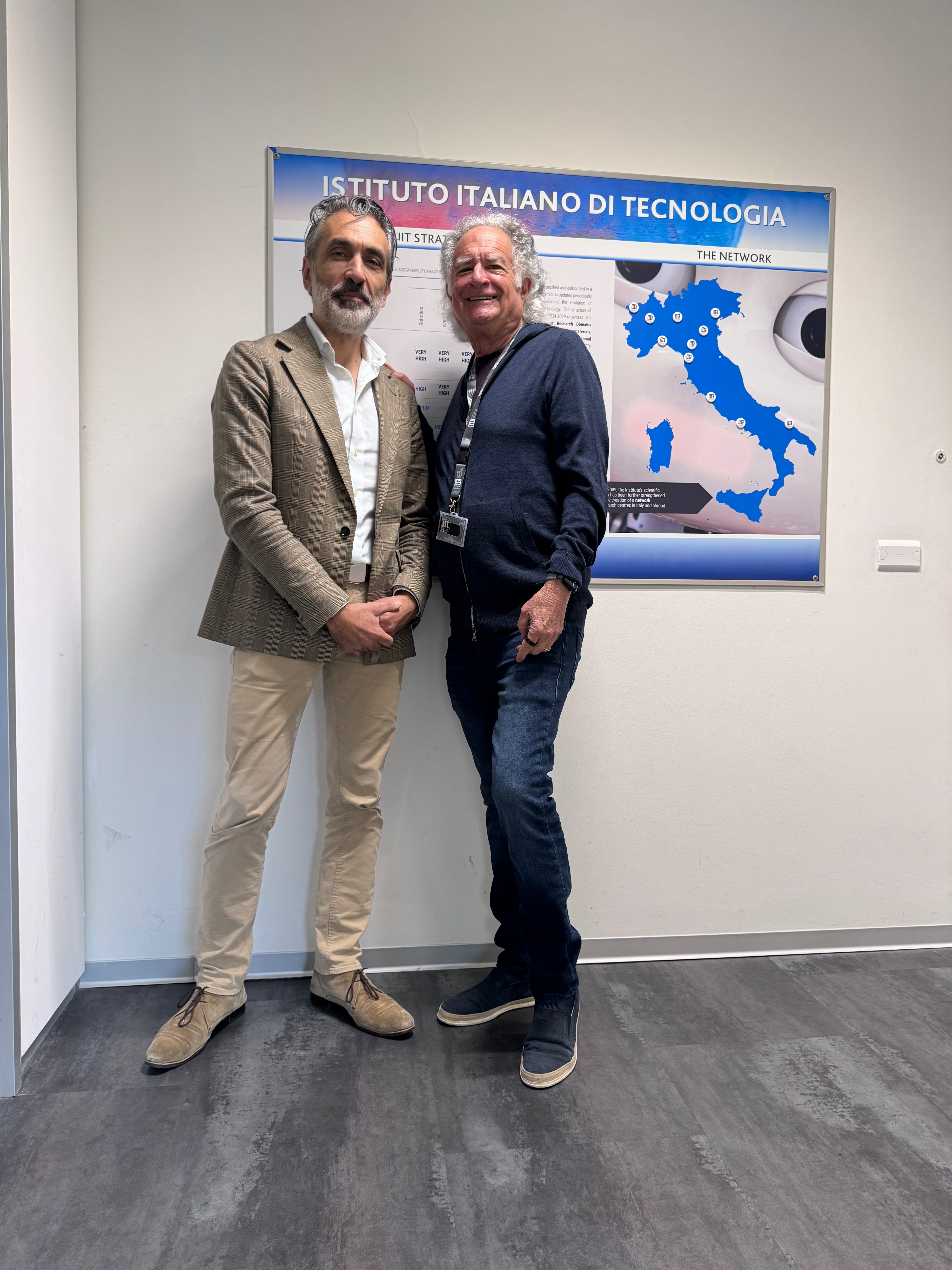
    Giorgio Metta, Science Director and Avram Miller

    I am thrilled that I have been appointed as a Fellow at the Italian Institute of Technology (www.iit.it). It is an incredible honor to work alongside the remarkable Giorgio Metta, the Science Director and his team to embracing the future. Exploring their projects promises to be both enlightening and enjoyable, with the exciting possibility of spending time with some of their fascinating robots.


    The Italian Institute of Technology (IIT) is a leading research center based in Genoa, with 15 locations throughout Italy and a community of more than 2,000 people, including scientists, engineers, and technical staff from around the world. It drives innovation through over 80 active research projects spanning robotics, neuroscience, materials science, and artificial intelligence. IIT’s mission is to advance knowledge and technology, transforming scientific discoveries into real-world solutions that foster sustainability, progress, and improved quality of life.

    (more…)
  • My first speech in 27 years

    I am working on my keynote address at the World Business Forum in November. I use to give many such speeches but the last one I gave was in 1998 when I shared the stage with Steve Jobs. Hard to imagine.

    I didn’t think I had a lot to say after I left Intel in 1999 so I stopped. What I set out to accomplish, the creation of residential high speed networks coupled to the Internet had happened. I no longer had much of an agenda. But AI has fired me up, I guess. So when I was asked to give this talk, I said yes because I now have a lot to say.

    (more…)
  • Now for a surprise-you may live to be a 120 year old

    Life expectancy has been increasing worldwide by about 0.2 years every year — roughly two extra years per decade. Even more importantly, health span — the number of years we live in good health — has been rising as well, which is critical.

    If you’re 40 today, actuarial tables suggest you’ll live to about 85 on average. With steady medical progress, 95 is realistic for many. Already, the healthiest 20% have good odds of crossing 100. But that does not account for breakthroughs that are likely in the coming decades. Already, drugs like the GLP-1s are transforming metabolic health, and that’s just the beginning. Advances in gene editing, regenerative medicine, and AI-driven drug discovery could push the boundaries even further. I’ll go out on a limb: I believe some of you will live not just to 100 or 110, but to 120.

    That is 80 years from now. The world in 2105 will be very different from the world of today — perhaps beyond our imagination.

    (more…)
  • Strong Man or Smart Man

    The weak man wears the amor of ego.

    Deborah and I spent a few days with the mountain gorillas of Rwanda, in 2018.  It was an amazing experience which also included a  profound realization which sadly has come true; the power of the Alpha Male.  I witnessed how the alpha male used force to dominate and intimidate the males (mostly drive them out) and to dominate the females.  Looking at the suppliant behavior of the families (tribes) and thought “we are so fucked.”  I was so right.  What I realized that there were genes flowing through some of us that would respond to the alpha male.  That is what Trump also realized even if his pea brain is not really capability of articulating it.  He grew up with an alpha male father.   

    Humans are primates.  We are most closely related to  Chimpanzees and  Bonobos sharing 98.7% of our DNA with them.  The former has a very strong dominant hierarchies  while the latter are more matriarchal.  I think we are some kind of mix.  While some of us will relate to the Alpha Male and fall in line, others of us will not even understand the concept.  That may be at the root of the political turmoil we are now seeing and also explains much of human history.

    This dissonance in how we relate to authoritarians can be seen so clearly in the political situation in which the world finds itself. a world that has mostly been run by tyrants and dictators.  It is, sadly, the world we once again find ourselves.

    So while some of us want to be lead by someone smart (does not have to be a man) others want to be lead by someone strong (most likely a man).  It is also possible to have a hybrid, someone that is both an authoritarian and smart such as Lee Kuan Yew, the amazing founder of Singapore.  But I think they Hybrid is the exception as is the Smart Man.

    I wonder how much of the predisposition to supporting a Smart Man versus a Strong Man is genetic.   Perhaps this could be tested using genetics and AI? I am sure there is a difference by gender. 

    Diversity, Equity, and Inclusion

    The DEI movement can be thought of as an unconscious attempt to resist the Strong Man.   DEI distributes power while the Strong Man concentrates it.   It is very difficult to be really powerful without concentration of power.  Having few people with power makes it more practical for  the leader to consolidate his power.

    The role of Religion

    God, while portray as benevolent, can  also be seen in the Abrahamic  religions (Christianity, Islam and Judaism) as the ultimate Strong Man and is invoked by the hierarchy of the various religious institutions.  God is seen as male.  But for the human Strong Man, God is just another Strong Man whose power can be used to bolster his own position.    

    Why Science has to be repudiated by the Strong Man

    The Strong Man has  little appetite for science because it does not lead to a concentration of power. Science is open-ended and based on doubt, experimentation, and revision. It is decentralized with no single person having  the “final truth. It is transparent where data, methods, and peer review are public and open to challenge. In contradiction to the Strong Man,  science constantly reveals how much we don’t know.

    The Strong Man, by contrast, is an authoritarian: He claims absolute truth, often without evidence. He is dogmatic and sees questions as threats, not invitations. The Strong Man is hierarchical, expects loyalty, not peer critique. The Strong Man needs to appear invincible and infallible.

    What can bring the strong man down

    The Strong Man fears that emergence of other Strong Men that can challenge his leadership.  So to protect himself, he will end up surrounding himself with weaker and less effective versions of himself.  He will seek to create conflict between them so that none of them can consolidate power. He will often turn against them and remove them.  The result is that he can never create an effective team to deal with the issues that confront him.  To stay in the Strong Man’s graces, the mini versions will never confront him with the truth if they think it will displease him. Rather, they will tell him what he wants to hear. 

    Hitler was a great example of this.  He probably thought he could still win the war until a few days when the Russians entered Berlin, Then he poisoned his newly wed wife, Eva Braun, and blew out his brains with a gun. 

    Most strong men historically end up with a violent death (Hitler, Mussolini, Gaddafi, Hussein, and Ceausescu) or public disgrace (Nixon and Berlusconi ).  But the Strong Man can do so much damage while in power.  The Strong Man doesn’t just want obedience—he wants  worship. Legacy is everything to him. His deepest fear? Becoming a footnote instead of a monument.

    Many if not most Strong Men suffer from some physiological problems.  Some were/are likely  psychopaths such as Stalin. While others demonstrated sociopathic behavior such as Gaddafi.  There term Malignant Narcissism might be an apt description for others such as Trump.  

    The Smart Man

    It has been a struggle to come up with examples of a Smart Man leader.  In my opinion the last clear example was Roosevelt more than 80 years ago.  We had some that came close, such as Jack Kennedy. Obama could have been this but in my opinion lacked the political skills needed.  Outside the USA, we have a few examples such as  Nelson Mandela, Lee Kuan Yew of Singapore and Angela Merkel.  Obviously, Merkel is a woman but since she was the only example of a Smart Woman leader, I could find, I choose to put here together with the few Smart Men leaders I found. I think she would not mind the company.

    After Mao (the ultimate Strong Man), China had a collection of hybrids until Xi who is a text book example of a Strong Man.  The UAE leaders are a fascinating collections of Royalist, Strong Men and Smart Men.

    Israel, the country that is the closest to my heart was initially lead by Smart Men, starting with  David Ben-Gurion, Menachem Begin, Yitzhak Rabin and Shimon Peres.  But since 1996, it has been run by Benjamin Netanyahu who is definitely a classic version of a Strong Man.

    Strong Women and Smart Women

    I used the term Strong Man and Smart Man but these traits are not limited to men.  It is just that most leaders have been men.   Example of Strong Women are Margaret Thatcher (the Iron Lady) ,  Indira Gandhi and Golda Meir. 

    Evolution and the Strong Man  

    It makes sense that we would have the strong man/alpha male in our midst.  It probably serviced to have such people especially those that were a hybrid of strength and intelligence such as Genghis Khan.  But as human civilization evolves and increase in complexity, we must have smart leaders not just strong ones.  Unfortunately, and to me,  surprisingly, we seem to be going in the opposite direction.  

  • Formerly, the Former Avram Miller

    Turning 80

    Turning 80 last month was not easy for me. I used to be the youngest person | in the room. Now I am the oldest. Once, I was a child prodigy. Now I am an elderly man who gets seats offered to him when he rides the metro. 

    Frankly, I am struggling to deal with my age and the issues related to it. It is mostly psychological but not completely.

    In 1999, I left Intel, where I was Vice President of Corporate Business Development and the co-founder of Intel Capital. I am best known for these roles, as well as being a key driver in establishing the residential broadband infrastructure that became so instrumental in creating today’s consumer internet.  I did important work which was valued then; this is now.  We are entering into a period of increased longevity.   The percent of people over the age of 80 in the USA has increased from 2.3% in 1980 to 3.7 in 2020, a more than 60% increase. This increase is expect to continue.  I don’t want to forecast much into the future because we do not know what kind of advances will be made in health care.  But most of us are not prepared for life after 80.  Also, most people that age have health problems that impact there lives.  Less than 25% are still 100% fit.  I fall into that category at least for now.  For most of my life, i was focused on the future including my own future.  Now I need to live in the present.  That is where I am struggling.  If I could just focus on the present without concern about the future.  My present is really very good.  I live well and have an amazing relationship with my wife.   

    My past is disappearing 

    At its height, Intel was one of the top ten companies in the world. That is when I walked out. When I resigned, the market cap of the company was about $250 billion. It would grow to almost $500 billion at its peak a year later. Since I thought that Intel had some room for appreciation, I hedged my stock and sold it right at the peak. In 2003, Forbes placed me in the 8th position on its Midas List of the top venture investors.

    My decision to leave Intel was based on several factors. Not only did I not see a continuing role for myself, but I also had serious concerns about Intel’s future, which sadly proved to be correct. I  no longer wanted to work for a company. I wanted to be on my own. I wanted to see what I could accomplish without Intel at my back. 

    In 1996, I was diagnosed with prostate cancer. It was treated using a new technique called brachytherapy (using radioactive seeds that are implanted directly into the prostate). I chose that method on the advice of Andy Grove, who did the same thing a year before me. Unfortunately, I had a reaction that was later identified as a PSA bounce, a phenomenon not recognized until several years after my treatment. It occurred in younger men (prostate cancer affects men as they age, and a 51-year-old like me was considered a young man). Instead of my PSA (the marker for prostate cancer) going down, it started to go up. It looked like my cancer had metastasized. My doctor said, “Well, at least it’s not going up quickly,” and then, of course, it started going up quickly. It was a very stressful time for me, to say the least.  A number of doctors told me that it had metastasized.  One even said that I probably had 5-10 years to enjoy my life. 

    It was then that I decided I would think about my future assuming that I only had ten years more to live. Prior to the cancer, I had been planning on starting a private equity firm with my friend Dave Roux of Oracle, but that no longer fit into my ten-year “rule.” He went on to found Silver Lake Partners. I became a limited partner.

    I was just 54 years old when I left Intel. With my experience and successful track record at Intel Capital, it would have been natural to start a venture capital firm, but I never actually thought of myself as a venture capitalist. Rather, I thought of myself as an activist strategist, and I wanted to help a few companies develop their strategic plans. Fortunately, I was financially comfortable and did not have to be concerned about adding to my wealth. I served on a number of boards, advised investment banking firms, and invested in early-stage companies for my own account. For instance, I put together much of the first round of Oura Ring. But slowly, I began to lose interest in business. I also realized that much of my standing in the world of technology was associated with Intel and its success. I remember thinking that the half-life of a technology strategist was about a year. The result is less than 1% after ten years.

    It was then that I started to jokingly refer to myself as “The Former Avram Miller.” For the longest time, I could explain that I had been an executive at Intel and founded its very successful venture arm, Intel Capital and people would be impressed.  Now, Intel is seen as a failing company. Intel Capital is a shadow of what it was in my time and is in the process of being spun out as a separate entity with a new name. A big part of my identity has  been eroded.

    From a ten year horizon to a five year horizon

    Fortunately, I am in good physical and mental health. But at my age, how long will this continue? So now I have revised the time horizon for decisions. I make life decisions assuming I have only five years. When I had a horizon of ten years, I felt that I had a lot of time to make things happen, but with five years, I have my doubts.

    I no longer want to be on boards, and it is unlikely that any board would want me at this age. I am happy to advise entrepreneurs, but this results in at most a few hours of engagement a week.

    I am still able to keep up with the key developments in technology. I have returned to my first career, which was in medical science. But I want  to transition to something I can do all by myself. I wrote a memoir called The Flight of a Wild Duck, which was published in 2022. It took three years and was, all in all, a good experience. I am considering writing another book, but perhaps this time it will be a work of fiction. I like the idea of creating something out of nothing. It was what I did when I was programing computer and composing music.

    But right now, I feel lost. Saying this probably makes some people uncomfortable. I guess you are not supposed to say that kind of thing. However, I have always been able to share my feelings, and I think it may be valuable to others who are having some of the same experiences.

    The depressing state of the world

    To make things even more complex, the world situation is creating a great deal of instability and uncertainty, which is also impacting me like so many. We moved out of Israel just before the Oct. 7th war. We traveled for a while before moving to Amsterdam while we thought about where we would want to settle longer term. Eventually, we decided to move to Italy, where we are now living. We are studying Italian. This will be my fourth language. I am hoping I will love it.  I was never able to master my third language, Hebrew.  

    We do not age uniformly

    Health is a consideration. Our bodies do not age uniformly. So while I may look sixty-five to some, I know that my hearing and sight are not sixty-five. I struggle to see my  computer screen as I write this post. I have trouble understanding people in noisy environments. I have arthritis in my hands, which makes it difficult for me to play the piano with the same level of energy as in the past. At some point, I will probably have one or more chronic diseases and have to spend a lot of time dealing with that. This is not something to look forward to.

    When I see people my age whom I have not seen in a while, I am stunned by how they look. The beautiful girl that I met and loved when she was 16 is now a senior citizen.  My oldest son is older than I was when I left Intel. Three of my four grandsons are adults. Every year, a few friends die. Many just disappear. Perhaps they are struggling with some of the same things that confront me now.

    I need some reprograming

    For the first time in my life, I have bouts of depression. If I say anything about this, people start worrying about me because of the suicide that runs in my family. But I think it is better to own up to it. I hope it does not get worse.  

    Still, I am adventurous. We have traveled to twelve countries in the last year. I guess most my age would not just pick up and move to a different country which I have now done three times in the last ten years and each with a different language.  

    Fortunately, I am married to the most amazing woman, Deborah. She is my joy and blessing and more than enough reason to stay alive.

  • The end of the human race as we know it

    I have been thinking about the Fermi Paradox for some time so I really enjoyed this blog post. Tim Urban does a much better job than I think I could do in discussing the issue of why we have not had contact with other intelligent life (I am including all things intelligent and not just carbon based creatures).

    You have all heard that there are billions of stars in each galaxy, and there are billions of galaxies. Many stars, it is believed, would have planets that would be suitable for life forms such as us not to mention life forms based on other structures. So why have we not seen evidence of other life forms especially when you consider that the universe is a lot older than our planet?

    The blog post discusses “filters”. For instance, maybe it is extremely hard for life to form in the first place. Or even if simple forms of life form, it is very difficult to get to multi-cell life forms that can evolve. Or even if this happens, it is very unlikely that intelligent life forms such as us (excluding the USA congress) would evolve. Or even if intelligent life forms evolve perhaps they are only around a for a brief amount of time before they blow themselves up or destroy their planets (as we are trying our best to do). Maybe all these filters are in effect so it is one very improbable event multiplied by another multiplied by another. There is also the possibility that the kind of life form we represent transitions rapidly into something we are not capable of recognizing and it is intact all around us.

    My own point of view is that the kind of life form we are seeking last less than a thousand years and maybe much less. I am talking about life forms capable of sending electromagnetic energy into space. We have been doing that less than 200 years and our planet is about four billion years old. I don’t think we will be doing it more than another 100 years, myself. There are children that are born now may actually witness the end of the Human Race as we know it or better said, the transition of the human race.

    Of course, there are those that think we were created by a divine force who only create us. Frankly, I find that one hard to buy into.

    So please read this excellent blog post. As I said, it is better than anything I would have written.