Due terzi compiuti

Pensieri e esperienze di un’anatra selvaggia di ottanta e un anni.

Avram Miller by the sea
EN | IT

587 post pubblicati dal 2006

Categoria: Tecnologia

  • Andy Grove Demonstrates early Cable Modem as well as ProShare -PC Expo 94

    In conducting extensive research for my book, The Flight of a Wild Duck, I recently came across a video of Andy Grove doing the Keynote at PC Expose in 1994.  The title of the his speech was “The Ubiquitous PC.”  This was at a time that most thought that it would be the TV and not the PC that would be the interactive device in the home.  Later we began to use the term “The PC is It.”.  By 1993, I had be come convinced that it would be the PC and not the TV and had already embarked on what became an extremely successful initiative to use both cable and telephone infrastructure to create residential broadband.  I devote a large section of my book to this undertaking.  

    Andy speaks about cable modems as well as ProShare

    While Andy became a believer in the combination of powerful home computers coupled with high speed communications to create a new medium.  Getting him there was not easy. Even in 1994, when he gave this speech, he did not really believe that cable companies were capable of developing residential broadband.  He literally would laugh at me but to his credit, he did not stop me and even supported my efforts publicly on occasion  

    On the other hand, Andy believe that it would be the telephone companies that would provide connectivity to the home.  He was a big believer in ISDN which was offered by many phone companies around the world to provide digital services. It could provide 64 k-bits or in some cases 125 k-bits. But it was expensive and hard to deploy.  Later, the phone companies would develop DSL initially in a failed attempt to provide television services to consumer.  I got the Intel Architecture label to modify this technology and create a standard that let the phone companies eventually offer broadband services to consumer.  

    In this video, you can hear Andy really promote IDSN and in conjunction with one of Intel’s greatest failures, ProShare. ProShare provided one to one video conferencing for about $25,000. Interestingly. ProShare was led by Pat Gelsinger, the recently elected CEO of Intel. Originally, I wrote a chapter on ProShare for my book but ultimately cut it out as it was not that relevant to the main flow of the book. I will be posting that section on the web site that I have created for my book as part of a series of essays that did not make it in the actual publication (www.wildducklfight.com) If you go there you can sign up to get notification about essays as they are published. Pat was a very bright and talented man but he had no previous business experience. Andy tapped Pat for this job because he was convinced that Pat was great at execution. ProShare was one of the few times that Andy himself pushed a new business idea. But a bad idea done right is still a bad idea. I tried to pursued Andy and Pat not to count on ISDN but they ignored me. But even if ISDN would have not had issue, ProShare would have failed. Andy eventually realized this himself when he stopped using it.

    When Andy decided to demonstrate a cable modem at PC Expo, I was so thankful.  Still, I got very tenuous support.  Andy just could not relate to the cowboy mentality of the cable industry. He was much more comfortable with phone companies who had processes (and did they ever).  On the other hand, Bill Gates was more comfortable with cable companies. For instance, Microsoft invested $1 billion in Comcast in 1997, more than $200 million in Time Warner’s Roadrunner cable modem service. However, Gates was a strange believer in interactive Television and wasted a lot of money developing products for that purpose.  

  • Goodbye Michael Johnson, you were one of a kind

    This has been a year of lost.  Four of my friends and former colleagues have died, way before their time.

    A remarkable man left us last Sunday.  My friend, Michael Johnson, died at his home in South Africa. I attended a memorial Tuesday evening on Zoom.  I think there were 20 or more attendees, friends and family from all over the world.   We all knew him at different times and it was amazing to hear everyone’s stories and how much impact Michael had in their lives.

    Michael Johnson

    I meet Michael in 1997.  He was working for Richard Li in Hong Kong.  It had been Michaels idea to buy a failed satellite, Hughes Westar,  from the insurance company that underwrote it’s launch. Michael, who was at that time living in South Africa, read about the failed launch in the news paper.  Somehow he imagined that  it could be used to broadcast video major parts of Asia including India which had very limited access to Television at the time. 

    He flew soon after to Hong Kong where he meet with people Hutchison Whampoa which was controlled by Li Ka-Shing, one of the richest men in the world. I don’t know how this meeting came about but evidently Michael pitched the idea to Li Ka-Shing’s younger son, Richard Li. Richard, just 25 years old, loved the idea and together with Michael was able to assemble a group of people. Most of the money came directly from Li’s father.

    They were successful in acquiring the satellite. The service was called Star TV. A year or so later, Rupert Murdoch invested $525 million for 2/3’s of the company and a in 1995 he bought the remainder for $299 million making Richard very rich on his own right. Richard used this money to start Pacific Century Group. Michael took some time off to live with his family in Italy. Richard was subject to a non compete in the Television business. Richard became interested in the Internet. I was introduced to him around 1996 by an other amazing man, John Evans of NewCorp. I helped Richard learn about the internet as a favor to John including advising him not to buy Web TV (which Microsoft ended up doing).

    One day, Richard calls me to say that he has an idea for something that might make sense for both Intel and his company. He asked me to talk with Michael Johnson and George Chan which I did via a video conference as they were in Hong Kong. Out of that, came a joint venture between Intel and Pacific Century Cyber Works (one of Richard’s companies) to use satellite to remote locations in China and provide a form of Internet. I go into this in my book, The Flight of Wild Duck, which will hopefully be published in September of 2021.

    Michael and his wife plus George Chan came to live in Silicon Valley to work with a bunch of Intel people to create the new service. Because of the growth of the consumer Internet, the strategy changed. Michael proposed a new service that would combine television and the internet which would be offered in Hong Kong and Europe. The service was called now.com. Intel, converted its shares in the joint venture into shares in Pacific Cyberworks which was no a public company. Michael moved to London where he created a studio and hired a lot of people. By this time, I was no longer at Intel. In fact, I was on the board of Richard’s company. The potential of now.com fueled the stock price of PCCW which became one of the most valuable internet companies in the world. PCCW wisely decided to utilize it high valuation to buy a real asset, the Hong Kong Telephone company.

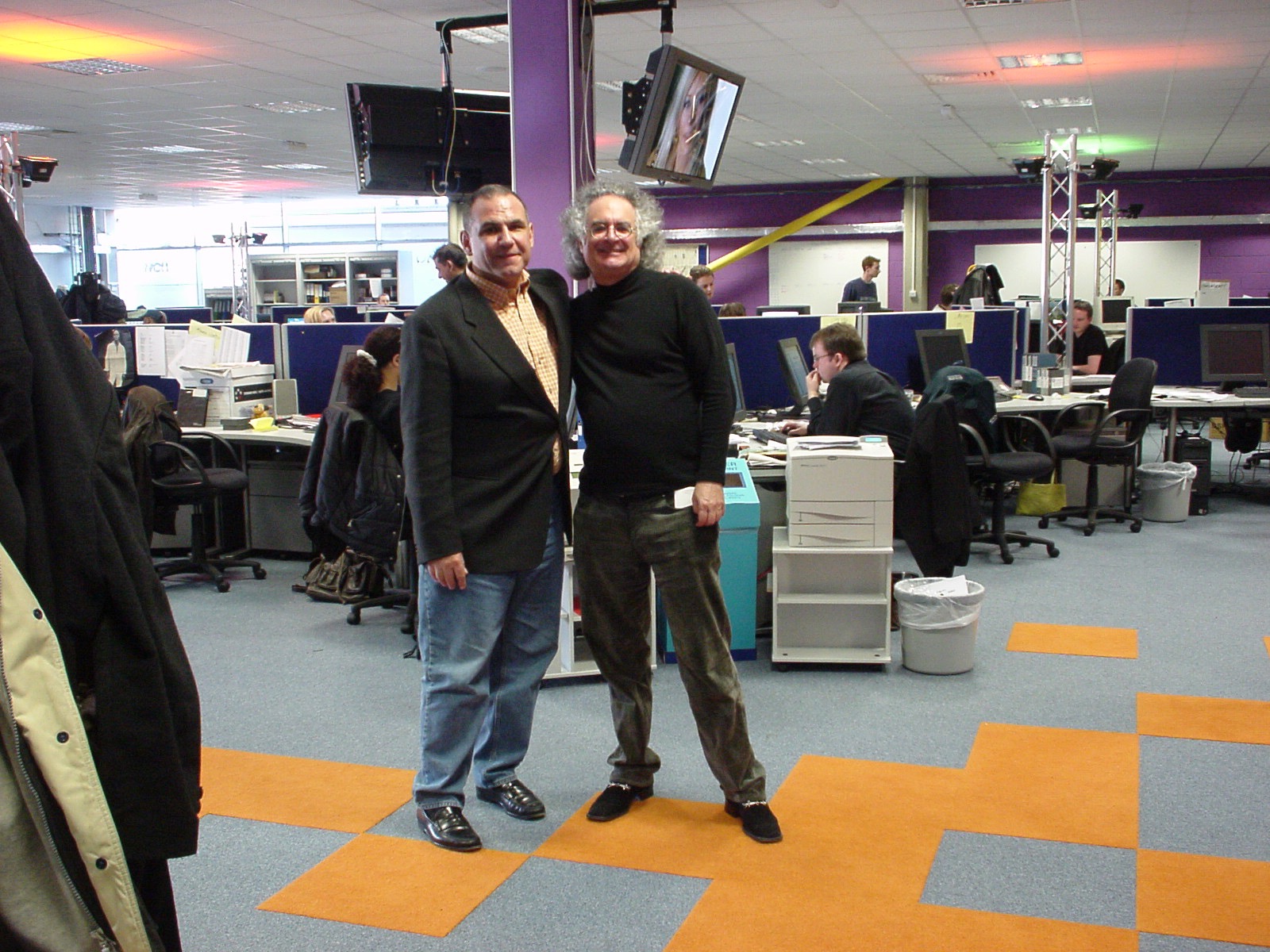
    Michael and me at the now.com studio outside of London in 1999

    In 1999, I was on the board of both PCCW and CMGI, one of the leading American internet companies.  I introduced the two CEO’s and at my recommendation it was decided to set up a partnership to do early stage investments in Asia.  Michael was involved in the negotiations.  

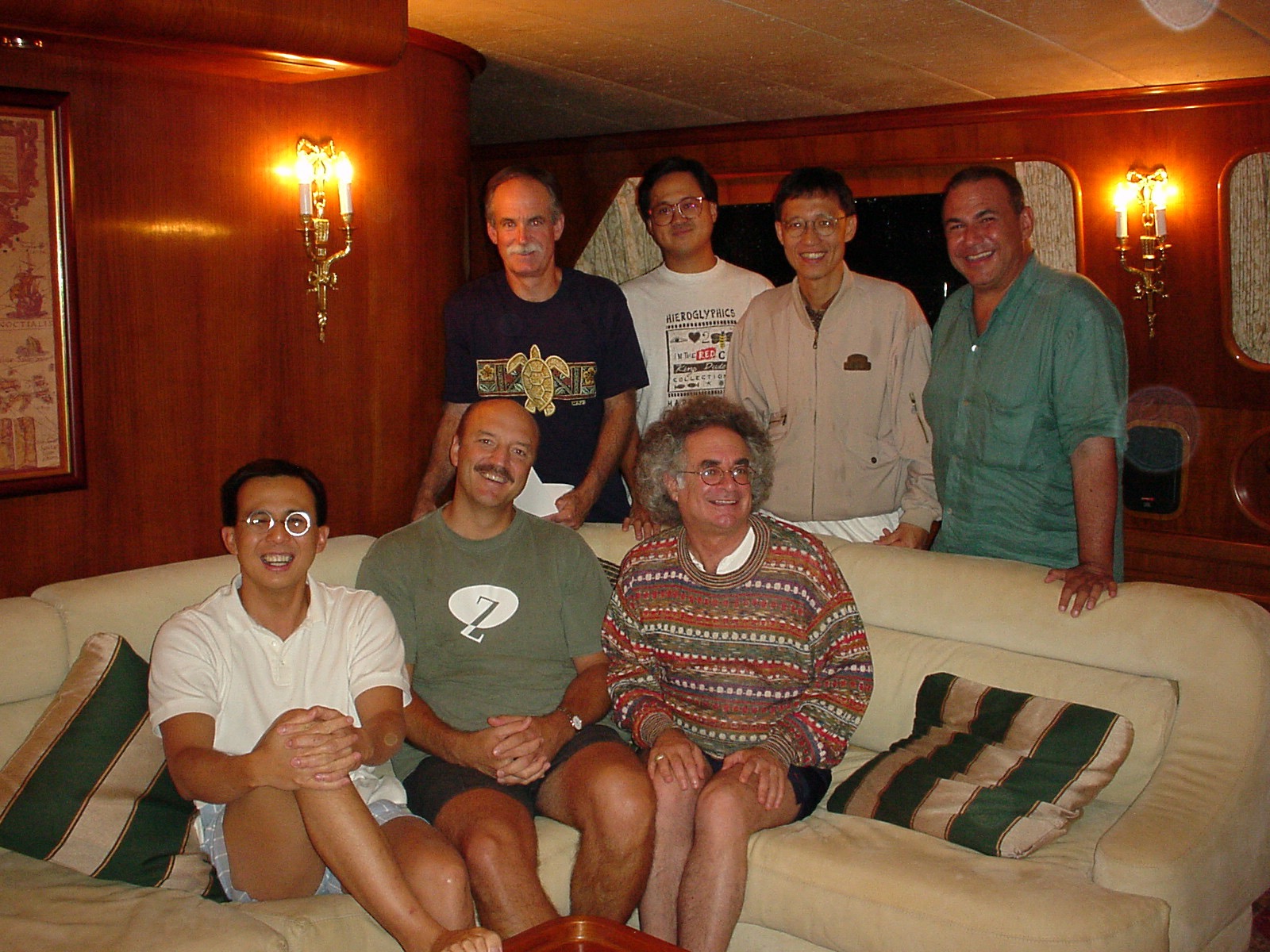
    Richard Li, Dave Wetherell and me win the front, Michael Johnson on the far right, aboard Richard’s yacht, 1999.

    The world witnessed the melt down of internet company valuation in 2000.  now.com was advertising based and the adds dried up.  PCCW reluctantly downsized now.com. The venture with CMGI was also terminate. Michael, left the company and moved back to South Africa.  He and I communicated a few times over the years.  

    While writing my book, which chronicles my journey in the world of high tech, I had the opportunity to work closely with many renowned business leaders but I also worked with some very creative business minds.  Michael was right up there.  Not only was he creative and brilliant, he was driven to make his ideas actually happen.  I call people like this, Activist Strategies.  It is a term I sometimes use for myself.  Michael was right up there.  He could see things that other could not see and he could make them happen. He was a generous and caring man but also complex and could leave chaos in his path.   I will always be grateful for the times I spent with this man.

  • Goodbye and thanks Doug Semon

    When I decided to write a book about my high tech journey, I had several objectives. One of those was to document the creation of residential broadband in which I played a leadership role. I wanted to tell my personal story, but I also wanted to make sure that the people who contributed to its creation got the credit. At this point in my life, I often say that my contribution to the future of technology is to document its pass because that is how I feel. As I began working on my book almost three years ago, I was glad that most of the people I worked with were alive and still accessible to me.

    Sadly, today, I learned that Doug Semon, one of the pioneers in developing residential broadband over cable died. It was a privilege to know and work with Doug in 1993 and 1994. Doug was one of the first people to understand the potential of combining high-speed connectivity to powerful personal computers in homes.

    Doug Semon was director of Viacom’s cable operation before they sold it to TCI. It was a time when Time Warner was pushing a concept called the Full-Service Network, which had the Television at the heart of home interactivity. I discuss all this a length in my book, which I hope to have published early next year. Billions would be wasted by cable, telephone, and computer companies on what was a bad idea.

    In the process of exploring doing a small scale version of the Full-Service Network, Semon had put out a Request for Proposal for the various piece of technology needed. One proposal, from a company called Hybrid Networks, did not make sense. It did not deal with interactive Television. It was about a modem that could use the cable network to transfer information at very high speeds to a computer located in a home and use the telephone system to send data back. That is why they had “Hybrid’ in their name. At that time, most cable systems either did not have an upstream capability or if they did, it was of minimal bandwidth and poor quality.

    Doug was a bit geeky, including putting together his computer out of parts. A light must have gone off in his head when he realized the potential of the cable industry offering broadband. He meets with the founder of Hybrid, where they demonstrated a cable-based connection to one of the few web servers in the world. It had a graphically oriented website that would have taken a very long time to display using conventional telephone modems. Doug sought support from his management to do a trial.

    Around this time, I was introduced to Hybrid. I had already decided to have Intel, together with General Instruments, the largest provider of equipment to the cable industry, develop a cable modem. We invested in Hybrid. They told us about their discussions with Semon. We saw this as an excellent opportunity to do a trial. It took a while to get Viacom’s management to agree. This even involved discussions with the CEO of Viacom, Frank Biondi.

    However, I wanted to have a modem that works bi-directionally on cable and did not require a telephone line. I was convinced that the key to success would have an always-on, always-connected, high-speed communications capability. We had set up a cable modem development group at Intel, Arizona. We had some of those engineers modify the Hybrid product so it could use the upstream capability of the cable plants. Fortunately, the Viacom test used had this capability.

    The trial took place in Castro Valley, a community in the San Francisco East Bay. The first modem got installed in Oct. 1994, but no one was charged until December of 1994. here were 50 homes initially, but it grew to 256 by one 1995. The downstream rate was 10 Mbps, and the upstream rate was 128 kbps. It was at a time when the state of the art telephone modems were 28.8 kbps.

    Viacom and Intel conducted focus groups. The users’ reaction was extremely positive and was very important in gaining support both within Intel and Gi but, importantly, the other cable companies.

    During the same period, Intel/GI/Hybrid did a trial with Comcast in Marion, PA. It was also very successful. Doug and his counterpart at Comcast, Steve Craddock, would argue with each other about who was first. In my mind, they were both first.

    Both the Viacom trial and the Comcast trial were announced in December of 1994.

    Doug Semon went on to have a successful career in the cable industry and played an important and continued role in making cable modems a success. He will be missed by many.

  • My book in the making

    Below is a description of sorts about I book I am working on. It is actually a great deal of work as I have to conduct a lot of research and assure its accuracy.  Now, I need some feedback. I am concerned that the companies, people and events may not be relevant to today’s readers. Any suggestions about how to make the book more appealing to readers that are under 40 would be appreciated.
    This book is primarily about my experiences in the computer industry from 1979-2004. This includes my time at Digital Equipment Corporation (1979-1983), Franklin Computer (1983-1984), Intel Corp (1984-1999) and as an investor, board member and advisor (1999-2004).

    While the book will have some autobiographical elements including how someone who never attended university and barely graduated from High School ended up as an Associate Professor at the age of 29 and then went on to be a corporative office at Intel at a time when it was one of the most successful companies in the world.

    My book will be a combination of history, antidotes, and stories but importantly, it will also contain lessons that I believe can be helpful to those creating and/or investing in high tech businesses. I have been fortunate to have known many of the leaders of the computer industry during my times, this includes Bill Gates, Steve Jobs, Ken Olson and of course Andy Grove and “being in the room” when important decisions were made.

    The book will explore topics like the transition from the Mini Computer/Vertical industry to the PC/horizontal industry. It will tell stories like how Intel tried to kill the microprocessor that eventually became the fuel for its success. It will cover Microsoft’s achievements and its many failures as well as covering the relationship between Intel and Microsoft which I witness closely.

    Since I played a principal part in the development of high-speed residential broadband, a significant portion of the book will deal with this in depth.  I think it is a really interesting story and much of it has not yet been told.
    As one of the founders of Intel Capital, I will discuss its history and accomplishments and discuss the role of corporate venture investing.

    The book will touch on my failures which were many as well as my successes. This will help guide some of the discussions on lessons. In doing research for the book, I have learned that I did a lot more and accomplished a lot less than I thought. It has been a humbling experience. I have also learned about the failures of others and how elusive and random success really can be. I have come to believe that not only does luck play an important role but it may be the most substantial factor in determining success.

    The book in a sense will be a collection of stories and wisdom told entertainingly that should give insight and perspective not only on the past what also on the future of the computer industry.

    Please send your comments to avram@avrammiller.com

    Thanks.

  • Drinking the kool-Aid (how billions were lost creating PDAs)

    As I try to decide if I should write a book, I have been reading or rereading various books about the computer industry.  I just finished Jerry Kaplan’s Startup, written in 1995. Jerry founded GO Corporation in 1987 to develop pen-based computers, and I still think the book has value today for those starting technology-based companies.  It would be hard for me to review this book objectively since I was involved with so many people, situations, and companies it discusses.  The book is richly detailed since Jerry kept many notes and recordings during the more than six years of GO’s existence (1987 to 1994). I wish that I had documented my experiences during my career. It would make writing my book much easier and more accurate!

    Reading Jerry’s book brought back many memories of this period for me. Although I don’t think I believed much in those early Personal Digital Assistants (PDAs), I did interact with many of the companies involved, especially GO and General Magic.

    Personal Digital Assistants (PDA)

    Many companies were formed in the late 1980s and early 1990s around the concept of the PDA, a logical extension of computing’s evolution. First came mainframes, which were not only used by many people at once but were also required a staff to maintain and operate them.  Next came minicomputers, often used only by one person at a time and which did not require staff to keep them operational.  Both mainframes and minicomputers required a fixed location, though sometimes users could be located remotely (time sharing) using a terminal.  With the personal computer, individuals could, for the first time, own and control their own computers.  However, until the development of portable or notebook computers, these, too, had fixed locations: so we went from having computers on floors to computers on desktops.

    Even back in the 1970s, then, many dreamed of having a computer that could fit inside a briefcase or, even better, inside a pocket or purse. Today, with smartphones (like the iPhone), we take this entirely for granted.

    PDAs required small size, ease of interactivity, and the ability to connect to more traditional, more powerful computer systems.  In a sense, then, these devices were akin to intelligent terminals.  Because size was such a significant consideration, a traditional, typewriter-style keyboard would not fit.  Therefore, it was believed that users would need to interact with such devices using a pen, a stylus, or their fingers.  Several companies developed user interfaces that combined handwriting, drawing, and gestures, including GO, Apple (with the Newton), and Microsoft (with WinPad), to name a few of the more prominent examples. General Magic, wisely realizing that accurate handwriting recognition would not be possible with the available technology, provided a screen keyboard that could be tapped with a stylus. There were also many attempts to add handwriting capabilities to traditional desktop computers.

    With the possible exception of Palm, which was formed in 1996, all the companies formed between 1987 and 1997 to exploit this perceived opportunity failed—after raising staggering amounts of money.  The people involved spent years of their lives following a dream they never realized.  Some were and are the most talented people in the computer industry.

    Why did so many fail?

    Why did so many invest so much money and time into the development of PDAs?  It’s a fascinating question.  Besides the key notion of portability, computers were considered to difficult to use, which restricted the size of the market.  The PDA was meant to be as easy to use as paper but as powerful as a computer; humans would interact with the device through a pen on a small screen. Handwriting was considered a more natural way to interact especially because so few actually knew how to type.

    Two things went wrong with this concept.  First, handwriting recognition is a difficult computational problem, and it was just not yet a feasible technology with the portable computing power available at that time.  It might seem amazing that so many great minds did not recognize this, but I have seen this pattern happen time and time again.  Second, people do not really want to use handwriting on their computers, as I think we can now clearly see.  Although we have the computational capability to recognize handwriting on portable devices, almost no one uses handwriting on such devices.  Instead, we are happy to type on glass as proven by today’s smartphones.

    So, why did so many venture capitalists and corporations invest so much in PDAs?  Well, I don’t think VCs are very strategic.  I’ve often joked that VCs approach market research by counting the number of entrepreneurs coming into their offices with virtually the same business plan.  If so many smart people want to start companies to do the same thing, they figure that thing must make sense.  Once a few VCs begin to invest in a particular area, other VCs jump in as followers.  Then, VCs need to find others to invest the bulk of the next rounds of financing.  Getting large corporations to invest is especially helpful, as they are generally thought to be less sensitive to valuation.  A few large corporations succumb to the notion that the idea must make sense because so many VCs have invested.  Other large corporations, fearing they’ll be left out in the cold, then decide to start internal projects, which eventually fail.  Seeking an alternative, the corporations buy the startups instead.  If the timing works out right, the VCs and a startup’s employees can earn significant returns before the business fails, but if it starts to fail before it sells, only the early-stage VC investors usually make any money.

    Considering the history of the PDA as an example of such institutional behavior, we might ask ourselves if this kind of thing is still going on.  I think it is and would point to Virtual Reality as one example.  Over $3 billion was raised by VR startups in 2017.  The most prominent being Magic Leap who has raised $2.3 billion dollars to date.

    GO never got going

    Turning back to GO, it turns out that Intel was an investor.  Though I knew that when I started Jerry’s book, I forgot the full story.  As frequent readers of this blog will recall, I was co-founder (along with Les Vadasz, one of the founding team of Intel)  of what became Intel Capital, we called it Corporate Business Development (CBD).  In Jerry’s book, I learned that I had not initiated Intel’s investment in his company.

    I started doing early-stage investments and acquisitions for Intel in 1988.  I had a few people working for me, and I reported to Les Vadasz, who managed Intel’s Systems Division in addition to trying to manage me.  Then Les went on sabbatical and taught at Harvard for a while, during which I reported to Frank Gill (who had taken over from Les) and later to Dick Boucher (who kept Frank from firing me—Frank was not interested in venture investing).  When Les returned to Intel in 1991, he decided to devote himself full-time to acquisitions and venture investing, and together we set up CBD.  Before that, some investments were made directly by the various business groups at Intel.

    John Doerr, a former Intel employee an partner at Kleiner Perkins, brought Jerry Kaplan to meet with Andy Grove about making an investment in GO.  Jerry’s book describes those discussions.  For Intel, the key was for GO to commit to move their product from the Intel 286 to the Intel 386 processor and to agree to always port GO’s operating system (PenPoint) first to the Intel Architecture.  Though Kaplan was unhappy about these requirements, he needed Intel’s money and blessing to help GO close a big round of financing.

    At some point, Les asked me to meet with the GO team, which was having some problems.  I went to their offices in a large building in Foster City, San Mateo.  There I met with the founder, Jerry Kaplan, and members of his team, including the legendary Bill Campbell, recently joined as CEO.  I had met Bill many years earlier when he ran Claris, then the software arm of Apple.  Bill and I later developed a friendship.  He was a fantastic man who sadly, died a few years ago.   After GO failed, Bill went on to a very successful career as CEO of Intuit, board member of Apple, and advisor to many prominent Silicon Valley companies.  He “coached” Steve Jobs, as well as Larry Page and Sergey Brin (the founders of Google).  Bill and I both lived in Palo Alto when I worked at Intel.  We would occasionally meet up there to chat.

    I’m not sure whether Intel lost money on its investment.  When GO started, it had a hardware group.  Later, it decided to concentrate on developing its pen-based operating system, spinning out the hardware group into what became EO, which got a large investment from AT&T.  Eventually, GO and EO both merged. AT&T invested enough to become majority owner of the new entity.  Part of that investment went to fund the combined company, but part of it bought shares from existing investors, including Kleiner Perkins and, I assume, Intel.  According to Jerry, Kleiner Perkins got their money back and more, while the founders and employees of GO got nothing in the end.  Kleiner Perkins was always very good at making sure they did well even when their portfolio companies did not, but that is another story.

    At the end of the book, Jerry rightly wonders not why GO failed, but why it lasted so long and could raise so much money.

    Besides Jerry Kaplan and Bill Campbell, GO had many successful alumni: Stratton Sclavos later founded Verisign ( a company in which Intel invested) Randy Komisar became CEO of LucasArts and later a partner at Kleiner Perkins, and Mike Homer was VP of Marketing at Netscape when it made its very significant IPO.

    The magic moment

    General Magic, spun off from Apple in 1990, was perhaps the most impactful independent PDA company—impactful, that is, in the sense that it was a highly visible failure.  It was founded by Marc Porat, Andy Hertzfeld, and Bill Atkinson.  Andy and Bill were the two people most critical to the development of the Macintosh.  Marc, strangely enough, produced a film commissioned by Digital Equipment Corporation to celebrate that company’s 25th anniversary, a movie in which I played the “leading role.”  I knew Marc very well professionally and personally.  He was a masterful storyteller which, combined with the pedigree of the other founders, made a very compelling pitch, especially to corporate partners.  General Magic raised $200 million from 16 strategic partners, including Sony and AT&T.  They also raised $96 million in an IPO. The valuation was $834M The stock price doubled on its first day of trading.  The professional investors who were able to buy stock in the IPO sold off their shares and price dropped back to close at the offering price.  That was the company’s high point.  Its PDA product was not at all successful.  Marc Porat was replaced a year after the IPO, and most of the team left.  The company staggered along for another eight years before bankruptcy.

    General Magic’s device was more or less an intelligent terminal.  They had a very sophisticated model of networked computing, with various computational tasks assigned to computers across the network.  Though their interface still used a pen, General Magic avoided handwriting recognition, displaying a keyboard on the screen which one could tap using the pen.

    I can remember that I was impressed with some of their concepts, especially their networking model which created a distributed system. I am pretty sure that Intel did not invest, but I’m not sure why. I know I had several meetings at General Magic, and I can remember explaining the company to Les and others.

    Even though General Magic came out of Apple, Apple only owned 10% of the company.  John Sculley, Apple’s CEO (Steve Jobs had already been forced out), started an internal, competitive PDA project, called Newton.  Many in General Magic felt that Apple stole ideas from their company. Newton had insufficient connectivity and relied on handwriting recognition, which was not very accurate, but it completely sucked the air out of the market for General Magic.  The first Newton units shipped in 1993, and the product was not successful.  The last Newton was made in 1998, and its failure helped turn the market against the idea of PDAs.

    The alumni of General Magic are very impressive.  Besides the founders, Ton Fadell later co-invented the iPod and iPhone and later founded Nest.  Megan Smith later became the CTO of the United States under President Obama (a position since eliminated).  Andy Rubin founded Android, Pierre Omidyar founded eBay, and Steve Perlman co-founded of Web TV, among many more.

    Recently, a documentary on General Magic was released.  I have not yet seen it, but here is the trailer.

    WinPad

    Besides Apple with the Newton, many corporations had PDA projects.  WinPad was one of these, which I only mention because I was involved.  In 1992, Andy Grove asked me to take the lead in coordinating with Microsoft to deliver their needs for consumer products.  Intel had no interest at that time in the consumer market, but Microsoft did.  My job was primarily to keep Bill Gates happy and make sure they did not turn to our biggest competitor, AMD.  My counterpart was Rob Glaser at first.  When he left, towards the end of 1992, to found Real Networks, I worked with Craig Mundie, who eventually became Microsoft CTO.

    We identified three major consumer projects.  The first project, which never really got started, was a game console.  The second was an intelligent set-top box. WinPad was the third.  I’ve written a lot in the past about the set-top box project (internally nicknamed Pandora’s box at Intel), because it eventually led to the creation of today’s residential broadband network (with no thanks to Microsoft).

    I coordinated a team to work with Microsoft to prototype the WinPad and help develop partnerships that could take it to market.  I thought the WinPad had a chance because it used the Microsoft code base and therefore would be appealing to corporations. I did not think it would be a consumer product.  Companies like Compaq, Dell, and even IBM started projects based on the WinPad.  However, the project ended sometime in 1993, probably because it could not meet its cost goal.

    Visionaries or Dreamers

    I like to say a Visionary is a Dreamer with a PR department.  Much can be learned by studying the history of the PDA.  Billions of dollars were spent pursuing an idea that was not only technically unfeasible but also undesirable, most likely, to its target market.  Brilliant entrepreneurs spent many of their most precious years chasing the dream of the PDA.  Some of the most successful venture capitalists invested hundreds of millions of dollars in early-stage PDA companies, and key firms in the computer and communications industries spent hundreds of millions of dollars either in investments into early-stage companies or on their own internal projects.  PDA companies taken public later failed entirely.

    Just as we have examples of such failures, we also have examples of success.  Once early-stage companies like Amazon, Google, and Facebook grew to become enormously successful.

    How is it possible to distinguish between the two?  You might have to wait for my book to find out.

    History of Pen Computing

    Bill Campbell

    Bill and Andy’s excellent adventure

    More on GM

    GM IPO

    Case Study of GM

  • Seeds of Discontinuity


    Flip phone  number of digital photosiPhone

    A small part of the Apple iOS 12 announcement got me thinking: Live Listen.

    I love spotting little pieces of new technology that can profoundly affect the evolution of human culture: I call them Seeds of Discontinuity. For example, I vividly remember seeing a flip phone in 1999 that had an embedded camera.  I had never before considered it possible for a camera to be part of a phone, but, at that moment, I knew the world of photography would change forever.  Of course, the capabilities of that phone’s camera were far less than what was then available from a standalone camera.  However, always having a camera in your pocket meant always being able to capture an image. This was extremely powerful.  Once photography crossed into the digital realm, attributes like resolution would ride Moore’s Law, improving exponentially.  All this was clear to me in that moment of insight, though the now-commonplace social networking aspects of photography were not apparent to me at that time. 

    GPS (Global Positioning System) is another example of a complementary technology that has led to profound results. The GPS project was announced in 1973 for use by the U.S. military.  While it did not become fully operational until 1995, civilian use started in the 1980s.  The iPhone of 2008 iPhone (just ten years ago!) provided positioning information for the first time by triangulating cell towers.  It was the iPhone 4S (Oct. 2011) that first supported GPS.  I wrote a blog post in 2008 about GPS. contemplating some of the effects of GPS, but that was before its integration with the cell phone.  The integration of GPS and the smartphone led directly to companies like Uber and Waze.  Positional information is now prominent in our interactions on the internet, including interactions through social media.  For instance, our photos are now tagged with location data.   If we choose, we can let our location be known to our friends on social media.  We can find information about stores and restaurants that might be near us.  We can even find our devices if we lose them.

    Spotting the Seeds of Discontinuity

    My ability to spot the Seeds of Discontinuity and understand at least some of their potential impacts has not just been my hobby.  It is also largely how I made my living, especially when I co-founded Intel Capital along with Les Vadasz.  For reasons I still do not fully understand, I have been pretty good at this.  Frankly, I don’t know if I am still good at it, because it takes many years to learn whether your predictions were correct!


    Expanding the range of human communication

    Before the nineteenth-century inventions of the telephone and the telegraph, humans could only converse with each other within speaking distance.  Now, almost any human being can talk to any other human being in real time, no matter where they are located.  Even hundreds of people can communicate with each other in real time over audio, from anywhere on the planet.

    In 1965, when I was just twenty years old, I lived in Paris.  I could call my mother in San Francisco, but it cost a small fortune, and I had to use a phone booth.  I also had to tell the operator if the call would be Person to Person or Station to Station.  Person to Person was more expensive. While Station to Station meant you would speak to anyone, the operator found on the other end of the call.  To save money, I worked out a protocol with my mom.  I would call Person to Person and ask for my mother, Marilyn Miller.  She would pick up and tell the operator that Marilyn Miller was not there and that I should call back in an hour.  That was the code telling me she was there and would answer the next call.  Then I would call her Station to Station.

    Later, I developed a way to bypass payment.  In those days, an operator knew you had put in your money by listening to tones generated by the phone as you deposited your coins.   Different coins had different tones.  I bought one of the first portable tape recorders and recorded the sounds of the coins dropping.  So, when the operator said, “deposit 50 francs,” I played the recording of the tones adding up to 50 francs and had a pleasant conversation with my mom.

    Today, with applications like Skype, FaceTime, WhatsApp, and WeChat, we can speak to one or more people for as long as we like, wherever they and we may be.  I believe that the next evolution will seem like continuous communication, but more about that later. A whole generation is growing up that has never known anything else.

    Until very recently, two people could not see each other unless they were physically close together.  That, too, has changed.  While less prevalent than voice communication, real-time video communications between two or more people located anywhere on the planet are now common.  I routinely have video conferences with as many as ten people found on multiple continents.  While we all know where we are each situated personally, and while we may also be aware of where the others are located, the virtual location of the conference has no physical counterpart. 

    At some point, we will be able to experience the sensation of touching others, no matter where they are.

    My early experiences with computing and audio

    In 1967, the year I learned to program computers, I had my first experience with computing and audio.  I was providing technical support to Dr. Joe Kamiya in his research on brainwave bio-feedback at the Langley Porter Institute at the School of Medicine, University of California San Francisco.  I worked closely with another programmer, Pete Harris, on several projects.  We used to program late at night when the computer, a PDP-7 from Digital Equipment Corp., was not busy being used for experiments.  We noticed that the console lights on the computer’s control panel would interfere with our transistor radio. Then, one of us got the idea to program the lights to generate sounds.  Next, we were able to get the computer to play songs.  (We later got the tape drives to dance, but that is another story!)  Since I was also a pianist, I took a continued interest in the use of computers in music. 

    The end of time and space

    In 2006, FastCompany Magazine asked “ten of their favorite brains” to describe the most important change that would affect business in the coming ten years     (2006–2016).  I was one of those “brains,”  and I was amongst excellent company, such as Malcolm Gladwell (author), Kevin Roberts (CEO of Saatchi and Saatchi), John Mackey (CEO of Whole Foods), and Ester Dyson (Host of PC Forums).  I identified the most important trend as “the end of time and space.”  It’s fun to see what everyone had to say since we are now past the predicted ten years and can see what has happened.  Indeed, as I predicted, it no longer matters where you are or even what time it is where you are, as we have moved more and more of our communication onto the internet. 


    MuseumTelephone_2011.10.04airpods

    Back to Live Listen, the iOS feature that had me thinking

    The iPhone has a capability Apple calls Live Listen, which allows specific hearing aids to “pair” with an iPhone and use the iPhone’s more powerful microphones.  So, instead of using the hearing aid’s microphone and its speaker, the hearing aid acts as earbuds alone, allowing the microphone to be placed at some distance from the listener.  At the very end of 2016, Apple released the AirPods, a set of Bluetooth earbuds.  I think they are a great product, and I use mine daily.  They seem very popular: by the end of 2018, worldwide sales are expected to exceed 50 million. AirPods can be connected to the iPhone, iPad, Macs, Apple Watches, and Apple TVs, or almost any Bluetooth device, although many advanced features work only with Apple devices.

    Someone at Apple had the idea to make Live Listen available to anyone with AirPods. I started to think about the implications of decoupling the microphone from the speaker.

    loud restaurants

    Conversation Peace

    About eight or nine years ago, I had the idea to create a product called the “Conversation Peace.”  I often find myself in noisy restaurants.  It can be frustrating to go out for a meal with friends or business associates and try to have a conversation.  I have a decibel (loudness) meter as an app on my phone, and it’s shocking how loud some restaurants are.  My concept was a tabletop device that could make noise cancellation to create a “cone of silence.”  Of course, while creating such a product might have been possible, it would have been too large and too expensive to be practical.

    Eventually, I realized that everyone at a restaurant table could use their phones and earphones to call into a conference line.  I never actually did this, but I have tried calling individual people at a table so we could converse.

    I think if I were out at a restaurant with a group of friends that all had AirPods, I would certainly consider trying Live Listen to cope with the noise.  Apple will even have some presets audio filters available with Live Listen.  One of them is called “Restaurant.” 

    Networking conversation

    I then started thinking about all the capabilities that networking could add.  There is no reason to limit me to one microphone at one location. For instance, instead of using my iPhone at a restaurant, to listen to you, I could also connect to your iPhone’s microphone.  In fact, all the iPhones on the table could link to some audio mesh network, creating fantastic fidelity.  Just think about how this capability could be applied at a concert. 

    But there is no reason the “microphone” must be physically near.  One could place a microphone in a child’s room: if the child cries for longer than some set period, the sound of crying could be mixed into one’s audio. I could have a conversation with you while my assistant, located halfway around the world, could “whisper in my ear.”

    Of course, voice control, as we already have with Alexa and Siri, is an integral part of such applications. One powerful capability would be to couple the microphone to highly intelligent reminder applications.  So, if I said to you, “let’s meet on Saturday for lunch,” a reminder would be captured on my calendar. The microphone need not be in your ear to do this.

    Augmented reality will take a lot longer

    Perhaps I should mention augmented reality here.  I first became involved in augmented reality in 1999, as an advisor to a company called Microvision.  Driving my interest in augmented reality was my sense that smartphone screens would be too small for many critical mobile applications.  I also believed that voice could better handle input instead. I was right about the problem, but I was way off on the timing.  (I continue to be somewhat involved with the field, having worked with http://www.emacula.io/ for more than 15 years.)  Screens have very significant constraints due to physics and physiology that are difficult to overcome.  Audio has very different limitations and possibilities, and I believe we will see an explosion of audio applications that will alter the way humans communicate with each other and with the technology that serves them.

    The future of audio communication

    In 1999, when I first saw a phone that was also a camera, it would have been difficult for me to imagine that almost everyone would have a phone/camera in their pockets today.  But this has happened.  Right now, it’s hard to believe that nearly everyone will have something in their ear all the time, but I am willing to take that bet.  I just might not be around long enough to collect.

  • Intel: How a vein of gold turns into a big hole


    Selling Silicon By the Ton

    When I joined Intel in 1984, it was primarily a semiconductor memory chip company.  I use to joke that it sold silicon by the ton, but that was true.  Then, the memory business was under attack by the Japanese because it was a commodity, and the Japanese were just better at manufacturing and therefore had lower costs and a longer time horizon.  I remember driving the now deceased Andy Grove to the airport and he told me he was afraid that Intel might not survive, and perhaps it would be best to sell the company to one of the Japanese competitors.  Intel’s revenue was just over a billion dollars and I think the market cap was the same.  It would have barely qualified as a Unicorn. 

    Finding the Vein of Gold

    A few years later, Gordon Moore who was still CEO and Andy Grove who was COO famously decided that they had to transition the company from the memory business to the microprocessor business. They really had no idea at the time what this would lead to. The PC industry was still in its early phase of development.  This decision resulted in laying off about 30% of the employees.  It was painful and risky, and one of the greatest business decisions ever.

    Everything is coming up Roses

    Fast forward about ten years to the mid-90s.  Intel is doing extremely well and on the way to becoming the most profitable and most valuable company in the world.  I am now a Corporate Officers (one of about 33), Vice President of Business Development.  Intel Capital, which I founded together with Les Vadasz was becoming a force in early stage technology investment.  I was leading Intel’s effort to establish residential broadband (cable and DSL).  I was doing everything I knew to do to get Intel to understand the Internet and the opportunities it could provide the company but this had little effect on the company’s strategy. 

    Not invented here

    In 1990, I had a chance to visit a young company called Qualcomm and meet with the CEO Irwin Jacobs.  Their company was primarily selling communications systems to the trucking industry but had developed digital communications systems called CDMA that they targeted for the growing mobile phone business.  Irwin explained the concept of spread spectrum to me and I was blown away.  I desperately wanted Intel to acquire Qualcomm but there was no way that was going to happen.  The idea was rejected without any real consideration.  The good news is that allowed me to buy stock in the IPO which turned out to be a good move personally. There were other companies like Broadcom that we could have purchased. 

    So I started saying “Intel was in the memory business selling silicon by the ton.  One day, it found veins of gold called the PC.  Intel decided that it was better to mine gold than “coal”.  It put all its people and investments into the gold mining business.  Sometimes it looked for other veins of gold, but did not make too much of an effort because there was so much gold in this one vein.”  Then I would say, “do you know what you have when you extract all the gold from a vein? A big hole.”

    Founder magic was gone…let’s play it safe

    Towards the end of my Intel days, I realized that the company was not capable of making the kind of transition that Gordon and Andy did even thought this transition would have been much easier.  Andy gave up the reins as CEO to Craig Barrett. I left soon after in 1999.  Later, Paul Otellini  would become CEO.  Paul and I had been friends and I offered to help develop a strategy for the company as an unpaid and invisible advisor.  Intel had been very good to me and I felt that I owed the company this.  Paul never took me up on my advice except once when he asked me to look at the company’s mobile plans.  I did and told him I was underwhelmed.  I also put forward an alternative strategy that involved both mobile and server products that  could dramatically increase the security of mobile computing. 

    Intel appoints a semiconductor manufacturing guy to lead the company

    When Brian Krzanich was appointed CEO and my friend, Renee James was appointed President,  I once more offered my help including outlining a strategic initiative.  I sent it to them.   There was no reaction and I doubt that they read it.  Renee, who had the best chance of understanding the future, appears to have been pushed out and left the company at the end of last year.

    Fire and spend

    Now, Brian is taking action but is it the right action and is it too late.  More than 12,000 employees will lose their jobs. Brian brings in new blood but is offering compensation packages that are off the charts.  I don’t know Brian, and I have no idea what his plans for the company are other than what I read in the press.  The only thing I know for sure is that it did not have to be this way.  Intel had so many opportunities.

    I remember something that Ken Olsen, the founder and former CEO of Digital Equipment Corp told me.  He said, “It is not what you do when things are bad that matters.  It is what you do when things are good.”  Of course, Ken did not take his own advice.

    Maybe Intel needed Bill Campbell

    Bill Campbell, affectionally known as ‘The Coach’ recently died.  They called him the coach because was once a football coach but more importantly because he coach many CEO’s in silicon valley.  I knew him well in the 90s both professionally and socially.  He was a remarkable man who had a major impact on Apple and Google and 100s of over companies.  A few months ago, a close mutual friend told me that Bill was dying.  I asked my friend to pass on my regards and to give him a hug for me.

    This is what Bill told my friend “”What a great guy. When he left Intel, a lot of forward thinking disappeared. A really good man.”  That made me very proud. 

    Intel’s future:  Get a bigger shovel

    I started this post by saying that Intel was selling silicon by the ton when I joined.  They the found the PC was a vein of gold and the extracted all the gold that they could and found themselves in a big hole.  Now they are going to move away from the PC.  I wish them luck and want to offer one last piece of advice to Brian: Get a bigger shovel. 

  • Jean-Patrick Grumberg interviews Avram Miller on Net Neutrality

    Periodically, my friend, Jean-Patrick Grumberg and I get together at a Cafe to chat.  Jean-Patrick likes to work articles that he publishes on very successful French blog while having breakfast.  I join him on  occasions, but I just have coffee since I get up much earlier than he does (or maybe anyone else) and would have eaten hours earlier.  We normally talk about politics.  Jean-Patrick  recently he asked me if he could interview me about Net Neutrality.  Frankly, I have been staying away from this topic and was not even sure about what I would say or even what I thought but if you are interested in learning more about what I had to say please go qui.

  • Your wrist: The most important real estate on the earth and why Apple wants to own it now.

    I remember when Bill Gates told me and a few others, that the most important real estate in the world was the square foot on top of your television set. It was 1992 and the set-top wars were raging. It turned out to be a war in which there were no victors. Bill’s prediction, like most of his predictions about the future of technology, was wrong.  I actually believed he was right for a while until I realized that we had not yet reached the point where technology would allow for a device on top of the TV that would have the needed functionality, the TV did not have enough pixels and that the Cable Industry was not capable of letting this happen.  That is when I secretly started up the Cable Modem project that I so often boast about  on this blog.

    Instead of the TV,  it turned you that for the next twenty years or so, the most important real estate in the home was wherever your PC was located. It was the PC connected to high-speed residential broadband that created today’s internet. As we said then “The PC is it”. Ironically, by the time, true interactive capabilities came to the TV it no longer had a top at all, and Bill was long gone from his role as Microsoft Visionary. There was, of course, one important exception to this; game consoles where young males learned the manly arts of shooting automatic weapons, blowing up buildings and automobiles and abusing women. Game consoles made it to the top of the TV for a while. Even Microsoft benefited via the Xbox.

    Apple failed to achieve a leadership role in the era of the connected PC.  But then Steve Jobs realized that the most valuable piece of real estate was not always located in your home. No, it was in your pocket or your purse. With the launch of the iPhone in 2007, Apple changed the world of technology and in the process became one of world’s leading companies.

    Soon there will be a new battle for real estate: A battle for what might be the most valuable real estate of all, your wrist. Apple fully intends to own it.

    Importance of limited space

    Right now there is a lot of attention evolution of TV industry. It is not clear that any one company will dominate the connected TV market. Flat panel TV’s not only come with many slots (HDMI) but many have their own capability to connect to the internet. I have an Apple TV; Chromecast and Amazon Fire connected to my TV. I could add several more devices if I liked. There is not much of a difference with respect to what I can do with these different devices. But I am pretty sure that there will only be one device on my wrist.
    The Watch

    Many people wear watches although younger people are relying more and more on their phones to check the time. Watches can also be status symbols. While some people own more than one watch, most do not. Those that wear watches tend to wear them most of the time taking them off when the wash or sleep. For those of us that have been around for a while, we can even remember when watches did not have batteries and had to be wound up by hand. My first experience carrying around a battery on my person was a watch and for many years it was the only object that I carried that had a battery.

    Recently there has been a challenge to the watch as various fitness devices have sought to compete for the right to occupy your wrist. We now have devices that can track the number of steps, your heart rate and even blood oxygen levels. Companies like Fitbit and Withings are competing for the location where your watch normally lives.

    By the way, I am aware that we all have two wrists but for some reason, we seem only to want to use one of these. So while this may change, I am going to act like we only have one useable wrist.
    Why Apple wants to dominate the Wrist Market
    I believe that Apple’s primary objective is to insert itself into the world of retail transactions. Because of iTunes, it now has more credit cards than any company including Amazon. I wrote about this concept before and pointed out the intersection of iBeacon, low power bluetooth and iTunes billing.

    While the device that Apple will offer is so much more than a watch, I will refer to it as iWatch for now. Apple’s goal will be for you never to take off the iWatch. It will become part of you. And in a very real way, it will become you. For instance, it might not need to have a fingerprint sensor but will have some intrinsic way of knowing that it is attached to you.

    Of course, it will know where you are and where you have been. It will know if you are with others that also have an  iWatch and who they are. It will know your habits like no one knows including you. It will be capable of listening to your conversations and that of others. It will know what music you like and what TV shows you watch.

    It will not be dependent on any other device like an iPhone, but it will communicate and integrate with these devices. The iWatch will have to have WiFi.

    I could go on and on with ideas about the functionality but you have an imagination so please use it so I can finish this post.

    The importance of wellness functionality
    It is no secret that Apple is investing aggressively in wellness/fitness technology. Apple has hired some of the greatest experts in a number of very important wellness areas. I suspect that the iWatch will be able to measure very important psychological data including Blood O2 and Glucose. There will be a big emphasis on healthy sleeping that will require the owner of the iWatch to keep it on when they sleep. I don’t want to downplay the importance of health in connection with the iWatch. We will soon enter a major shift in healthcare with a much great emphasis on prevention and early diagnose of a disease. I am sure that Apple wants to have a big role in this not only for business reasons but because of what happened to Jobs and Tim Cooks commitment to fitness. However, the key is to make the iWatch the one piece of technology that you never leave behind.

    Business Model
    While the iWatch will be profitable but I can’t see it providing the kind of gross margin that Apple has gotten from the iPhone and iPad unless its price is beyond $500 which would limit it acceptance. But if I am right that the iWatch is tied to Apple’s intention to dominate retail transactions, they may be willing to sacrifice margin.

    Major Challenges
    There are many challenges to designing and producing the kind of iWatch that I envision.

    • Style: The iWatch more than any other product that Apple will offer has to be stylish. Apple understands this. Therefore, it will not bring out the iWatch unless the available technology allows for a product that is both functional and stylish.
    • Comfort will be very important.The idea here is to make sure the owner never takes it off. That also means it also has to be water proof.
    • Power: If you never take it off, how do you charge it. I don’t know but here are a few ideas. It could be charged using RF (radio power) probably from a device on the night stand. It might be able to use solar, movement or even body heat.
    • Functionality: The iWatch must have to have incredible functionality to dominate this market and to fulfill its mission of literarily being “always on”.

    I think these are the kind of challenges that appeal to Apple. The iWatch provides the opportunity to once again define a category, and have a product that is clearly superior to anything else in the market. It is also an opportunity to create a lot of IP that it can use as a moat to protect its castle.

    It is not clear when Apple will announce the iWatch. I suspect it will be in the fall, but it could be earlier. The first generation will, of course, fall short of my of the capabilities I have described, but you only have to look at the iPod and iPhone to see how Apple was able to add capabilities rapidly.


    Want to have some fun

    There are a lot of skeptics about the iWatch and some of them are pretty funny.  Here is one in particular.


  • Announcing Pluto.tv – Lay back and enjoy


    My First Commercial

    Today, Pluto.tv was officially launched.  I am proud to be an early advisor and investor in this company. Those of you that read my blog frequently will know that I have been following and in some cases participating in the restructuring of the medium we call TV.  I am pretty excited and decided to give it a plug on my blog.  Please think of this post as an infomercial because it kind of is.

    First start with the teaser:

    A revolution in TV that started over twenty years ago 

    In 1992, when I began to work on residential broadband starting with the development of the Cable Modem, I realized that the combination of powerful home computers coupled to a high-speed always on connection  to the Internet would result in a new medium for communications, commerce, education and entertainment.  

    Back then, the only computer in the home was a PC.  We did not yet have smart phones, tablets and powerful set-top boxes.  I was watching developments at the Intel Architecture Lab.  In the early 90s, PCs began to be able to play back video in real-time without special chips.  We called that Native Signal Processing.  By 1998, the labs were demonstrating the ability to encode video in real-time.  It was then that I realized that the TV industry was about to turn on its head, albeit slowly.

    Enter the DVR

    At that time, I was on the board of King World Productions which was the largest syndicators of TV content.  We distributed such shows as Oprah and Wheel of Fortune.  I thought that the technology I was witnessing in the lab would allow devices to be built that would provide for the ability to Time Shift Television Programing.  I knew about Replay and Tivo, the first DVR companies.  Both of which launched their companies in 1999.  I was pretty sure that the DVR would also allow TV advertising to be skipped.  So I recommended to the Board of King Word that we sell the company, which we did, to CBS. That was 15 years ago.

    The beginning of self published TV

    I left Intel in 1999 and joined a number of boards.  One of which was CMGI.  We started a business called iCast which was the brain child of the CEO of CMGI, Dave Wetherell.  iCast was Youtube but just five years too early.  But it helped me to understand the power of user-created content.  

    Over the last 15 years we have seen more and more video content on the Internet. Much of it is just regular video programing repurposed.  You get a video clip here and a video clip there.  We have also seen the use of the Internet to augment Video on Demand.  So now we have applications like HBO GO.

    Cut the Cord

    We have also seen the growth in what is called Cord Cutters.  These are people, mostly young people, who have decided that they no longer need a subscription to cable TV.  They might not even have TVs but they certainly watch TV.  They just do it over the internet and use one of their devices as the display. 

    How long is your format?

    I would say that up until today’s announcement of Pluto.TV, there have been two kinds of applications of the Internet for Television.  One is a transport for more traditional TV programing.  In addition to HBO GO we of course have Netflix which one could think of as being an Internet Cable Company offering traditional programing via the Internet.  The other use, is short format TV.  Examples of this abound with the most prominent being YouTube.  I like Shelby.tv myself.  Short Form TV is fun and a good way to kill a few minutes but if you want to lay back and relax you probably turn to traditional TV, even if it is delivered over the internet via some device.  

    However, there is a lot of great long form TV that is Internet only.  Examples of that would be TED.  Sites like TED even come with Applications so you can easily select programing on you phone or tablet.   Smart Set Top Boxes like Apple TV or even Smart TV’s may allow you to connect directly to a large screen and lay back on you sofa and watch.  But these sites only represent a fraction of the long form content on the internet.  Much of the really great content has to be discovered.  So we sometimes get links sent to us by a friends or embedded in some electronic newsletter, like Huffington Post.  But then we often forget about this content and can not find it again.  Frankly, it’s a lot of work.

    The Role of Pluto.tv

    So what is the role of Pluto.tv?  It provides much of the same experience one would get by watching cable TV, but the content is from the  internet.  Pluto has editors that curate by subject.   You can browse channels much as you do if you are watching cable TV.  But you can go deeper.  You can have not just one cooking channel but many.  And not only can you send a link to a friend about a program but you can synchronize and watch the program together but from different locations.  

    You can watch on any device and if you want to put it on a big screen, you can use AppleTV or Chromecast.  Please give it a try and let me know what you think.

    PLUTO.TV OFFERS A NEW WAY TO EXPERIENCE

    THE MOST ENTERTAINING ONLINE VIDEO CONTENT

    Free Video Platform Brings the Best of the Web to Viewers

     With Nearly 100 Curated Channels Available on Any Device


    LOS ANGELES, March 31, 2014 – Pluto.TV announced today the launch of its video platform that allows viewers to watch the most entertaining online and traditional content in one place. Pluto.TV curates and continually streams content around areas of passion including music, sports, news, entertainment, comedy, lifestyle, technology, art & culture, education, and kids, so viewers no longer have to search for it.


    At launch, Pluto.TV will offer nearly 100 channels, featuring a wide variety of content programmed to specific interests like hip-hop, snow, surf, food, health and fitness, travel, sketch comedy, and many more. Pluto.TV is also partnering with some of the most popular content creators from the web and well-known television programs to create individual channels, including Funny or Die, QVC, Refinery29, RocketJump, The Young Turks, and more.


    Pluto.TV is live and available for free on any device, 24 hours/day, so viewers can start watching on their laptop at home or in the office and move to a mobile device with no interruptions. Users can also share content on social networks and chat live while watching Pluto.TV. Pluto.TV features include:

    •        Curated channels: Pluto.TV hand picks the best video content across a multitude of interests and passions.
    •        Intuitive channel guide: The Pluto.TV guide helps viewers navigate everything there is to watch. Select channels and programs in an easy to use and familiar interface. From the home screen, viewers can see the programming schedule breakdown, find what’s coming up, and read through descriptions to help decide what to watch first.
    •        Personalization: Users can create a personal “favorites” list by adding a “star” to favorite channels and programs for easy and immediate access to preferred channels.
    •        DVR: If viewers like what they see, they can rewind, pause or fast-forward the content.
    •        Multi-platform: The Pluto.TV mobile app is available for both tablets and smart phones on iOS and Android. Pluto.TV is available for free at www.pluto.tv and in the App Store and Android Market starting today.
    •        Social features: Pluto.TV is built for sharing with social features like live chat that allow users to talk with friends and family in real time as they watch, as well as share what shows they’re into by notifying their friends. Users also can invite friends to watch or share through social media.


    “Pluto.TV is revolutionizing the way people enjoy video content online,” said Pluto.TV co-founder and chairman Nick Grouf. “We’re making the process of discovering new content seamless by delivering free programming around areas of interest anytime, anywhere. Pluto.TV has done the heavy lifting for you, so you can sit back, watch, and enjoy.”


    “Pluto.TV provides premium content and the best entertainment for our viewers, from traditional TV favorites like sports highlights, breaking news, and comedy to engaging content like educational talks, Funny or Die videos and the hottest music online,” said Pluto.TV co-founder Tom Ryan. “Whether viewers are watching the latest runway show from Milan or the coolest skating tricks, Pluto.TV helps them discover that content in a way that’s easy, engaging, and fun.”


    Pluto.TV was co-founded by seasoned entrepreneurs Nick Grouf, Ilya Pozin and Tom Ryan in 2013. The company’s investors and advisors include Terry Semel’s Windsor Media; Jeremy Zimmer, CEO,UTA; Avram Miller, founder, Intel Capital; Mich Mathews, former CMO, Microsoft; Chris Silbermann, president and partner, ICM; Greg Steiner, COO, Beachmint and former COO, eHarmony; Nas & Anthony Saleh’s Queensbridge Venture Partners; Great Oaks Venture Capital; Dennis Phelps, general partner, Institutional Venture Partners; Jonathan Nelson, CEO Omnicom Digital, Omnicom Group Inc.; Tom Whalley, former CEO, Warner Bros. Records and co-founder, Interscope Records; Jamie Tarses, former president, ABC Entertainment; Brent Weinstein, head of digital media, UTA; David Waxman, managing partner, TenOneTen Ventures; and Jeremy Welt, SVP marketing, Maker Studios.


    About Pluto.TV

    Pluto.TV is an online video platform that offers a new way to experience the most entertaining and engaging content on the web. Viewers can experience continuous programming around areas of passion for free, and available 24/7. With nearly 100 channels organized into popular common interest categories like Music, Sports, News, Entertainment, Comedy, Lifestyle, Tech, Art & Culture, Education, and Kids, Pluto.TV is for everyone who enjoys being entertained. Pluto.TV is headquartered in Los Angeles.