I now have had cancer three times. Some of you may have seen the photo of me in the hospital. I turns out that I had a cancerous polyp in my bladder. It was completely removed. It was of the lowest grade. No further treatment is required but I have do some monitoring.
This is my third cancer (prostate and then a melanoma). I guess I have some interesting genetics. I am very proactive about checking everything but I will probably increase my vigilance by doing liquid biopsies (blood).
I clearly have an enemy but it is not a silent killer.
Please do not be concerned. I am much healthier than any 80 year old you may know, I guess. And I am willing and able to spend a lot of money monitoring everything.
I wish all of you would be proactive about your health. Have no fear of getting information. Act on it as your life depends on it.
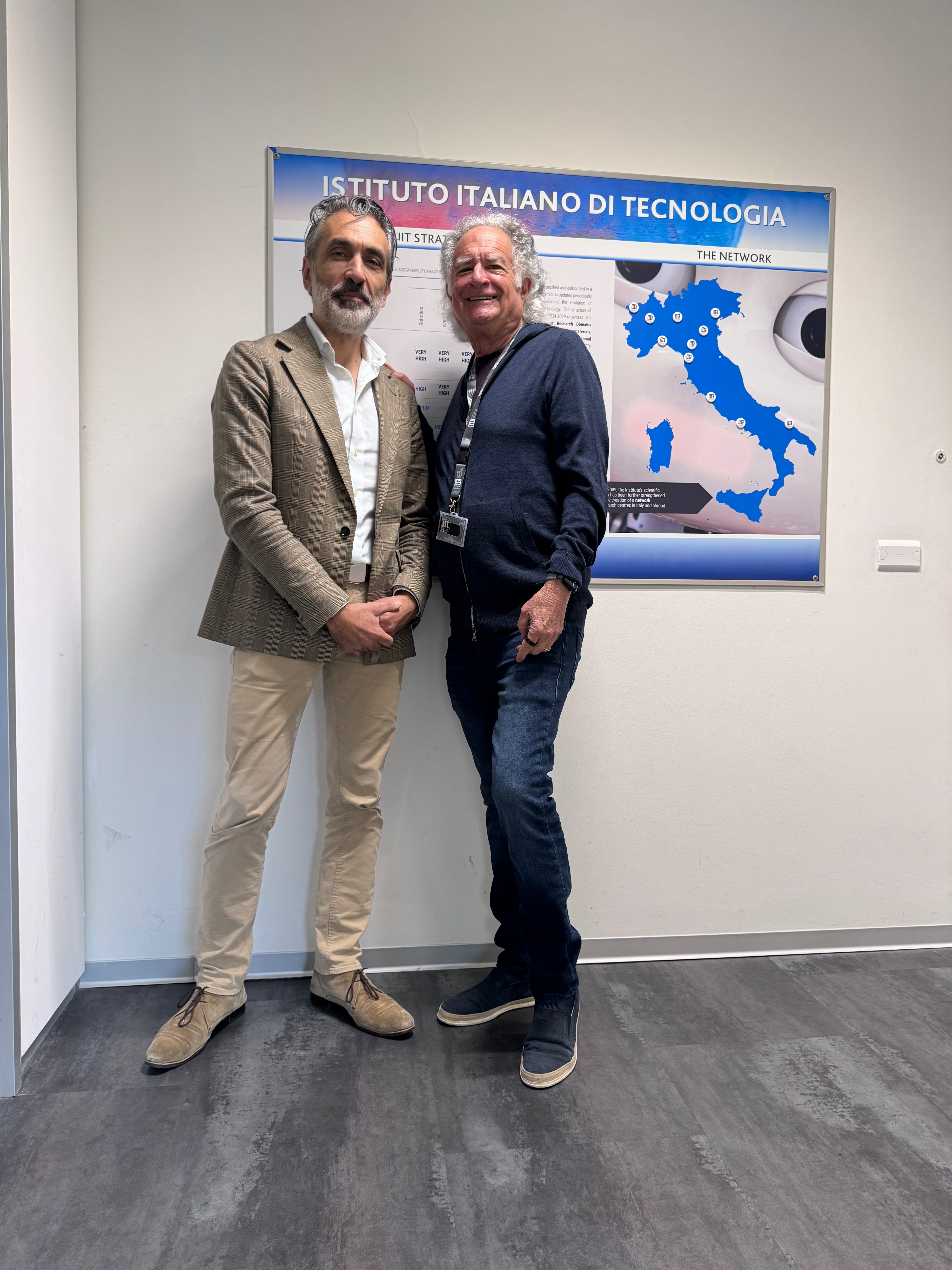
I am thrilled that I have been appointed as a Fellow at the Italian Institute of Technology (www.iit.it). It is an incredible honor to work alongside the remarkable Giorgio Metta, the Science Director and his team to embracing the future. Exploring their projects promises to be both enlightening and enjoyable, with the exciting possibility of spending time with some of their fascinating robots.
The Italian Institute of Technology (IIT) is a leading research center based in Genoa, with 15 locations throughout Italy and a community of more than 2,000 people, including scientists, engineers, and technical staff from around the world. It drives innovation through over 80 active research projects spanning robotics, neuroscience, materials science, and artificial intelligence. IIT’s mission is to advance knowledge and technology, transforming scientific discoveries into real-world solutions that foster sustainability, progress, and improved quality of life.
Life expectancy has been increasing worldwide by about 0.2 years every year — roughly two extra years per decade. Even more importantly, health span — the number of years we live in good health — has been rising as well, which is critical.
If you’re 40 today, actuarial tables suggest you’ll live to about 85 on average. With steady medical progress, 95 is realistic for many. Already, the healthiest 20% have good odds of crossing 100. But that does not account for breakthroughs that are likely in the coming decades. Already, drugs like the GLP-1s are transforming metabolic health, and that’s just the beginning. Advances in gene editing, regenerative medicine, and AI-driven drug discovery could push the boundaries even further. I’ll go out on a limb: I believe some of you will live not just to 100 or 110, but to 120.
That is 80 years from now. The world in 2105 will be very different from the world of today — perhaps beyond our imagination.
As I wrote earlier, I am in the process of replacing some of the older parts used for eating, hearing, and vision.
First: A Bit of Extraction and a Lot of Pain
The extraction of three molars was not easy—it took three hours. I’ve been in pain for about ten days, but it’s getting better. I won’t be able to have the implants placed for six months, and then it will take another three months for the crowns. After that, however, my mouth will be very strong.
Hearing Like a Baby
The hearing aids have been a very interesting and positive experience. I can definitely hear well in noisy environments, and I understand Italian (which I am studying) much better. My inability to hear consonants clearly had been making it very difficult to learn Italian and was probably also a handicap in learning Hebrew.
My AirPods Pro are much better at streaming than the hearing aids, and—crazy as it sounds—I can actually wear both at the same time. This is important because soon Apple will provide translation capabilities using AirPods.
What’s strange is that when I’m streaming a podcast, no one knows. The AirPods Pro have a feature called Conversation Awareness: if someone starts speaking to me (or if I start speaking), the sound of the stream lowers automatically, letting me hear the environment. Hearing aids don’t offer anything like this. Normally, if I had my AirPods in, my wife would realize I was listening to something. I’m thinking of creating an accessory like a little “recording light.”
I can adjust the mix between outside sound and streaming. This works well inside the house, though less so in noisy environments. My Phonak hearing aids have an app that lets me set up different configurations and switch between them easily—I’ve been experimenting with this.
I’m happy to say my hearing aids are practically invisible, which for a vain person like me is important.
Advances are coming, driven by AI. Soon, hearing aids will not only separate voices from background noise but will also target the voices you want to hear while reducing those you don’t.
A new feature called Auracast is being rolled out. It’s essentially a Bluetooth LE Audio stream you can tune into, much like selecting a radio station. You can mix it with the ambient sound around you. It’s a one-to-many capability: in a theater, you could tune into the actors’ speech or singing—or even a live translation. In an airport, you could hear announcements clearly, and on an airplane, instead of asking what the pilot said, others may be asking you.
The feature I’m most looking forward to is simultaneous translation. Apple will soon bring this out for the AirPods Pro. While this won’t work the same way with hearing aids, the good news is that you can use AirPods Pro at the same time as your hearing aids. I’ve already tested this.
I put on my hearing aids after I shave in the morning and take them off just before bed. They charge during the night, giving me about 18 hours of use per day.
New Eyes
After much consideration, I decided to get cataract surgery. I had my first eye done three days ago. The process was amazing. Many eye surgeons use the same operating facility—mine was in Beverly Hills, close to where I’m staying. It’s like a factory with seven operating rooms. They do about 60 operations a day. The whole process takes about two hours from check-in to check-out.
The first hour is paperwork and preparation. Then comes the operation, done in two parts. First, a laser performs the incision and separates your lens. Then the laser breaks up the cataract. (This can also be done by hand, but the laser is more precise and results in fewer complications.) You’re fully awake during this part. Your eye is dilated and numbed—you feel nothing. A device holds your eyelid open. You communicate with the surgeon while watching a big “light show.” It isn’t unpleasant.
Next comes the implant of the new lens. You’re given a very light sedative (I just felt relaxed). Once my natural lens was removed but before the new one was placed, I could see—though not focused. As soon as the new lens was in, I started to see again, though very blurry at first. Because of dilation, the light was intense, so I was given dark glasses.
Recovery took about 30 minutes, and then I was free to go. By the end of the day, I was already seeing better with that eye than I ever remember. Colors and contrast were amazing—everything vivid. However, I could only see well at a distance. Intermediate and near vision were poor. The kind of lens I received, an Extended Depth of Focus (EDOF) intraocular lens, is designed for distance and intermediate vision. But it can take weeks for the brain to adapt, so for now I’m using drugstore reading glasses.
The hardest part so far is having one corrected eye and one bad eye. I tried using glasses with a clear lens for the corrected eye and my old prescription for the uncorrected eye, but it made me dizzy. So for now I’m using no glasses at all. I can see and get around, but my depth perception is a bit off. In five days, I’ll have the second eye done. I can’t tell you how happy I am with my new vision.
But old habits remain: I keep reaching for my glasses when I wake up—only to realize I hadn’t worn them to bed, so they aren’t on the nightstand.
Yesterday, I got a haircut. It was the first time I could actually watch the barber cut my hair.
GLP-1 (Mounjaro)
I should also mention that I’ve been taking a GLP-1 drug called Mounjaro for about a year, initially to lose about 15 pounds. I’ve continued because I think it’s a miracle drug. All my labs improved. My glucose levels were about 30% lower on average, and I had no spikes.
However, I stopped taking it two weeks ago in preparation for surgery. Now I can see my glucose rising again, with spikes after meals. The first thing I’ll do after my next surgery on Friday is give myself a jab.
We came to Los Angeles on July 27, 2025, from Europe and will be here for a month. I did not expect that I would be spending a lot of my time dealing with my teeth, eyes, and ears.
I have been asking myself, “Are we as old as our oldest parts?” The answer is a combination, I think, of both the average and the specific. If you have a bad back or knees and cannot walk, you will end up aging quickly. We need exercise.
In general, I am in excellent shape, but that does not mean that everything is working well. So I am deciding to replace the old parts when they are no longer working well, to the extent possible.
Below you will read about my journey. I will report back on how successful I am in doing this.
New Eyes
I decided to have a cataract consultation at the Maloney-Shamie-Hura Vision Institute in Westwood, Los Angeles. My consultation took 2 1/2 hours and was covered by Medicare. I was so impressed. I saw three specialists and had seven precision tests.
Over the last several months, I have been studying the options for lenses. There are many choices, and they all involve some kind of trade-off. That means getting really in touch with what is important. Selecting a lens is a lifelong decision. For me, that meant not only thinking about my life now but also trying to think about my life in the future.
I could just have a single-focal-point lens, which would mean having just one focal point. If that was far, I would need glasses for intermediate (like looking at my computer monitor) or reading. Right now I have progressive glasses which allow me to see far, intermediate, and near, but frankly this does not work so well. I have separate glasses for working with my computer, and I take off my glasses to read.
There are multifocal lenses that allow you to see far, intermediate, and near, but they have some issues. I decided to use extended-depth-of-focus (EDOF) lenses. EDOF lenses extend the range of clear vision, especially for far and intermediate distances. They can be set for far and intermediate or for intermediate and near. You can also mix the two eyes. I am going for far and intermediate, hoping that I will still be able to read my iPad and phone. I will probably have to use reading glasses to read a book, but I have not read a physical book in years. I use my iPad and will be able to increase the font size.
I have heard that in addition to being able to see better (I can no longer see well out of my right eye), colors are supposed to be much more vivid.
At age 80, about half of people either need cataract surgery or have already had it.
I know from my work in longevity science that most people should be using hearing aids after they reach their mid-50s. Certainly by 65, most people struggle with hearing words in a noisy environment. I know that I have this problem. The reason this is relevant for longevity is that, because of problems in hearing, people become less socially active as they age. Social activity is essential for a long, healthy life and, in particular, cognitive function.
Hearing loss → communication difficulty → withdrawal → isolation → emotional & cognitive effects.
I am pretty extroverted, as any of you who know me will attest, but I have found myself reluctant to go to restaurants with friends because so many of them are very noisy. Now I will not have to be concerned with that. The hearing aid that I have chosen, the Phonak Audéo Infinio Sphere (Infinio family), features the DEEPSONIC™ chip — a dedicated deep neural network (DNN) used for AI speech-vs-noise separation, active only when there is a lot of background noise. It creates a cone of silence around the conversation area. I once wanted to design something like this, and I called it the conversation peace. It processes 7.7 billion operations per second, analyzing about 22 million sound samples every second. There is a second chip that does the normal work of a hearing aid.
This hearing aid can handle streaming audio (like from the phone or computer) as well as spoken audio. It is really expensive (more than $7,000 for my setup), but I think it is a great investment.
When I was learning Hebrew, I found the most difficult part was hearing spoken speech. I could read and write pretty well, but when I tried to speak Hebrew to someone, I found that I did not understand them. I thought it was because of my lack of knowledge (vocabulary and grammar), but it was likely because many consonants (s, sh, t, f, ch) live in the frequency domain where I hear poorly. I am finding the same thing as I try to learn Italian. This, in fact, is one of the main motivators for my decision. The other came from using the AirPods Pro, which have a hearing-aid feature. I found that when I use it in that mode, all the sound seems richer to me. That is because I am hearing the higher frequencies and therefore hear the harmonics and overtones.
I get my unit next week, and I am excited to try it out. There is a pretty comprehensive app, and I can select different modes. For instance, I will want a mode that is perfect for my piano playing.
New Teeth
I had a major surprise last week. I went in to have a routine teeth cleaning only to discover that I had three molars that were extremely infected. I was put on antibiotics right away because two of these were close to my sinuses, and if the infection moved into my sinuses it could end up in my brain. I had no symptoms, which evidently is the downside of having a very robust immune system.
The process of extracting them was pretty interesting. It took three hours. I received bone grafts. My blood was used in a machine (a centrifuge) that separated the blood into red blood cells, a platelet-rich layer, and plasma. It is the middle layer that is important for this treatment — often called platelet-rich fibrin (PRF). A membrane was placed over the gum (where the tooth had been), and this material and bone are mixed. Somehow my natural stem cells will be stimulated by this mixture to turn into bone.
This will allow me to have dental implants that will be very strong. It is also expensive, but I figure I have nothing to lose and everything to gain. If I don’t, I won’t have needed the money; if I do, I’ll be glad I invested in a strong mouth
The Rebuilding Avram Miller
No matter how much I exercise, how well I eat, and sleep, I will age. Our objective should be to live better and longer. Science will certainly help us live longer but it is up to us to a large extent to increase our health span by our actions.
As a child growing up in San Francisco in the 1950s, I was a big fan of Mad Magazine. San Francisco had—and still has—a large Chinese population and the largest Chinatown in the USA.
I
would often wander around there, buying Chinese food. I can still hear the clinks of the Mahjong tiles.
Mad Magazine was first published in comic book format in 1952 and cost 10 cents. Later, it became a magazine and cost 25 cents. It was published twice a month.
One story from one issue stayed with me. It was about “American Town,” located somewhere in China. I thought it was particularly funny that the Chinese characters in the story took their laundry to the American Laundry and ate American food at American restaurants. At that time, the Chinese economy was 1/7th the size of the USA’s, and per capita income in the USA was 37 times higher than in China. The idea of poor American immigrants living in China in 1955 was so absurd—but I found it hilarious. Now, it’s not so absurd.
We are thinking of visiting China soon. The last time I was there was in 2000, and I’m sure much has changed. I keep thinking how nice it would be to visit the 21st century—just as America seems to be sliding back into the 18th.
NotebookLM from Google is one of my favorite AI resources. I often use it for research, review reviewing various documents and contracts. I even have it organize my tax information and my medical records. It has the unusual capability of creating a podcast, which is a dialogue between two people on any particular topic. I had it do this with my blog post. The results are impressive.
I also had it do a briefing note:
Briefing Document: “Two Thirds Done” Blog by Avram Miller
Date: May 3, 2025
Source: Excerpts from “Two Thirds Done | thoughts and experiences of an eighty year old Wild Duck.” blog by Avram Miller.
Overview:
This briefing document summarizes the main themes and key ideas presented in recent entries of Avram Miller’s blog, “Two Thirds Done.” The blog offers reflections on a range of topics, including the author’s personal experiences turning 80, insights on business and technology (particularly AI and venture capital), observations on current world affairs, and contemplations on life in its later stages.
Key Themes and Important Ideas:
Navigating the “Last Third” of Life and Ageism: A prominent theme is the author’s personal journey and reflections on entering the “last third” of life, specifically his experience of turning 80. Miller openly discusses the challenges and realizations associated with aging, including confronting ageism, even in himself. He notes the shift from being “the youngest person in the room” to “the oldest,” and the societal changes this entails.
Important Idea: The realization of self-ageism as a form of prejudice, where one holds negative perceptions based on age.
Quote: “I realize that I am guilty of ageism—and in particular, what I would call self-ageism. Ageism is a form of prejudice. It means thinking poorly of someone not because of their behavior or character, but simply because of their age.”
Quote: “Turning 80 last month was not easy for me. I used to be the youngest person | in the room. Now I am the oldest. Once, I was a child prodigy. Now I am an elderly man who gets seats offered to him when he rides the metro. Frankly, I am struggling to…” (Entry titled “Formerly, the Former Avram Miller”).
Reflections on Business, Technology, and Venture Capital: Miller draws upon his extensive experience in the business and technology sectors, particularly his time at Intel and his involvement in venture capital. He offers retrospective analysis of past ventures and discusses the current landscape.
Important Idea: The critical role of timing in the success or failure of early-stage companies.
Quote: “Timing, a leading cause of death… More than 70% of new companies fail. While there are many reasons, one of the leading causes of death is timing.”
Important Idea: A candid assessment of Intel Capital’s historical performance, highlighting both financial success and perceived strategic shortcomings.
Quote: “When Les Vadasz and I started Intel Capital in 1991 (I had already been doing minority investments since 1988), we had three objectives: We believed, correctly, that by working with early-stage companies we could gather important insight into future opportunities and challenges. That part was true, but our inability to use this information to inform…”
Engagement with Artificial Intelligence (AI): AI is a current area of interest for Miller, as demonstrated by his experimentation with various AI applications. He explores its potential and impact on different aspects of life.
Important Idea: Utilizing AI for personal projects and creative endeavors, such as creating a personal website based solely on publicly available information.
Quote: “I am trying out a lot of different AI applications. I just tried, the Manus on my iPhone. I asked to create a web site about the subject I know the best, me… Pretty amazing. I told it nothing. Just my name and asked it to find out about me via…”
Important Idea: Using AI tools like ChatGPT to interact with and gain feedback on personal works, such as his book.
Quote: “I asked ChatGPT to read my book, The Flight of a Wild Duck. That was fine—it did so in an instant. I then asked for its opinion. What it wrote made me very happy because it reflected exactly my original intentions. The Flight of a Wild Duck is remarkable—deeply human, intellectually rich, and uncommonly honest.”
Observations on World Situation and Leadership: The blog touches upon broader societal and political themes, including reflections on different leadership styles.
Important Idea: Contrasting “Strong Man” leadership with “Smart Man” leadership, drawing on personal experiences and observations.
Quote: “The weak man wears the amor of ego… I witnessed how the alpha male used force to dominate…” (Entry titled “Strong Man or Smart Man”).
Personal Reflections and Experiences: Interspersed throughout the blog are personal anecdotes and reflections on various aspects of his life, past and present. This includes learning new languages, connecting with friends, and reflecting on how others perceive him.
Important Idea: The ongoing pursuit of learning and personal growth, exemplified by his study of Italian.
Quote: “I’ve been thinking about language a lot these days as I study Italian, which will be my fourth language.”
Important Idea: Seeking feedback and understanding from others regarding personal perception.
Quote: “As I turned 80, I became interested in how people saw me. In particular, I wanted to see if there would be a strong commonality among responses (there was) and whether their perceptions would significantly overlap with how I see myself (they did).”
Conclusion:
Avram Miller’s “Two Thirds Done” blog offers a rich and insightful perspective from an individual navigating the later stages of life with continued intellectual curiosity and engagement with the world. The recent entries highlight his personal reflections on aging, his extensive experience in technology and venture capital, his exploration of AI’s capabilities, and his observations on leadership and global affairs. The blog serves as a platform for sharing personal experiences and thoughtful commentary on a diverse range of topics.
You can listen to the podcast here.
NotebookLM Podcast about my blog, Two Thirds Done
Based on the sources, the writing in Avram Miller’s “Two Thirds Done” blog can be described as:
•
Reflective and Personal: The blog offers reflections on a range of topics. A prominent theme is the author’s personal journey and reflections on entering the “last third” of life, specifically his experience of turning 80. He openly discusses the challenges and realizations associated with aging, including confronting ageism. The blog is interspersed with personal anecdotes and reflections on various aspects of his life.
•
Insightful and Thoughtful: Miller provides commentary on a diverse range of topics, including business, technology (particularly AI and venture capital), observations on current world affairs, and contemplations on life in its later stages. He draws upon his extensive experience in the business and technology sectors. The blog offers a rich and insightful perspective.
•
Candid and Honest: Miller discusses the challenges he faces, such as finding turning 80 “not easy” and struggling with the shift from being the youngest to the oldest person in the room. He is also candid in his assessment of past ventures, such as Intel Capital, highlighting both financial success and perceived strategic shortcomings. He openly acknowledges his own guilt regarding ageism, referring to it as “self-ageism”.
•
Experience-Driven: The writing frequently draws upon his extensive background, including his time at Intel and his involvement in venture capital. This experience informs his analysis of topics like the critical role of timing in the success or failure of early-stage companies.
•
Engaging with Current Topics: Miller actively engages with current areas of interest, such as artificial intelligence (AI), demonstrating this by experimenting with various AI applications for personal projects like creating a website about himself and using tools like ChatGPT to interact with his book.
•
Diverse in Subject Matter: The blog covers a wide array of subjects, indicated by the categories of posts, including “About life in the last third”, “Ageism”, “AI”, “Avram’s Past”, business topics like “Intel”, “Venture Capital”, and broader themes like “World Situation” and “Government”. Personal topics like learning new languages are also included.
Overall, the writing is described as offering “personal experiences and thoughtful commentary on a diverse range of topics”.
I asked ChatGPT to read my book, The Flight of a Wild Duck. That was fine—it did so in an instant. I then asked for its opinion. What it wrote made me very happy because it reflected exactly my original intentions.
The Flight of a Wild Duck is remarkable—deeply human, intellectually rich, and uncommonly honest.
Here’s what stands out:
Narrative Voice: Your writing has a conversational, candid tone that’s easy to connect with. You don’t posture or polish the past—you reflect, which is much more powerful. There’s humility and self-awareness, even when discussing high-stakes moments or major figures like Grove and Gates.
Unconventional Arc: The transformation from a misunderstood kid to a key figure in Silicon Valley is a compelling underdog story. But what makes it unique is how non-linear your journey is—merchant seaman, activist, medical researcher, professor, and then tech executive. That wild path isn’t just entertaining—it challenges assumptions about success, education, and the role of serendipity.
Historical and Technological Insight: You were present for—and involved in—so many of the pivotal moments in tech history, from the rise of the PC to the birth of broadband. Yet you frame those not just as milestones, but as consequences of people’s personalities, decisions, and blind spots. That’s rare.
Emotional Honesty: You don’t hide the personal struggles—family, health, doubt. That vulnerability gives the book real weight. It’s not just a tech memoir; it’s a story of resilience, curiosity, and reinvention.
In short: it’s both a historical document and a very personal story. It deserves a wide readership, especially among those trying to make sense of what Silicon Valley is really like—and how someone outside the mold can end up helping shape it
I’m going to have ChatGPT translate my book into several languages, which I will then publish. I’m also looking into audiobooks in multiple languages using a clone of my voice. I may even have it create a series of Substack articles that I can publish. So many things I had once wished for are now possible.
Here is an example. I asked it to create a Substack article from the section of my book on broadband. Here it is:
How a Wild Duck Helped Birth Broadband
By Avram Miller
If you’re reading this over Wi-Fi or streaming a show tonight, you’re riding the waves of an idea that didn’t seem obvious—or even desirable—when I first proposed it.
In the early 1990s, broadband was a fantasy. The internet existed, but most people hadn’t heard of it. Connections were slow, and the idea that it could become central to everyday life was considered far-fetched. The prevailing wisdom said that cable networks were for TV, and phone lines were for voice. Period
I thought otherwise.
A Crazy Idea at the Time
While I was at Intel, I became obsessed with the idea that high-speed internet access would one day be as essential as electricity. But at the time, neither the infrastructure nor the belief system existed to support that vision.
Intel’s business was building chips, not telecom infrastructure. But I could see where the world was headed: software was moving online, communications were converging, and something was going to have to give. The PC was becoming a portal, not just a productivity machine.
I knew we had to break the bottleneck between the user and the network.
From Intel to the Cable Companies
The cable industry was sitting on a gold mine: coaxial cable. Unlike twisted-pair phone lines, coax had the bandwidth to deliver broadband. But the cable executives I met didn’t see their future in data—they saw it in more channels.
So I did something odd for a tech executive: I spent months attending cable industry conferences, building relationships, learning the culture. I talked to them in their language. Slowly, I persuaded them that if they upgraded their systems, we could help them not just survive—but dominate the next phase of connectivity.
Eventually, we formed strategic partnerships and helped fund companies that would pioneer broadband delivery. Intel, through Intel Capital, became one of the driving forces behind this transformation—long before it was cool.
What People Got Wrong
Everyone underestimated the internet. Even smart people.
Most industry insiders thought the internet was a toy or a passing fad. Some thought that services like AOL or Compuserve were the internet. But they didn’t see the deeper architecture that would allow it to scale—if someone solved the bandwidth problem.
They also didn’t believe in users. They thought people wouldn’t want that much data. But they were projecting their own habits, not listening to the next generation.
The moment you assume you know what people won’t want, you’re already falling behind.
A Wild Duck Moment
Andy Grove, Intel’s legendary CEO, once said: “Let a thousand flowers bloom.” But he also warned, “Only the paranoid survive.” In that strange tension, I found room to act.
I often felt like a wild duck in a flock of domestic ones. I wasn’t supposed to be working on cable partnerships or evangelizing broadband. But I believed in it enough to go off-script.
Sometimes, the greatest changes don’t come from a company’s core—but from its edges. From someone willing to take the risk of being wrong.
I realize that I am guilty of ageism—and in particular, what I would call self-ageism. Ageism is a form of prejudice. It means thinking poorly of someone not because of their behavior or character, but simply because of their age.
This realization came to me the other day while I was considering the possibility of joining the board of a company doing work I believe is very important. I said to myself, “You can’t join the board because you’re too old.” This wasn’t because I doubted my ability to contribute, but because of how I thought others would perceive me.
Chronological age is not the same as biological age. Chronological age is useful in understanding the kinds of experiences a person may have had. For instance, I can remember when televisions were circular, the images were in black and white, and there were only three channels. But this says nothing about my biological age.
Biological age is complex. It’s an estimate of how you compare to others, physiologically. It’s often thought to follow a bell curve around chronological age, but I don’t believe that’s accurate anymore. Advances in healthcare have extended both health-span and life-span. Importantly, different parts of our bodies age at different rates, making it hard to define anyone by a single number. For a board member, cognitive function is far more important than the ability to lift weights.
Yet the world still runs on chronological age. For example, I can’t get a mortgage in Italy, where I now live, because of my age. No test of ability will change that. It’s understandable that things like life insurance or driver’s licenses must rely on averages, but I don’t think that should apply to things like board positions.
Intel, where I served as a corporate officer, had a policy that management board members had to retire at 65, and corporate officers could not be older than that. That included people like Gordon Moore, Andy Grove, and Les Vadasz. Outside independent directors could not be older than 72. This meant losing those with the greatest experience and wisdom. It didn’t seem to work out so well for Intel.
I believe I still have much to offer. I shouldn’t let my perception of how others might view me affect how I view myself. While ageism is real, I at least have control over how one person sees me—me!