Two Thirds Done

Thoughts and experiences of an eighty one year old Wild Duck.

Avram Miller by the sea
EN | IT

587 posts since 2006

Tag: Technology

  • Would You Like to Talk to My Digital Twin?

    Today’s large language models remind me of banner ads in the early days of the internet. They are impressive, useful, and often surprising but I don’t think they represent where AI is ultimately headed.

    I’ve written before about forms of AI that will touch us much more personally. AI that feels less like a tool, an employee, or an assistant, and more like a companion or collaborator. I am especially interested in using AI to augment human intelligence rather than replace it. I call this Hybrid Intelligence. 

    As part of exploring that future, I came across a company called Onix. Full disclosure: I am an indirect investor through a venture fund in which I am a limited partner.

    The founders of Onix started with an interesting observation. Most of humanity’s knowledge isn’t floating around on the public internet. It exists inside people’s heads. It’s the accumulated experience of physicians, lawyers, accountants, entrepreneurs, investors, scientists, teachers, and countless other experts. Much of that knowledge has never been written down, and even when it has, many experts have no desire to hand it over to Google, OpenAI, or anyone else.

    So Onix built a platform for creating digital twins of experts.

    The platform doesn’t simply collect publicly available information. It also allows experts to contribute their own private knowledge while retaining control over it. That’s a critical distinction. A tax attorney, financial advisor, or management consultant may be happy to share decades of experience with clients—but not by giving it away to the world.

    Onix has also created a business model that allows experts to monetize their expertise. That’s important for professionals whose income is ultimately limited by the number of hours they can work.

    I think this approach has real merit.

    When Onix was developing its platform, I was one of the first people to create a digital twin. Today the company is focusing primarily on health and wellness as its initial market and area that I believe has great potential, but my digital twin was trained on something quite different: entrepreneurship, venture investing, technology, innovation, and the lessons I’ve learned over the past sixty years.

    If you’re curious, I’d love for you to try it.

    Download the iOS app: https://onix.life/app

    Invitation code: AvramVIP

    Here are two examples of the kinds of conversations we’ve had.

    Why did you start Intel Capital?

    Ah, Intel Capital. That’s a story that goes back to 1991, although I’d already been making minority investments since 1988, reporting to Les Vadasz. Les and I really co-founded it.

    We had three objectives:

    • Gain strategic insight into emerging technologies.
    • Grow Intel’s existing business by strengthening its ecosystem.
    • Generate an attractive financial return.

    Initially, I focused as much on acquisitions as investments. We explored buying companies like Cisco and 3Com, but those opportunities never materialized. I eventually realized that Intel’s culture was so strong that acquisitions were often rejected by the organization almost like antibodies attacking a foreign object.

    That insight led us to emphasize minority investments instead. Intel Capital ultimately became enormously successful financially, but my biggest regret is that although we often saw the future before others did, we weren’t always able to persuade Intel to change its long-term direction. We had a remarkable window into what was coming, but the mothership didn’t always turn.

    What is the most important skill for the future?

    The most important skill isn’t accumulating knowledge. AI can do that better and faster than any of us.

    The truly valuable skill is imagination—the ability to see what doesn’t yet exist, connect unrelated ideas, ask questions that no one else is asking, and envision entirely new possibilities.

    In the era of Hybrid Intelligence, where humans and AI will increasingly work together, imagination becomes our greatest competitive advantage.

    Right beside imagination is adaptability. Technology is changing so quickly that we all need to be lifelong learners. The people who thrive will be those who remain curious, embrace change, and continuously reinvent themselves.

    Imagine. Adapt. Stay curious. That’s the Wild Duck’s guide to the future.

    I hope you’ll spend a few minutes talking with my digital twin. More importantly, I’d love to know what you think, not only about how well it captures me, but about the broader idea of preserving and sharing human expertise through AI.

  • Avram Goes Video

    My blog posts are now available as short videos on my new YouTube channel. You can subscribe here. I will also put a link on blog posts for which I have created videos. I hope you enjoy the new format. Here is an example:

    My primary form of communication has been writing blog posts, along with posts on social media such as Facebook and LinkedIn. Yet I myself consume a lot of video from YouTube, TikTok, and Instagram.

    It is a bit strange, because during the majority of my career I often gave speeches, sometimes to audiences of over a thousand people. Most of those were never recorded, although a few were, such as my testimony to Congress regarding the development of HDTV and interviews on news shows.

    Over the last 20 years, I have done a number of video interviews, especially around the time of the publishing of my book, The Flight of a Wild Duck.

    I still give talks, but not often. For instance, I gave a speech at the World Business Forum, which was held in Milan in November 2025.

    I am really comfortable speaking and love having an audience, especially one that can ask me questions. But when I have tried to make videos on my own, they are really awful. I am stilted and have no energy. I need a live audience — but perhaps one of the AIs can simulate this for me.

    However, I have now found an easy way to create videos from my blog posts using NotebookLM’s video generation capability.

    Next, I intend to create a clone of my voice to replace the voice that NotebookLM uses.

    I would be grateful for your comments. Do you think the videos do a good job of capturing what I wrote on my blog? Do you prefer the video or the written blog? Do you think using a clone of my own voice would make this more interesting?

  • A Favor to Ask

    I have been writing this blog since 2007. There are about 570 posts with 430,000 word which is equivalent to about five books.

    I have never worked very hard at getting anyone to read it. Which is a strange thing to admit, because I clearly want people to read it. Otherwise, I would have just kept a diary.

    This week I finally sat down and looked at the numbers properly.

    What I found

    For years I believed I had around fifteen hundred subscribers. I did not. 640 of you receive these posts by email. Another 500 or so follow the blog in a WordPress app and never see an email at all. And 700 more signed up, were sent a confirmation link they never clicked, and have been sitting in limbo ever since, some for years, probably wondering why I stopped writing.

    Several of you have told me exactly this. You subscribed and never heard from me. I am sorry. I did not know, and the dashboard kept telling me everything was fine.

    (more…)
  • Has Apple Entered Its Tail-Fin Era?

    In the early days of the automobile industry, competition was driven by engineering. Faster engines, better suspensions, and more reliable cars won customers. But by the 1950s, something changed. America’s highway system had matured, and most cars were already fast enough for the roads people actually drove on. Competition shifted away from performance and toward design: tail fins, chrome trim, annual styling changes, larger bodies, and more luxurious interiors. The industry had moved from performance to fashion.

    Watching Apple’s recent announcements, I found myself wondering whether the company is entering its own tail-fin era.

    I am deeply embedded in the Apple ecosystem. I have a Mac mini, a MacBook Air, an iPad, an iPhone, an Apple TV, several HomePods, an Apple Watch, AirPods, and a dozen AirTags. There was a time when I would have been first in line to buy every new Apple product. Not anymore. I still use an iPhone 15, an older MacBook Air, and a previous generation of AirPods. The upgrades no longer feel compelling.

    Even so, I used to look forward to Apple’s product announcements. They were often a glimpse into the future. This year’s event felt different. I found myself losing interest, and eventually I turned it off. The repeated promises that new features would “delight” users reminded me of something I witnessed nearly forty years ago at Intel.

    The Wild Duck at Intel

    In 1988, I made my first presentation to Intel’s Board of Directors. My role at Intel was to be a change agent. As Andy Grove would later say, “Avram was Intel’s wild duck.” That phrase eventually became the title of my book, The Flight of a Wild Duck.

    At the time, Intel was focused almost entirely on microprocessors and the PC industry. I believed that networking would become just as important as computing itself. The network was no longer merely connecting computers. It was becoming the computer.

    To explain my concern to the board, I used the same automobile analogy. Intel, I argued, was like an engine manufacturer, focused on making ever-faster processors while ignoring the emerging highway system that would connect them. I wondered what would have happened to the automobile industry if carmakers had taken a more proactive role in building the highway system itself. I believed Intel needed to establish a major position in networking, just as it had in microprocessors.

    To do that, I proposed exploring significant acquisitions. One obvious candidate was Cisco. It had not yet gone public and had recently taken venture funding at a valuation of only about $10 million. Intel, by contrast, was worth roughly $5 billion. Cisco represented a rounding error against Intel’s value. Another possibility was 3Com, which had already gone public.

    The board approved the strategy of looking for acquisition opportunities. But the acquisitions never happened. Andy Grove thought Cisco was too expensive and that 3Com had too many problems. He did not like anything I proposed. Later, other executives such as Frank Gill would try to get Intel into the networking business, but they were stopped by Andy.

    So over the next decade, Intel repeatedly failed to establish a significant position in networking. History took a different path. Today, Cisco is worth roughly as much as Intel.

    I have posted my book, The Flight of the Wild Duck for free on Substack. The chapter that deal with the network acquisition strategy can be found here.

    An Uncomfortable Sense of Déjà Vu

    (more…)
  • The Next Era of AI Is Personal

    Like many of you, I’m deeply immersed in learning and using AI. It’s not an exaggeration to say it has been life-changing for me.

    Right now, AI is largely synonymous with Large Language Models — ChatGPT, Gemini, Perplexity, Claude (my current favorite), and even Grok. But I suspect that in the not-so-distant future, we’ll look back on these models the way we now look back on the first search engines and portals: Yahoo, Lycos, AltaVista, and AOL. Useful in their day, but just the opening chapter.

    The LLM companies are on an extraordinary roll. Yet it’s easy to forget that most of the data on the internet isn’t actually available to them likely less than 10%. LLMs are aggregators of knowledge scraped from publicly available information, supplemented by what they learn from our interactions. Powerful, but inherently limited.

    I’ve been thinking for some time about how AI will evolve, and especially how it will become more personalized. So I was excited when my good friend Nick Grouf — one of the founders and managing directors of the Alpha Edison Fund, where I’m a limited partner told me about https://onix.life/

    Onix is taking a very different approach to AI — one that focuses less on scale and more on trust. Their newly launched platform, Personal Intelligence®, flips the typical AI model on its head. Instead of relying on large, generalized systems trained on the entire internet, Onix builds individualized AI systems trained on the proprietary knowledge of specific experts. The idea is simple but powerful: rather than an “average answer,” users get guidance rooted in the thinking of an expert they actually trust.

    (more…)
  • Brain Tech 60 years later


    There is a growing interest in coupling technology with the human brain, from devices that monitor brain activity and help relax or stimulate the mind, to the more ambitious goal of creating high‑speed connections between brains and computers.

    This year, CES in Las Vegas made it clear that brain technology is becoming one of the next major frontiers in health tech. Several companies demonstrated devices aimed at measuring, training, and enhancing mental states. CES is a show I used to attend regularly in my years as a corporate vice president at Intel, back when residential broadband was just beginning to reshape the world. Seeing this new wave of brain technology brought back memories .  

    While I helped drive the creation of today’s residential broadband, few people know that I was also a pioneer in EEG biofeedback. In 1966 I joined Professor Joe Kamiya at the University of California, San Francisco. I was twenty‑one, a hippie and jazz pianist with an unusual talent for designing electronics, and I was making ends meet as the night manager of a pizza parlor. Through a friend, Mel, who was a medical resident working with Joe, I was introduced to this scientist who had a radical idea: if people could see and hear their own brainwaves in real time, they could learn to change them.

    Joe believed that with feedback, people could learn to control their own brain states. He was right. Mel told Joe I might be able to build the equipment he needed to test this theory. Joe explained his vision and asked if I could make it work. I told him I didn’t know, but I would try and that if I succeeded, I wanted a job. He agreed.

    For the next two weeks I worked in Joe’s lab during the day and made pizzas at night. In less than a week I completed the first task, and Joe kept his promise and changed my life.  I quit the pizza parlor and joined the lab, first as a technician and later as a research assistant. Joe became my mentor, teacher, and friend. He turned a wandering musician into a scientist. Why he took that chance on me is something I still don’t fully understand.

    The equipment I built would look crude today. Brainwaves are extraordinarily faint electrical signal, only about 10 to 100 microvolts when measured at the scalp, roughly 100,000 times weaker than a AAA battery. We used around twenty electrodes attached to the head, which was messy and uncomfortable, especially with hair. I designed ultra‑low‑noise analog amplifiers using the first generation of operational amplifiers, filtered the signals to isolate different frequencies, and then digitized them with a custom‑built computer i designed and built, all in real time.

    (more…)
  • My recent interview with an Italian Journalist 

    L’INTERVISTA

    Avram Miller: “Da Intel Capital all’AI, la mia vita da agente del cambiamento”

    I had the pleasure of being interview recently by Luciana Maci of EconomyUP which is an Italian digital media outlet focused on innovation, startups, technology, and the transformation of business and society.

    The actual article in Italian can be found here.  

    When I said “pleasure” I really mean it.  I felt that Luciana actual got me in the way most business journalist do not.  This is what she so generously wrote on LinkedIn. 

    I am grateful for my work (which is also a bit of my passion) because sometimes it leads me to meet extraordinary people. It happened with Avram Miller, known in the world of large companies because, in the late 1980s, he gave life to the corporate venture capital of Intel Corporation. Said that way, it seems like something for insiders, but, believe me, Miller is much, much more: an American Jew who experienced firsthand the period of counterculture, met Janis Joplin and corresponded with Allen Ginsberg, never graduated but taught at a university. And again: a businessman, an investor, a scientist, a technology enthusiast. And again: a jazz pianist (this would have been enough to win all my esteem).

    Miller now lives in Lecce, he is 80 years old and yet he has the intellect, the enthusiasm and the desire to act like he is still a boy, so much so that he has a project to counter the demographic winter with the Italian Institute of Technology.

    What else to say? Read the interview, if you want, it’s my Christmas present for all those who have the kindness to follow me. Avram gave me the gift by giving me this interview.

    Avram Miller: “From Intel Capital to AI, My Life as a Change Agent”

    Interview by Luciana Maci – EconomyUp

    Complete verbatim English translation of the Italian article

    (more…)
  • Avram Miller Appointed Fellow at the Italian Institute of Technology

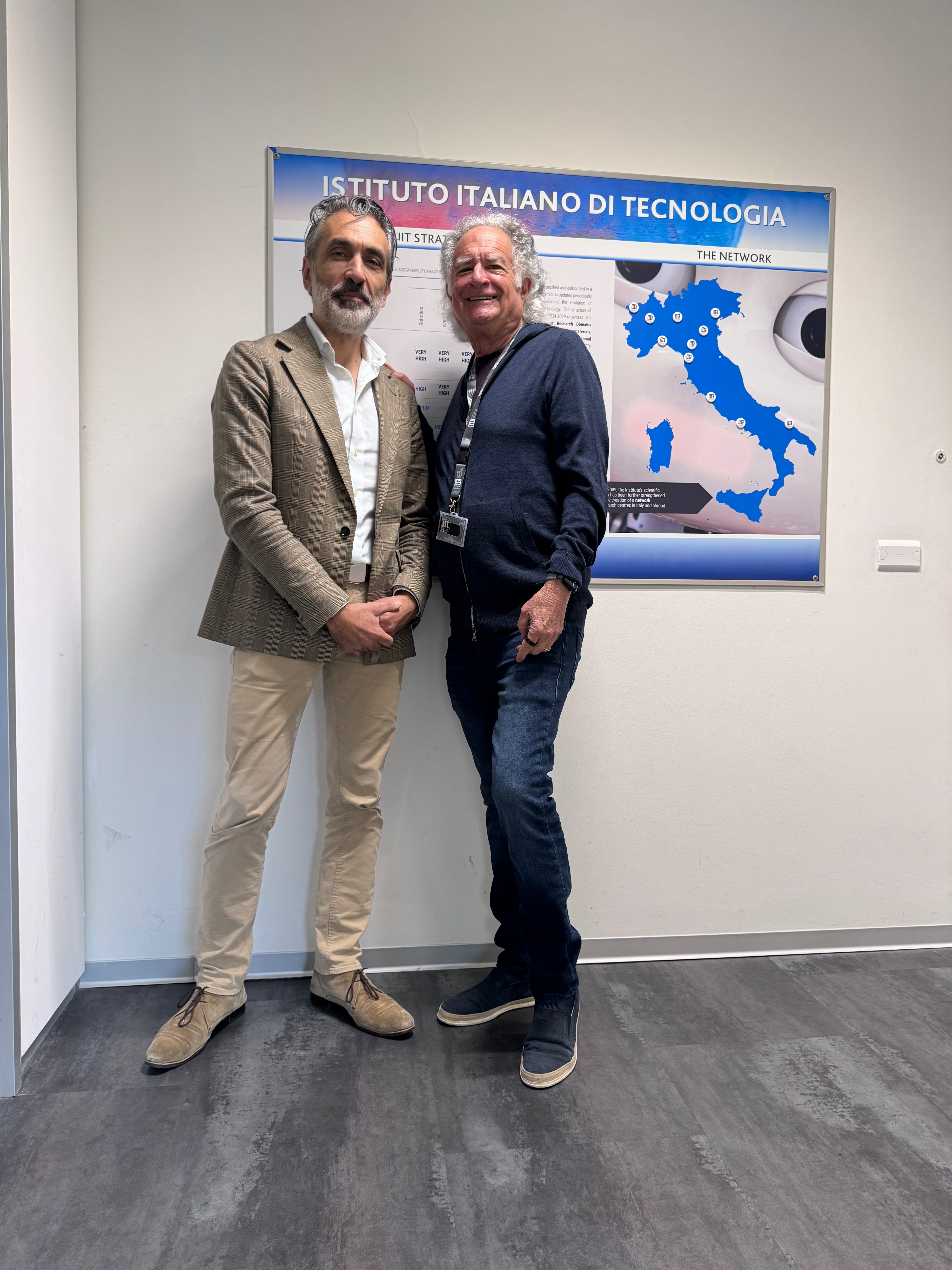
    Giorgio Metta, Science Director and Avram Miller

    I am thrilled that I have been appointed as a Fellow at the Italian Institute of Technology (www.iit.it). It is an incredible honor to work alongside the remarkable Giorgio Metta, the Science Director and his team to embracing the future. Exploring their projects promises to be both enlightening and enjoyable, with the exciting possibility of spending time with some of their fascinating robots.


    The Italian Institute of Technology (IIT) is a leading research center based in Genoa, with 15 locations throughout Italy and a community of more than 2,000 people, including scientists, engineers, and technical staff from around the world. It drives innovation through over 80 active research projects spanning robotics, neuroscience, materials science, and artificial intelligence. IIT’s mission is to advance knowledge and technology, transforming scientific discoveries into real-world solutions that foster sustainability, progress, and improved quality of life.

    (more…)
  • My first speech in 27 years

    I am working on my keynote address at the World Business Forum in November. I use to give many such speeches but the last one I gave was in 1998 when I shared the stage with Steve Jobs. Hard to imagine.

    I didn’t think I had a lot to say after I left Intel in 1999 so I stopped. What I set out to accomplish, the creation of residential high speed networks coupled to the Internet had happened. I no longer had much of an agenda. But AI has fired me up, I guess. So when I was asked to give this talk, I said yes because I now have a lot to say.

    (more…)
  • John Malone – The Master of Sub-Optimization


    I just finished John Malone’s 400-plus page account of his long and accomplished career. Whenever I read a memoir by someone I knew well earlier in my life, I admit I first search to see if my name is mentioned. Usually, it’s not. In my mind, I played an important role in their careers. They apparently thought otherwise.

    (more…)