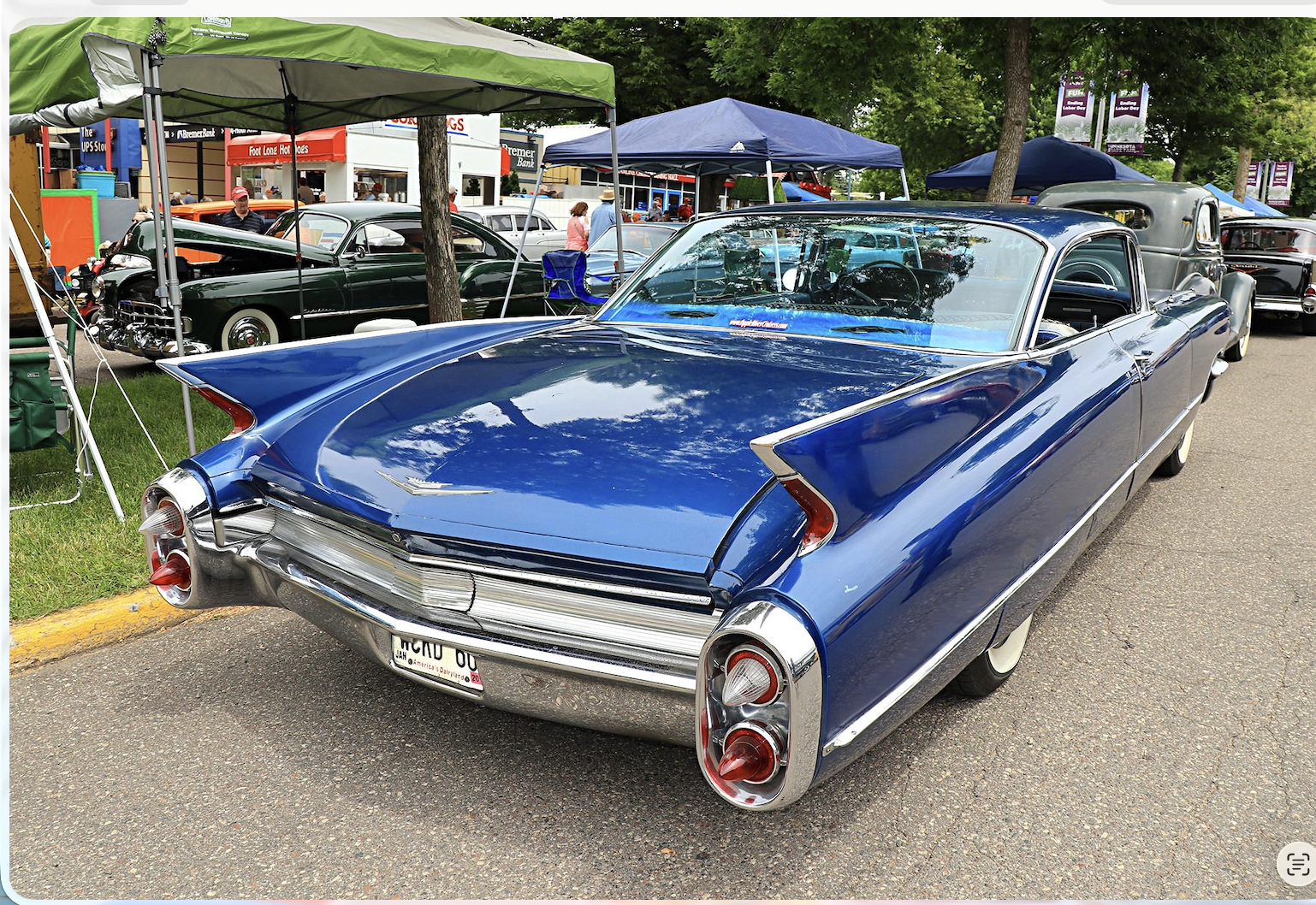
In the early days of the automobile industry, competition was driven by engineering. Faster engines, better suspensions, and more reliable cars won customers. But by the 1950s, something changed. America’s highway system had matured, and most cars were already fast enough for the roads people actually drove on. Competition shifted away from performance and toward design: tail fins, chrome trim, annual styling changes, larger bodies, and more luxurious interiors. The industry had moved from performance to fashion.
Watching Apple’s recent announcements, I found myself wondering whether the company is entering its own tail-fin era.
I am deeply embedded in the Apple ecosystem. I have a Mac mini, a MacBook Air, an iPad, an iPhone, an Apple TV, several HomePods, an Apple Watch, AirPods, and a dozen AirTags. There was a time when I would have been first in line to buy every new Apple product. Not anymore. I still use an iPhone 15, an older MacBook Air, and a previous generation of AirPods. The upgrades no longer feel compelling.
Even so, I used to look forward to Apple’s product announcements. They were often a glimpse into the future. This year’s event felt different. I found myself losing interest, and eventually I turned it off. The repeated promises that new features would “delight” users reminded me of something I witnessed nearly forty years ago at Intel.
The Wild Duck at Intel
In 1988, I made my first presentation to Intel’s Board of Directors. My role at Intel was to be a change agent. As Andy Grove would later say, “Avram was Intel’s wild duck.” That phrase eventually became the title of my book, The Flight of a Wild Duck.
At the time, Intel was focused almost entirely on microprocessors and the PC industry. I believed that networking would become just as important as computing itself. The network was no longer merely connecting computers. It was becoming the computer.
To explain my concern to the board, I used the same automobile analogy. Intel, I argued, was like an engine manufacturer, focused on making ever-faster processors while ignoring the emerging highway system that would connect them. I wondered what would have happened to the automobile industry if carmakers had taken a more proactive role in building the highway system itself. I believed Intel needed to establish a major position in networking, just as it had in microprocessors.
To do that, I proposed exploring significant acquisitions. One obvious candidate was Cisco. It had not yet gone public and had recently taken venture funding at a valuation of only about $10 million. Intel, by contrast, was worth roughly $5 billion. Cisco represented a rounding error against Intel’s value. Another possibility was 3Com, which had already gone public.
The board approved the strategy of looking for acquisition opportunities. But the acquisitions never happened. Andy Grove thought Cisco was too expensive and that 3Com had too many problems. He did not like anything I proposed. Later, other executives such as Frank Gill would try to get Intel into the networking business, but they were stopped by Andy.
So over the next decade, Intel repeatedly failed to establish a significant position in networking. History took a different path. Today, Cisco is worth roughly as much as Intel.
I have posted my book, The Flight of the Wild Duck for free on Substack. The chapter that deal with the network acquisition strategy can be found here.
An Uncomfortable Sense of Déjà Vu
Watching Apple today gives me that same uneasy feeling. The company seems increasingly focused on extending the success of its existing products rather than defining the next era of computing. Features such as Liquid Glass may improve the user experience, but they feel more like the automotive equivalent of new tail fins and chrome trim than a new engine.
Meanwhile, the industry is rapidly reorganizing around AI. Apple’s answer appears to be deeper integration of Siri into the operating system. Siri will gain access to applications, email, calendars, and other personal information. Those capabilities are useful, but they do not feel transformative. In fact, many of them can already be done today with tools such as Claude and other AI assistants. The difference is that Apple’s approach feels evolutionary, while the rest of the industry is experimenting with more radical possibilities.
The AI revolution may be today’s equivalent of the interstate highway system. It is changing the infrastructure on which the entire industry operates. The question is whether Apple is building the highways or decorating the cars.
Perhaps Apple is right. Its focus on privacy will prove important. The company has earned the benefit of the doubt more times than I can count. But I cannot shake the feeling that I have seen this movie before. When companies become dominant, they often focus on preserving today’s success rather than creating tomorrow’s opportunity. They optimize the existing franchise. They delight existing customers. Their strategy for the future is to preserve the present.
And sometimes, while they are busy polishing the tail fins, an entirely new highway system is being built around them.

Avram A very interesting perspective and hopefully not a revelation of Apples future. The analogy with motor vehicles may also have being the focus nohow do yo make vehicle that lasts only 20K miles and how do you market it. In the UK they used the term racing stripes. Tale fins make vehicles look like rockets and going into space was also was the big thing. V-8 engines had been perfected and attention to th rest of the mechanics of the vehicle like breaks efficiency was ignored. Marketing proposed make the wrapper look good but make the vehicles less expensive.
AI is another tool enabling leaps of productivity and creativity The Internet was another tool that enabled leaps in productivity in almost every organization. Every era of revolution, agriculture, industrial ,transport has unfortunately created job losses. This on maybe much worse but its speed of adoption and its ability to create Revenues may cause a revolution in how the fruits of productivity get distributed , buffering unemployment.
We see a step function in how wars will be fought and how many expensive weapons will over night become museum pieces.
Steve
>
LikeLike
The Internet is in the Absolute Advertising era …
LikeLike
Ah, yes! The 1959 Cadillac Coupe de Ville!
A group of us 16 year olds walked by one in the high school parking lot, and the Class Clown slapped the trunk and declared, “It sleeps six!” I still can’t see that car without hearing the laughter replay in my memory.
Moving on, I disagree that Apple is only tweaking more superficial “advancements.” I expect them to lean into AI that can be hosted on their devices, with most of the processing happening locally. As you stated, they already have privileged access to personal data, and they are one of the few companies that are trusted to protect reasonable levels of privacy, even if they move some processing to their own data centers. But where they seem to be going is vertical control from chip all the way to the top, all on their hardware. And Siri may become the most trusted form of OpenClaw-like personal agent. I wouldn’t count them out yet.
The real challenge may come from Johnny Ive and Sam Altman, who (last I heard) are claiming they’ll bring a new computing interface to market, presumably a pin or glasses with vision and audio built in. We’ll see.
We definitely live in interesting times.
PS – Smart move to open-source the Wild Duck; I hope you get broad readership. It’s a good read.
LikeLike