The Earth is heating up very quickly, and the things we needed to deal with climate change, we did not do. Governments have talked, held conferences, made commitments and set targets. Some progress has certainly been made. But not enough, not nearly enough.
In Paris in 2015, nearly every nation on Earth agreed to hold warming well below 2°C and try to limit it to 1.5°C. A decade later, the world is still heading toward roughly 2.5°C or more under current trajectories, and 2024 became the first calendar year to average more than 1.5°C above preindustrial temperatures. We must continue trying to reduce emissions. But we also need to confront an uncomfortable reality: a substantially hotter world is no longer a distant possibility. It is the world we now need to prepare for.
I wish I was wrong, but I think we need to begin with the assumption that the Earth is going to become a much more unfriendly place in which to live. Elon Musk wants humans to live on Mars. I fear we will find ourselves living on “Venus” instead.
Most of the climate discussion is still about how to stop the Earth from getting hotter. Of course we must continue trying. But since we cannot count on governments to solve this in time, we also need to ask a much more immediate question and one that can be answered on a personal basis:
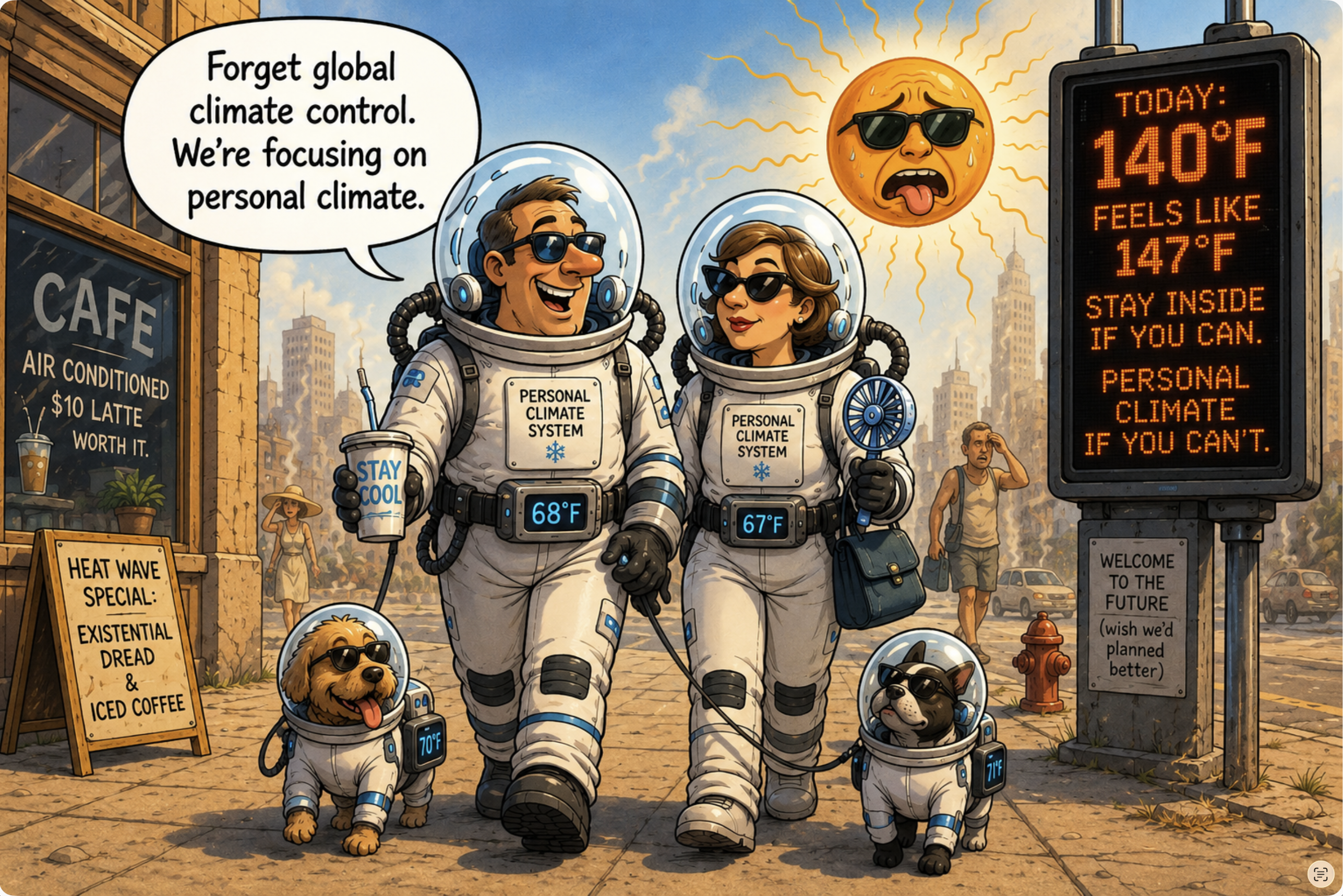
How are individual human beings going to live on a much hotter planet? My answer is something I call personal climate. Before explaining what I mean, consider the problem.
The Problem
Some countries will be relatively fortunate. Places that have always lived with extreme heat such as Dubai, Saudi Arabia, Israel already have air-conditioning, electrical systems designed around cooling, and a culture that considers air-conditioning essential rather than optional.
But much of the world was built for a climate that is disappearing. This is particularly a problem in Europe. Take the U.K. for instance. Fewer than 5% of British homes have air-conditioning. Now imagine that extreme heat becomes common rather than exceptional. Perhaps you can add an air conditioner to a house in the countryside. But think about London.
Only a small minority of London’s roughly four million homes have air-conditioning, and most of the city’s housing was built for a climate in which overheating was rarely a concern.In fact they homes were built to retain heat. Bringing conventional air-conditioning to 90 percent of those homes would cost tens of billions of pounds and, even with an aggressive national effort, could take 10 to 20 years, constrained not only by money but by skilled installers, planning rules, apartment buildings, historic façades, and an electrical grid never designed for nearly everyone to turn on air-conditioning at the same time. It would add several gigawatts of demand on the hottest days exactly when the grid is under the greatest stress. Extreme heat is arriving much faster than London could realistically air-condition itself. And what happens in the meantime?
I suspect cities are in much more trouble than they are willing to admit. We are already seeing cities create cooling centers where people can go during extreme heat. The focus is often on elderly people, who are among the most vulnerable. There is a strange analogy here.
Every new home in Israel has to include a protected space to help protect people against missiles and bombs. Perhaps cities in a hotter world will need the equivalent: heat shelters, not bomb shelters. But there is a problem. A missile attack may last minutes or hours. A heat wave can last a week. Perhaps eventually longer. You cannot put millions of people into cooling shelters for a week.
And this brings me to something I think is poorly understood about climate change. The average temperature is not the whole story. For an individual human being, what may matter much more is the sequence of extremely hot days and extremely hot nights. One hot afternoon is uncomfortable. Seven extremely hot days and nights in a row can be deadly.
The body does not recover. Buildings retain heat. Electrical systems are pushed toward failure. Elderly people become exhausted. People with cardiovascular disease and other medical conditions become increasingly vulnerable.
And nighttime may be particularly important. If the body never gets a chance to cool down, the physiological burden accumulates.
Humidity makes all of this worse. The body’s cooling system is sweat, and when the air is both hot and humid, sweating stops working. Scientists measure this as “wet-bulb” temperature, and beyond a certain point, even a healthy person sitting in the shade with a fan cannot survive. A fan does not help you when your sweat cannot evaporate.
So what do we do
The obvious answer is often air-conditioning. I don’t think that answer will be good enough for most people. Here is a very simple question that got me started thinking. Why do we cool an entire bedroom when all we really need to cool is the person sleeping in the bed? Think about how absurd our current system is.
A person lies in a bed occupying perhaps two square meters. To keep that person comfortable, we cool a large volume of air. We cool the walls. We cool the floor. We cool the ceiling. We cool the furniture. We cool empty corners of the room.
Why? Perhaps we should just cool the bed. Perhaps we need sheets that actively remove heat from the body. Perhaps mattresses should become intelligent thermal systems. Perhaps the bed should know my skin temperature, whether I am awake or asleep, whether I am entering deep sleep or REM sleep, and continuously adjust the microclimate around my body.
The objective would no longer be to keep the bedroom at 21 degrees. The objective would be to keep me at the right temperature. This is what I mean by personal climate.
And why stop with the bed? Clothing that keeps us cool. A chair that cools the person sitting in it. Cars that cool the occupants directly rather than first cooling a large volume of air. A small device worn on the body that makes a person comfortable in an environment that would otherwise be intolerable.
Of course, personal climate does not solve climate change.
But we cannot put an air conditioner around a wheat field
As temperatures rise, the effects on food may become as important as the direct effects on human beings. Crops have limits. Livestock have limits. Farm workers have limits. Water becomes more scarce precisely when agriculture may need more of it. A sequence of extremely hot days arriving at the wrong moment in a growing season can do enormous damage. This is one reason I do not see personal climate as an alternative to reducing global warming. It is a form of adaptation to a world in which we have already failed to prevent some very serious consequences.
And then there are the other living creatures that share our lives. What happens to our pets?
If I can wear a cooling device, what does my dog do during a week of extreme heat? Do we air-condition an entire apartment all day because a dog is sleeping in one room? Perhaps our pets will need personal climate too: cooled beds, intelligent mats, wearable systems and sensors that recognize heat stress before an animal is visibly in danger.
Once you begin thinking this way, the category becomes larger. Personal climate may not only be about keeping human beings comfortable. It may be about creating small, intelligent, energy-efficient survivable environments around living things in a world that is becoming increasingly hostile to them.
Existing Personal Climate Devices
When I began thinking about personal climate, I assumed I was mostly describing something that did not yet exist.
Then I started looking and what I found surprised me. Sony already makes a small device worn at the back of the neck that actively cools the person—the Reon Pocket. I ordered one. I have no idea whether it works. It may be useless. But that is not really why I ordered it. I ordered it because I wonder whether this primitive little device represents the beginning of something much bigger.
There are wrist-worn devices, like the Embr Wave, that create localized sensations of cooling or warmth. There are neck-worn systems that combine airflow with active thermal elements. There are cooling vests for workers and athletes. There are companies developing new materials and textiles intended to move heat away from the body.
And then there is the bed. This is perhaps the most developed example of personal climate already in the market. Companies such as Eight Sleep, Sleepme and BedJet sell systems that control the thermal environment immediately around the sleeper. They are already answering my question: why cool the bedroom when you can cool the person in the bed?
There are also companies and researchers working on heat-stress detection, biometric monitoring, cooling garments and portable systems intended to protect people in extreme heat.
The pieces are already appearing. But they are appearing in different industries and under different names.
Sony sees a consumer electronic device. A sleep company sees better sleep. A textile company sees cooling clothing. An industrial safety company sees heat stress. A medical device company sees heatstroke. A sensor company sees physiology. An AI company may eventually see prediction and control.
I see something else. I see a category. I believe personal climate represents a major investment and innovation opportunity.
This is familiar to me because I have seen things like this before. I have spent a significant part of my life identifing important technological changes before they became obvious. The biggest opportunities are often not in making an existing thing a little better. They appear when a new capability changes human behavior, creates new markets and makes possible companies that could not previously have existed. The largest opportunities often appear when an enormous change is inevitable, the existing solutions are inadequate, and the technologies needed to address the problem have not yet been assembled into an obvious industry. I think personal climate may be such an opportunity.
What interests me is not that there are already some products. It is that the products do not yet seem to understand that they belong to the same category. That is often what an emerging industry looks like before the industry has a name.
When I became deeply involved with the Internet, it was not a neat investment category containing a predictable set of companies. The pieces were scattered. Networking companies saw networks. Computer companies saw computers. Telephone companies saw communications. Media companies saw content. Semiconductor companies saw chips. The opportunity was in understanding that these apparently separate things were converging into something much larger.
I wonder whether we are at a similar moment with personal climate. The technologies are fragmented today because the market category has not yet been recognized. That is precisely when I become interested.
If everyone already agrees on the name of a new industry, publishes market maps of it and creates venture funds dedicated to it, much of the early opportunity may already be gone.
My Challenge to Entrepreneurs.
Do not build another neck fan. Do not begin by asking how to make a slightly better air conditioner. Begin with the human being. What does the body actually need? Where does heat need to be removed? How much of the body needs to be cooled to create comfort? Can a person sleep safely in a 30-degree room if the microclimate around the body is controlled? Can clothing maintain a survivable personal environment outdoors? Can we protect an 85-year-old person during a five-day heat wave without cooling an entire house? These seem to me like startup questions.
I would look for companies developing thermally active clothing. Intelligent cooling beds. Personal radiant systems. Cooling chairs. New materials that move heat away from the body. Wearable devices that cool particular parts of the body. Sensors that detect heat stress before a person becomes aware of it. AI systems that learn the thermal needs of an individual.
I would look at architecture designed around cooling people rather than rooms. Localized climate systems for elderly people. Systems for workers who must remain outside as temperatures rise. Personal climate for schools that cannot afford to air-condition entire buildings. Low-energy systems for the billions of people who may never have access to conventional whole-house air-conditioning. The intersection of personal climate and sleep.
I would also look at personal climate for animals: cooled beds and heat-stress sensing for pets, and localized systems that protect livestock without trying to cool an entire barn. And I would look at biology. Could we develop drugs that make human beings more capable of tolerating extreme heat? I have seen remarkably little discussion of this.
We use drugs to change blood pressure, heart rate, metabolism, inflammation and sleep. Could we increase the body’s resilience to heat? Could we improve thermoregulation? Could we protect vulnerable organs during sustained heat stress? Perhaps this is biologically impossible. Perhaps it is a terrible idea. But where is the research? I would also look very seriously at the combination of personal climate, sensors and artificial intelligence.
An 81-year-old person is not a 25-year-old person. A person with cardiovascular disease is not the same as a healthy athlete. One person is taking a beta blocker. Another is dehydrated. Another has been exposed to extreme heat for three consecutive days. Another slept badly the night before.
Why should all of these people experience the same climate system? Imagine a personal climate system that knows you. It monitors your skin temperature, heart rate, activity, hydration and sleep. It knows your age. It understands how your body responds to heat. It sees danger developing before you feel it.
Your bed manages your temperature while you sleep. Your bathroom adjusts temperature and humidity when you wake up. Your clothing helps remove heat when you go outside. Your chair cools you while you work. Your car recognizes that you are overheating. Your wearable device changes what it is doing because your physiology is changing. Your personal climate follows you through the day. This is not science fiction. Most of the underlying pieces already exist in primitive form. What does not yet exist is the category. And categories matter.
Before the personal computer, there were computers. Before the smartphone, there were mobile phones. Before the Internet became an industry, there were networks.
Sometimes the opportunity is not the invention of a single technology. It is recognizing that a collection of technologies is about to come together around a new human need.
I think that may be happening here.
An enormous energy argument
As the Earth becomes hotter, billions of people will want air-conditioning. Of course they will. But if billions of people respond to global warming by installing conventional air-conditioning, the demand for electricity will be staggering. It there is a vicious circle. The hotter the world becomes, the more energy we need for cooling. The more cooling we install, the greater the strain on electrical systems. And when electrical systems fail during extreme heat, that is precisely when people are most likely to die.
Many of the hottest places on Earth have one great advantage: sunlight. The sun that creates the need for cooling can also provide the power for cooling. This combination abundant solar energy and rapidly increasing demand for cooling will be enormously important. I would rather live in Dubai than London as the earth heats.
What exactly are we trying to cool: A major investment and innovation opportunity
What exactly are we trying to cool? A house? An apartment building? An office? A city? Or a person?
I am 81 years old. I am not going to spend the next 50 years building companies around personal climate. But if I were 30, I would be thinking very seriously about it.
If I were still a venture capitalist, I would not wait for a neat category called “personal climate” to appear in a market map. By then, the most interesting companies may already have been built.
The company that becomes important in personal climate may currently describe itself as a textile company, a sleep company, a medical device company, a wearable company, a materials company or an AI company. The investment opportunity may be seeing the connection before everyone else does. Most likely the companies that win in this space have yet to be started.
I have spent much of my life looking for those connections. Perhaps personal climate is one of them. I have had the experience of looking at something before it became obvious and realizing that the world was going to change. I have that feeling again.
We carry our computing with us. We carry our communications with us. We increasingly carry sensors that monitor our health. Perhaps, in the future, we will carry our climate with us as well. I think we are going to need it.
