Two Thirds Done

Thoughts and experiences of an eighty one year old Wild Duck.

Avram Miller by the sea
EN | IT

587 posts since 2006

Category: Friends remembered

  • Goodbye Mark Stephens AKA Bob Cringely

    My friend Mark Stephens died last Saturday. Most of the world knew him as Robert X. Cringely. I knew him as the neighbor who stood with me on garage roofs in Sonoma County, pointing dish antennas at distant ridge tops in 2020, because it was not possible to get a broadband internet connection at my location. That is how we became friends, more than 25 years ago.  We managed to use directional wifi and created a link to someone that had broadband several miles from my home.  

    Mark was creative, technically competent and a dreamer.  He was a gifted writer and storyteller. One of the few historians of his time to track the development of the computer industry. Sometimes we would dream together.  He and his family lived close to our home in Sonoma for many years.  He had an amazing family including a wonderful wife, MaryAlyce.   Eventually they moved back to South Carolina where is wife had family.  With all his moving and all my moving, we did not communicate often but we meant a lot to each other.

    When I published my memoir, I asked Mark to write the foreword. He ended it this way: “I believe I know Avram well enough to love the guy.” I want to say the same about him. I wish I could have been near him towards the end of his life so I could have held him and told him what a special person he was.

    Below you will find, his obituary, the forward he did for my book, The Flight of a Wild Duck and finally a long interview he did with me for a series on nation television in 2014.  It is my favorite interview.  

    Obituary of Mark Stephens

    https://www.hillandwood.com/obituaries/Mark-Stephens?obId=49806651

    FOREWORD to the Flight of a Wild Duck

    Though our careers in Silicon Valley overlapped by a dozen years, I didn’t meet Avram Miller until shortly after his retirement from Intel in 1999. We were neighbors in the rural Wine Country of Sonoma County, sharing the struggle of using long-distance Wi-Fi as the only alternative to crappy telephone dial-up Internet. We literally goto know each other on garage roofs aiming dish antennas at distant ridge-tops.

    Over the subsequent 20 years I came to know Avram, his children and grandchildren, his wife and ex-wife, even Avram’s father, who died a bit more than a year ago. I know most of the people mentioned in this book and I believe I know Avram well enough to love the guy.

    Avram is known for his intellect and specifically for his rare habit of asking the question Why? Why do we do things the way we do rather than some other way? In Silicon Valley the operant question for most people is How? not Why? But why is more powerful than how. How is by nature evolutionary while why is revolutionary. The other big proponent of asking why in Silicon Valley was Apple co-founder Steve Jobs, which pretty much makes the point of how important why can be.

    Dave House, one of Intel’s most senior executives—a noted asker of How? who worked with Avram at Intel before moving on to become CEO of Bay Networks, an important networking company—once told me at a Computer History Museum event that Avram was crazy “but also the smartest man I ever met.”

    Avram Miller co-founded Intel Capital and, by doing so, brought the chip giant into businesses that Intel founders Bob Noyce and Gordon Moore would never have considered on their own. Avram used Intel money to literally create home broadband Internet, even though Intel was not intrinsically a networking company. But the why for Intel and broadband was obvious to Avram if a mystery to those others.

    Home broadband drove demand for faster and more powerful processors in home computers, directly driving Intel’s growth and changing both the Internet and the world in the process. Avram Miller did that.

    The best part about this book you are about to read is its modesty. It’s the story of an inquiring mind finding its way in the world from very modest beginnings and almost no expectations. Avram’s lifestory is one of choices. Did he want to become a rabbi or a jazz piano player? Did he want to be a neuroscientist or a computer pioneer? All paths were open for Avram because of his ability and his creativity. The world is a better place for the choices he made. Young Avram once rented the space under a baby grand piano for a place to sleep. That’s a modest beginning and yet charming, like Avram, gaining him not only a place to live but also an instrument to play.

    Imagine how far he might have gone had Avram been able to afford to live under a concert grand?

    —Robert X. Cringely, host of the PBS TV series Triumph of the Nerds, and author of Accidental Empires: How the Boys of Silicon Valley Make Their Millions, Battle Foreign Competition, and Still Can’t Get a Date

    Mark interviews me

  • Geoffrey Wells (June 9,1945-July 26, 2024)

    The friends that I made when I was young are slowly dying.  We are no longer at the stage where people will say, “he died so young.” Even though I understand that death is what follows life, it remains a bit uncomprehensible 

    It was 1966 when Geoff and I first met. He was a bit younger than me, so we were 21.  Returning from Europe, where I had been living for the last year, I signed on to be a tutor in a new program at The College of San Mateo (San Francisco peninsula) called the College Readiness Program.  It was started by a fantastic woman, Jean Wirth.   Our mission was to tutor predominantly African American kids living in East Palo Alto who had been admitted to schools such as the University of California at Berkeley.  You can read about this fantastic program here. Also, here.

    Geoff was also a tutor. He was attending the University of California Berkeley, ) and was living that summer with his mother, her husband (Geoff’s father had died when he was a young child), two brothers, and a sister.  They lived in the wealthy town of Woodside.  The famous childhood actress Shirley Temple lived next door, and I would sometimes see her when I visited with Goeff.  

    After the summer, Geoff moved back to Berkeley.  His girlfriend, Stephanie, was 18, studying art.  I moved to San Francisco and began my career in medical science at the University of California Medical School in San Francisco.  I often spent my weekends with Geoff and Steph at their place in Berkeley. It was the time of the hippies, the summer of love.  We were not hippies, although I had played a role in the early stages of that movement in 1964-65.  We did smoke a lot of dope.  I remember Geoff and Steph’s wedding which took place on a small lake adjacent to his mother’s home in Sonoma. Many years later, moved to Sonoma myself. The last time I visited that home, was in 2015.

    The Anti-War Movement (Vietnam War) played a big role in our lives.  I had been given a 4-F status because of health issues, but Geoff was called. Rather than serve in a war he did not support, he and Steph fled the country and ended up in Paris.  We reconnected in 1969 when I stopped to see him on my way to my new position at the Medical School, Erasmus University Rotterdam.   There, I married Arianne, and soon after, Adin was born.

    Eventually, Geoff and Steph moved to Canada, where they had their daughter, Phoebe, and a son, Jason.  Arianne and our three children lived in Israel but moved to Boston in 1979.  I visited them in Canada, and once, Steph and her kids came to see us in Boston.  

    His daughter, Phoebe, moved to Sonoma, where Geoff’s mom had moved. I connected with the family and saw Geoff occasionally, but we had moved apart.  Our circumstances had become very different.  I moved to Sonoma with Deborah (my second wife) many years later. Eventually, Phoebe went to work for us as our assistant.  But I always felt she was family.  Geoff and Steph eventually broke up, but I also connected with her.  She would visit Sonoma from time to time. Her family lived there as well. She lived in Canada, where she still lives.

    Geoff moved to Hawaii.  He was not in good health, suffering from COPD and having to use oxygen.    We continued to communicate infrequently.  In his last message, a year ago, he referred to the political issues of the 60s and how it seemed we were back there again.

    Rest in peace, my dear friend. You will be missed by many.

  • My buddy is dead: Ed Story!

    Two days ago, I received a short email from my friend Ed Story’s wife, Joey. I had to reread it again and again. My dear friend, Ed, passed away unexpectedly. I was stunned. Ed had just turned 80, just 14 months older than me.He was the epitome of life, full of energy, curiosity, compassion, and thoughtfulness. I thought to myself, my buddy is dead. While I am fortunate to have many friends, Ed was my only buddy.

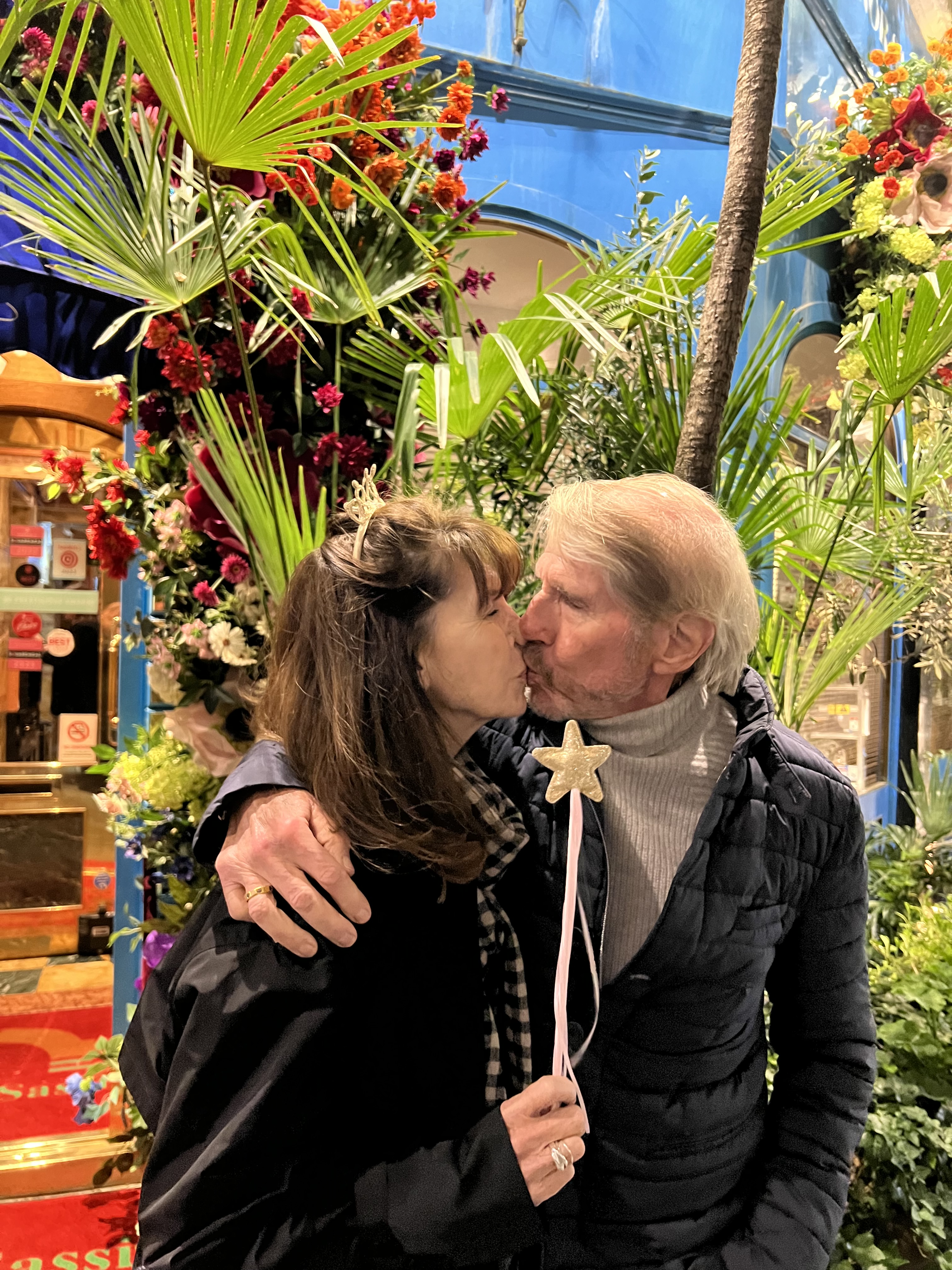
    Joey and Deborah have their birthdays in early Oct. Most years, we would arrange for the four us to be together to celebrate the birthdays. This photo was from the the last time, just over two months ago, in London. 

    We met in October 2006 at the Four Seasons tented camp in Chiang Rai, Thailand, in an area called the Golden Triangle, where Thailand, Myanmar, and Laos converge on the Mekong River. An area known for being the leading producer of opium in the past. 

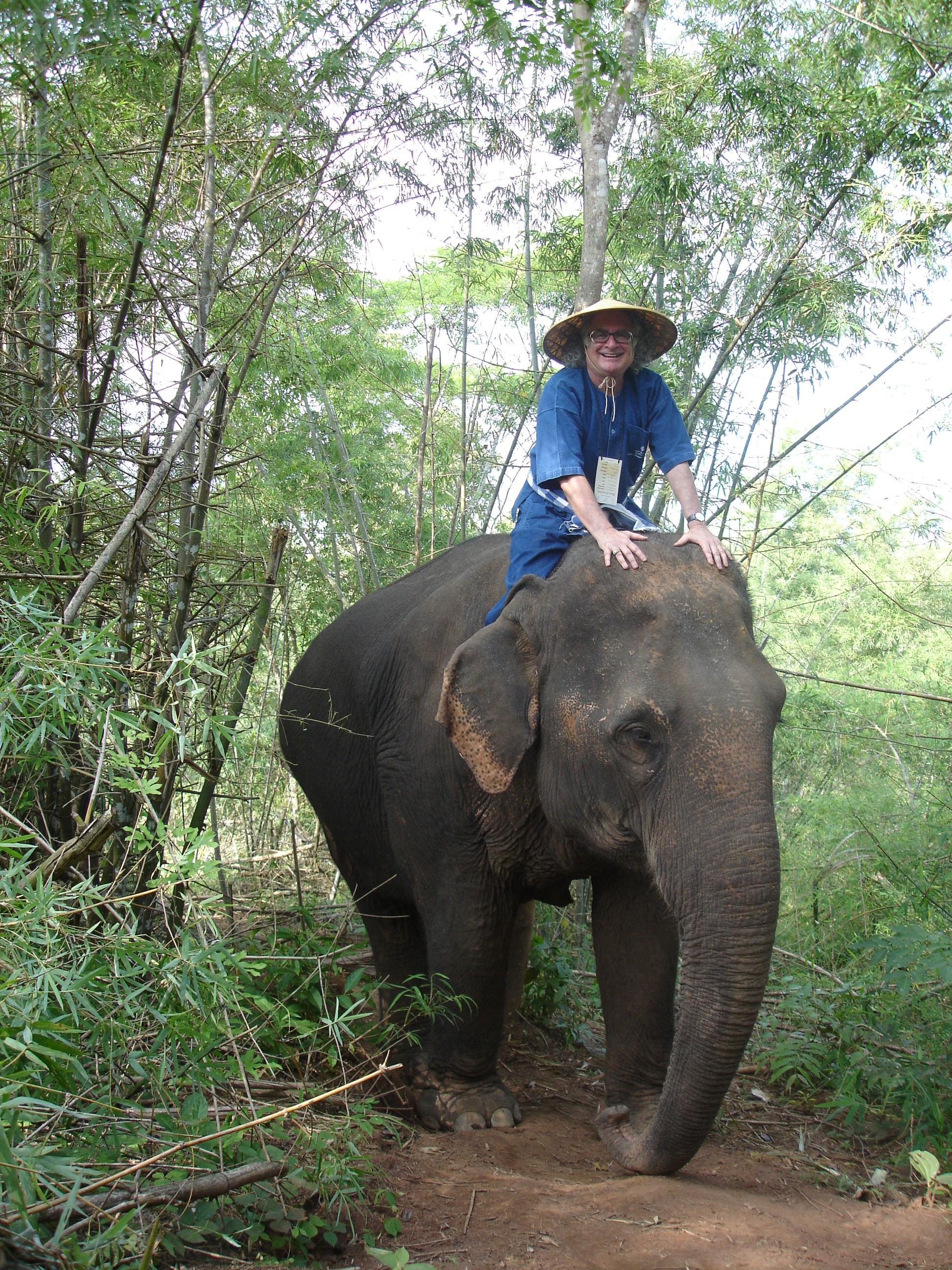
    It was my wife, Deborah’s first trip to Thailand (one of many to come), and she had read that the Four Seasons had a camp where learning to ride elephants was possible. Not to ride them on some platform but by yourself, bareback, sitting on the neck of the elephant with nothing to hold on to and just balancing and giving instructions to the elephant in the Thai language. We found ourselves at this camp. We were “glamping,” but this term did not come into fashion until a few years later. 

    There were fifteen tents, but I don’t think there were that many people there. I can only remember meeting Ed and his fantastic wife, Joey. We met them at a cocktail party given by the General Manager, Jason Friedman, who was very close friends of the Storys and became our friend as well.  

    Deborah and I noticed Ed’s clothes. He was wearing a crisp white deconstructed shirt that looked not only stylish but, I knew, expensive. We were standing beside them, cocktails in hand, when Deborah looked at Ed’s shirt and said, “That looks like something you would buy at the Library in London.” The Library is a small boutique in South Kensington, London, where I shopped regularly. Ed overheard Deb’s remarks and said that is where he bought the shirt. It turns out that both Ed and I periodically bought clothes as we were both frequent travelers to London.  

    Ed was the CEO of a small Oil development company whose primary business was in Vietnam. Since the company’s headquarters was in London and it was listed on the London Stock Exchange,  Ed and Joey had an apartment there. But they often stayed in Thailand and Vietnam. We sometimes joined them. Ed was able to speak Thai as he had spent much time in Asia starting in the 60s. He had the most amazing stories of his experiences in South Asia. He was also involved in Mongolia. Ed and Joey owned a penthouse in the capital city, Ulaanbaatar. He became the Honorary Consular of Mongolia in the USA. A Mongolian flag flew in front of his office in Comfort, Texas. I don’t know if it is still there.

    I so wish that Ed had written a book about his life experiences. I am sure I only know a fraction of the stories. Ed was a great storyteller.   You can read many of his stories here.

    Something clicked between the four of us, and we became fast friends. Life is random. Had we not decided to go to the Tented Camp on those days, we would never have met Ed and Joey. But once we met them, we knew they would be in our lives forever. The following year, they visited with us at our home in Sonoma. Then, we visited them at their home in Hill Country, Texas. Over the years, we traveled with them to Bhutan, Thailand, Vietnam, Italy, Greece, Morocco, many places in the USA, Estonia, Finland, Norway, and other places I have probably forgotten.

    In some sense, Ed and I grew old together. We were still relatively young when we first met (61 and 62), Ed had recently turned 80 and I will be 79 next month but Ed and I had the kind of friendship you typically develop when you are growing up. That is why I call him my buddy. I don’t think I will ever have another. We were so different. He was a child of the South, an “oil man” from Texas, although liberal in his social and political views. I was Jewish kid from San Francisco, who had a successful career in technology. We rarely discussed business. 

    Ed and Joey had a large ranch in Hill Country, Texas. I remember walking with him on the property. He carried a rifle. Evidently, there were mountain lions roaming about.

    Ed talking about Elephant Polol as a way to protect the elephants

    The Four Seasons Elephant Camp raised money for Elephant rescue. The elephants were not abused. It was just the opposite. The local villagers who took care of them were also treated very well. Ed went on to create unique ways to fund the sustainability of elephants in Thailand. He organized Elephant Polo Tournaments to get sponsorships for the elephants and created a store to sell actual elephant-related products called “The Elephant Story.”

    Ed actively supported the Cleveland Clinic after that institute saved Joey’s life. He was the head of the “International Leadership Board.” Ed invited me to attend many of their yearly meetings. Deborah and Joey would also participate. I started advising the Cleveland Clinic, a relationship that continues.  

    Like so many, I will miss Ed, especially his laugh. But part of Ed still lives in my mind and my heart. Not only in memories of the past but now and in the future, for Ed Story became part of who I am, and a part of him will continue to live within me. And in some way, the four of us, Ed, Joey, Deborah, and I will continue our friendship. . 

    Working on this blog post brought me joy which over came the sadness of losing Ed as I relived so many memories

    Ed, buddies forever! 

  • The Andy Grove I knew

    Yesterday, Andy Grove died. Frankly, I am still processing that.  I first met Andy in 1982 at the PC Forum.  Andy was 46 and I was 37.  The next time I met him was in 1984 when I was interviewing for a position at Intel. I would be reporting to Les Vadasz, who, like Andy, was a Jewish Hungarian refugee.  I interviewed with both Gordon Moore and Andy Grove, to whom, Les reported. I must have done something right that day, because, during the interview, Andy picked up the phone and told Les that he should hire me. I can’t say that I had many other days like during the times I worked with Andy.  He and I  had a kind of rocky relationship over the fifteen years that I worked at Intel.  I learned a great deal from Andy.  Sadly, I don’t think the opposite was true.  Andy never really got me, but on the other hand, was very supportive and respectful in his own way.  When I thought about leaving Intel out of frustration about three years after joining, Andy talked me into staying.  I will never forget him telling me that I should stay “because we accept you.”  I think he meant that while I was weird, that was ok because I shared many common values with Andy and Intel including the ability to get things done.  When Les proposed that I be made a Corporate Vice President (one of just 33 officers), Andy supported Les and sure enough, I became an officer of one of the most successful companies in the world. 

    I felt that Intel and in particular, Andy, was too insular and I tried to introduce Andy to people from other industries. I was able to get him to join me at the Allen&Co conferences in Sun Valley.  He loved going, I think.  But then when I brought Steven Spielberg to visit Intel and asked him to join the meeting, he called me a “star fucker.”  I got to bust him later when I saw a photo that was taken that day with Andy and Spielberg, taped to the refrigerator in the kitchen of his home. Over the years, I did see that Andy became more outgoing and more subtle.  But I was often frustrated, I guess with myself because I did not have the impact on this thinking that I wanted.  In particular, I failed to get him to understand the Internet was not just a way of connecting PCs together. 

    Once, I sent him a memo calling him the Mick Jagger of Technology.  I said that he, like an aging rock star, just wanted to make today last.  But that incidentally also demonstrated something special about Andy.  He could dish it out (and oh how he could dish it out) but he could also take it. I probably went up a notch in his thinking because of that email although I am sure he did not take is the message to heart.

    Andy was there for me when I got Prostate Cancer. He was in the class a year ahead of me. He was very concerned about my health.  But in the typical Andy fashion, he became fanatic about his diet and expected me to eat the same way.  I ended up hiding out in the cafeteria when I eat cottage cheese.

    Andy stepped down as CEO in 1998 but stayed Chair of the Board for a while. I left Intel in 1999.  I didn’t see him very often.  Les Vadasz stayed close to him and through Les and other friends, I learned about Andy’s Parkinson disease. It really upset me to think that Andy would be robbed of his health during the years when he could have turned his talents to other pursuits.  Of course, he did his best during those difficult years but how painful it must have been for him both physically and mentally and how sad and difficult for his wife, Eva.   Andy taught me one more lesson which is the importance of moving on. 

    The last time I saw Andy was in 2013 at the 45th anniversary of Intel. He was there with his wonderful wife, Eve.  I went up to him and said, “give me a fucking hug”.  He did and I am very glad that was my last experience of Andy.

  • Life Blues: My reaction to Outlaw Blues by Jonathan Taplin

    “Outlaw Blues is a story of the American counter-culture — the artists who created an American Avant-garde that pushed the culture forward into what we now call modernity. Though much of the book is centered on a group of musicians and filmmakers that Taplin worked with from 1965-1995, it is also the story of the roots of that era. The book examines rebel artists of America’s past — H.D. Thoreau, Mark Twain, Louis Armstrong, Orson Welles, Billie Holiday, Allen Ginsberg — the “mad ones” who made us who we are as a culture”.  From the book launch at the Annenberg Innovation Lab, Oct. 11, 2011

    Just finished reading the Outlaw Blues by Jonathan TapIin. I recently reconnected with Jonathan, an amazing man and the director of the Anneberg Innovation Lab at USC.  We probably had not seen each other for over tweleve years. We found each other on Facebook.  Since I am now living in LA part of the year, I reached out to him and he invited me to meet him at his lab. I also found out that he had written a book called, Outlaw-Blues last year.  The book had a powerful effect on me which I will explain later. It is an experimental e-book that I bought on iTunes and read on my iPad.  Actually, I expected more from the “experimental” part than just short embedded videos even thought they were very effective. Outlaw Blues is the name of a Bob Dylan’s song and also a movie staring Peter Fonda.

    This post is not a book review but I will say a few things about the book.  First of all, I strongly recommend it to anyone that is interested in the history of popular music and in particular, Bob Dylan, the Beatles, and the Rolling Stones and/or the history of independent  film makers like  Martin Scorsese  (Taplin produced his first film, Mean Streets).  Or if you are interested in people like Jonathan that have found their own unconventional way  through life and has impacted the development of today’s media industry. The book is a combination Jonathan’s recollections and experience  from the mid 60s to the end of the 90s.  Intersperse are stories of key figures that had profound effects on the evolution of media and culture.

    I first meet Jonathan in 1997 or 1998, I think.  In 1996, Intel and Creative Artist Agency created a lab to educate talent about the coming possibilities of broadband residential Internet and personal computers to create a new medium.  I  drove this project from the Intel side after meeting with Michael Ovtiz who was the founder and principle owner of CAA.  I knew that we were creating a new medium that would effect every aspect of our lives from commerce and education to communications and entertainment.  In my position as Vice President of Business Development,  and my additional  role as “Czar” of Intel’s broadband development activities and a leading investor in early stage companies dealing with the consumer market. I wanted to accelerate the development of these “applications”.  I was particularly concerned with how entertainment content would finds its way to this new world.  I was pretty sure that the folks in Silcon Valley would not be able to create compelling and entertaining content with the exception of computer games.  So I thought, lets get the people that make todays entertainment excited about the opportunity.  We set up the lab  within CAA with state of the art computing technology. CAA’s clients and others would come by the lab for demonstrations.  They key person on my side was Sriram Viswanathan.  In addition, we decided to invest in early stage companies dealing with entertainment and to do this together with CAA.  This activity was lead by Matthew Cowan from the Intel side and Hassan Miah from the CCA side.    We had some hits like Launch Media which was founded by Dave Goldberg. Launch was selling enhanced  CD’s.  I required that they move to the Internet as part of our investment.    Launch was eventually sold to Yahoo where Dave ran the Yahoo music business.  Lucky for him, he meet Sheryl Sandberg, the COO of Facebook , soon to be one of the richest women in the world….and a lovely person by the  way.  We also invested in Mark Cuban’s  Broadcast.com which went public and then was bought by Yahoo for more than five billion dollars. Of course they were not all successful and we invested in some duds like American Cybercast.

    During this period we learned of Intertainer, founded by Jonathan Taplin.  While I was aware that Jonathan had a background as a movie producer, I did not know anything about his extensive history in the music industry.  Intertainer  was one of the first companies to make deals with the movie industry and provide download-able movies.  Remember this was 1997/98. There were not that many consumers that had broadband in their homes. Intertainer did very well until the movie industry, lead by Sony, created an alternative called Movielink.  The result was that  studios cut off access to movies by Intertainer; bringing that company to its knees.  Intertainer sued a number of companies for Anti-Trust Violations in 2002.  In 2006, the suits were settled out of court.

    As I began to read the book, I was shocked to learn that Jonathan and I had a lot of overlap in our early days.  Jonathan, at 65 is two years younger than I am.  He grew up, went to school and lived  on the East Coast during the 60s.  If he had been living in San Francisco, we would have surely known each other.  Jonathan became Bob Dylan’s road manager.  In the early 60s, I was surrounded by the San Francisco music scene but in a very peripheral way. Bob Dylan showed up sometimes at the Blue Unicorn where I hung out.   I met Janis Joplin  while she was rehearsing with the Big Brother and Holding Company (she was not a very nice person I thought but when she sang it would bring tears to my eyes).   I hung out at the home of the Jefferson Airplane and went to a few parties at Gerry Garcia’s home.  But I was not into rock. I had studied classical music, composition and arranging.  I preferred Jazz (and life long addition) and so I spent my time listening to Jazz players when they came to San Francisco.   My engagement with first the “beatniks” and later the “hippies” was more extensive.  I would listen to Allen Gingsburg read poetry in North Beach even though I was just a kid.  I spent lots of time at the  City Lights Book Store.   Later, I became  friendly with Allen and was invited to his apartment a few times.  Outlaw Blues deals a lot with these people. I was also drawn to Jewish Mysticism and was for a while a follower of Shlomo Carelbach and very politically active in the anti war and civil rights movements.

    In reading Outlaw Blues, I realized how easily my life could have gone in a different direction.  Maybe, if I liked the music better, I would have become part of the rock music scene. My management and leadership skills might have taken me on a path similar to Jonathan and eventually my creative side might have emerged as it did for him.  I had a similar experience reading Holy Beggars by  Aryae Coopersmith  whom I recently met.  In reading Aryae’s book, I realized that I could have easily continued to explore the spiritual side of myself and may have ended up in Israel as a Rabbi. But I fell in love with technology. By 1966, I was working at the Langley Porter Institute, UCSF Medical School, designing equipment for brainwave bio feedback.  From that point on, I had a continuing connection to technology.  Now I am back to studying music.  Jonathan is a Professor at USC.

    At this point in my life, it is interesting to speculate on  the different paths I could have taken.  Life is so strange and random… or is it?

    Some relevant links:
    Outlaw Blues, the song  
    Outlaw Blues, the film 

    WSJ  on the book  
    Jonathan Taplin 
    Allen Ginsberg
    Michael Ovitz   
    Dave Goldberg

    Mark Cuban
    Broadcast.com 
    Intel/CAA Media Lab

    Holly Beggars   

    Shlomo Carlebach 

  • Goodbye Roy Moffa

    I was just looking for some old and important contacts and discovered that the man that gave me my first major chance in the computer industry had died recently (see).  I wanted  to remember him here and tell the story about how Roy opened the door to my future.

    In 1979, my wife and I decided that we needed to leave Israel where we had been for the last five years.  While we had a pretty comfortable life materially,  there were a lot of emotional issues that I will not go into here.  At that time, I was running a division of a medical electronics company called MG Electronics, located in Rehovot and also was an officer of the parent company, Mennen Greatbach of Clarence New York.  My specialty was the use of computer in real time applications in cardiology (CCU monitoring, Catherization Lab).  I also had an appointment as adjunct associate professor at the School of Medicine, Tel  Aviv University.  I felt that I was overly specialized and wanted to either focus on medicine or on computers.  If I was going to focus on medicine, I was going to go back to Holland where I had been living and was the country of my wife and where my sons had been born.  But if I was going to work in the computer industry, I was going to go  back to the USA. By the way, at that time my children spoke only Dutch and Hebrew  and my wife had never lived in the USA.

    Having a long standing relationship with Digital Equipment Company (the second largest computer company in the world at that time),  I used my contacts there to get interviews with several groups.  Some of the groups where in marketing but one group was part of central engineering.  This group  run by Dick Clayton (whom I knew) was responsible for a major part of the central engineering organization lead by Gordon Bell (now with Microsoft).  One of the key people within Clayton’s organization was Roy Moffa.  We hit it off pretty good.  I decided that it was Roy’s dept. where I wanted to work.  I knew to be successful at Digital I had to prove that I was a great engineer (of course I never studied engineering).  I spent a few days with Roy and his group. My wife had come with me for this week of interviews at Digital and she and I had dinner at Roy’s house and meet his wife.   And before I knew it, it was Friday late afternoon and Roy and I were going to meet at the bar of a restaurant in Maynard MA (where Digital had its headquarters). I fully expected to have Roy offer me a job.  But instead he told me, he could not offer me a job although he really wanted to and though I could make major contributions to his group.  But he wanted the other managers in his group to agree and one of them did not.  This man whose initial’s were JC  said he did not feel I would fit in to the group.  I told Roy that this was a  bad decision and that it was important for digital and important for me to join.  I asked him if I could speak with JC.  He said yes.  I called JC and asked him to meet me at the bar.  I then told him that I thought this was a mistake and asked him to reconsider his position.  He backed down and said he was ok with my joining.  About six months later, Roy moved to a new position starting up Digitals semi conductor business.   I got a new boss, Herb Shanzer.  Herb reorganized things and JC ended up working for me.  I fired him soon after.

    While I did not work with Roy long, we stayed friends.  I will always be grateful for the opportunity he  gave me even if I had to take matters into my own hands a bit.