Two Thirds Done

Thoughts and experiences of an eighty one year old Wild Duck.

Avram Miller by the sea
EN | IT

587 posts since 2006

Category: Making a difference

These are organization that I support and are making a difference.

  • It Will Take Innovation, Not Debt, to Save Italy

    In my recent post, “The Next War Will Be Like No Other,” I wrote about the growing tension between generations. As populations age, younger people are being asked to support more older people, while also inheriting the debts accumulated by their predecessors.

    That tension becomes especially difficult when economic growth is weak. Governments face demands to protect pensions, improve public services and preserve living standards. Borrowing offers a politically convenient way to postpone difficult choices. But postponing a problem will likely make it more difficult to solve.

    I moved to Italy in February 2025, and it is now my home. In this post I want to explain the economic challenge Italy faces as I see it, suggest some ways forward and describe the part I hope to play.

    Government debt must be measured against the economy’s ability to support it

    Debt per person tells us something about the scale of public obligations. Adjusting it for inflation helps distinguish a real increase from the declining purchasing power of money. But debt relative to GDP adds an essential perspective: how large are those obligations compared with the income the economy generates?

    The first graph shows how inflation-adjusted debt per person has changed. The second shows the debt burden relative to annual economic output.

    Line graph showing government debt per person from 2005 to 2025, highlighting growth for USA, France, Italy, and Israel. USA shows a 145.2% increase, followed by France at 93.0%, Italy at 33.7%, and Israel at 14.5%.

    Figure 1. Real government debt per person, percentage change since 2005. Cumulative change 2005–2025, with the compound average annual rate in parentheses: Italy +33.7% (1.5%), France +93.0% (3.3%), USA +145.2% (4.6%), Israel +14.5% (0.7%).

    Line graph displaying government debt as a share of GDP from 2005 to 2025 for Italy, USA, France, and Israel.

    Figure 2. General government gross debt as a percentage of GDP.

    Starting and ending values

    Measure · 2005 → 2025ItalyFranceUSAIsrael
    Real GDP per person Index, 2005 = 100100 → 103.5100 → 114.0100 → 129.7100 → 144.6
    Real debt per person Index, 2005 = 100100 → 133.7100 → 193.0100 → 245.2100 → 114.5
    Real debt per person Average annual change1.5%3.3%4.6%0.7%
    Government debt / GDP106.2% → 137.1%68.2% → 115.5%65.8% → 124.4%85.7% → 67.9%

    Source: IMF World Economic Outlook, October 2026, and calculations used in the accompanying graphs. Rounded estimates, subject to revision. Real series are indexed to 2005 = 100, not dollar amounts; debt is adjusted using the GDP deflator. Average annual changes are compound rates. GDP per person is an output measure, not household disposable income.

    The table tells an important story. Italy’s real debt per person rose by about a third over twenty years—less than in France or the United States. Italy’s problem is not that it borrowed more than they did. It is that its economy barely grew: real GDP per person rose just 3.5% in twenty years. The United States borrowed far more, but stronger growth cushioned part of the effect. Israel is the striking exception. Its debt per person barely increased, its GDP per person rose by 45%, and its debt burden fell. Growth, not austerity, is what brought the burden down.

    The principle is straightforward: government debt cannot persistently grow faster than the economy without the debt burden rising. The ratio comes out the same whether we compare nominal debt with nominal GDP or adjust both for inflation, as long as the same price index is used for both. That is why the real indices in the table produce exactly the same debt-to-GDP ratios.

    That does not mean governments should never borrow. Borrowing can help during emergencies and finance investments that improve future productive capacity. Nor must every country eliminate its debt. Borrowing to finance productive investment can strengthen the future; borrowing indefinitely to sustain commitments that outgrow the economy cannot. Interest payments compete with education, infrastructure, research and other spending that might improve that future. As younger people realize that their future is being mortgaged, they may opt to leave the country, weakening it even more.

    In Italy, this is already happening. ISTAT, the national statistics institute, estimates that over the past decade Italy has suffered a net loss of about 97,000 young university graduates—people whose education the country paid for and whose talent now strengthens other economies.

    Population aging intensifies the problem. Pension and care needs rise while the workforce supporting them may shrink. This combination can produce prolonged stagnation, painful tax increases, cuts in services or a fiscal crisis. Collapse is not inevitable, but neither is a comfortable adjustment.

    The politics of postponement

    The protests over pensions and public spending in Europe reveal how difficult these choices have become. People reasonably fear losing security or being asked to work longer without suitable jobs. Their concerns deserve serious attention.

    Populism makes that harder when politicians promise benefits today while disguising the future cost. Borrowing can become an electoral tool: the benefits arrive before the next election and help keep politicians in office, while much of the bill arrives afterward.

    This temptation belongs to no single political camp. It appears whenever leaders promise that difficult trade-offs can somehow be avoided.

    Nor do I believe that “tax the rich” is a sufficient economic strategy. Wealthy people should contribute, and effective enforcement matters. But capital, entrepreneurs and highly skilled professionals have choices about where to invest and live. Tax policy must account for those choices.

    Longer lives require a change in retirement policy

    A government needs a productive, expanding tax base. It cannot substitute ever-higher claims on that base for the work of helping it grow.

    As people live longer, retirement policy needs to adjust. If longer lives mean longer retirements without longer working lives, the cost falls increasingly on younger workers through contributions, taxes or government borrowing.

    The relevant measure is life expectancy among people approaching retirement. Linking pension ages to that measure would make adjustment more predictable and help distribute the benefits and costs of longevity across generations.

    The goal should be to enable longer, productive working lives. Governments and employers must support flexible hours, gradual retirement, retraining and opportunities for older workers. There must also be protection for people whose health or physically demanding occupations make continuing unrealistic.

    Italy already has a relatively high standard pension age. The greater challenge is the gap between the legal retirement age and when people actually stop working. Raising the threshold has limited effect if workers instead shift to unemployment or other benefits.

    Retirement reform can help, but it needs to be part of a broader economic strategy.

    Italy needs to grow

    I am uncomfortable with presenting “austerity” as a complete prescription for Italy. Spending discipline matters, but indiscriminate cuts can weaken the education, research and infrastructure on which future growth depends.

    Italy needs to examine what government spends, what that spending achieves and what government makes unnecessarily difficult.

    Bureaucracy can hang like a wet blanket over a business. A large company can employ specialists to navigate complicated requirements. A small company may find that compliance consumes the time and money it needs to survive.

    This is especially damaging for innovative companies, which are already dealing with technical uncertainty, limited capital and the challenge of finding customers.

    Simpler procedures, predictable decisions and faster administration are economic policies. Their value should be measured in businesses created, investment attracted and time returned to productive work.

    Israel shows that an economy can change

    Israel was not always the “Startup Nation.” The Israel I knew decades ago had a much stronger socialist orientation and a far larger role for the state in economic life. Its later transformation was a process involving economic reforms, research institutions, technical capabilities, immigration, entrepreneurship and access to international markets.

    Government helped connect those ingredients. The Yozma initiative helped develop a venture-capital industry capable of attracting international investors. Technology incubators helped entrepreneurs move from ideas toward businesses. These policies addressed a practical problem: research and technical talent do not automatically become successful companies.

    Immigration also mattered. Engineers and scientists arriving from the former Soviet Union expanded Israel’s technical capabilities. Giving that talent opportunities to build companies helped turn immigration into an economic advantage.

    Innovation is an important part of Israel’s economic story, although it is not the only explanation for its performance. Italy cannot copy another country’s history. It can learn from the deliberate effort to connect talent, research, capital and customers. A key to Israel’s remarkable success was government policies. The Israeli government was proactive in creating the environment that led to the Startup Nation.

    Three priorities for Italy

    I would concentrate on three connected priorities.

    First, make it more attractive to finance and join innovative companies.

    Italy should offer strong, straightforward and predictable tax incentives for early-stage investors and employees. Employee ownership is particularly important. Young companies often cannot compete with established employers on salary. Equity allows employees to share in the value they help create. Tax rules should recognize that an ownership stake in a young company may be illiquid and highly uncertain.

    Investor incentives should encourage genuine risk-taking and new investment. They should be simple enough to use and evaluated against results.

    Second, actively attract the people the innovation economy needs.

    Italy should welcome entrepreneurs, engineers, researchers and other professionals who wish to move to Italy and help build new businesses. It should also make it easier for international graduates to stay and for Italians abroad to return.

    Immigration policy should connect to practical needs: permission to work, timely decisions, recognition of qualifications and workable arrangements for families. The contributions of Indian immigrants to American technology and former Soviet immigrants to Israel illustrate the opportunity. Talent is distributed across the world. Countries benefit when they give that talent a reason to come and a way to contribute.

    Italy’s quality of life is an advantage. For people reconsidering their future in the United States, Israel or elsewhere, Italy could become an attractive professional destination as well as a beautiful place to live. But that requires a credible opportunity to build a career or company.

    Third, improve the path from research to business.

    Italy has excellent research institutions, including IIT. The challenge is to turn more of that research into products, customers and growing companies. The OECD has explicitly noted the gap between Italy’s excellence in basic research and its weaker commercial innovation.

    This requires experienced entrepreneurs working alongside researchers, practical arrangements for intellectual property, access to early capital and incubators that provide more than office space.

    Education also belongs here. I would like to see more approaches that connect learning with technology, entrepreneurship and practical problem-solving, with H-FARM as an example worth examining. Students need opportunities to experiment, collaborate and turn ideas into something useful.

    None of this is free. Tax incentives have costs, and effective institutions require people and resources. But progress does not always require an enormous new spending program. It often requires imagination, simpler rules and better use of capabilities that already exist.

    AI must be central to the response

    For an aging country, one of the most important questions is how to produce more value with a constrained workforce. I believe AI will be the most powerful tool for doing so in the coming decades, and a driving force of innovation.

    Italy should stop debating whether AI will change work. It will. The practical question is how Italian companies, researchers, educators and public institutions can use it well to raise productivity and create businesses.

    This matters especially in Italy, where most businesses are small. A small company cannot afford a team of specialists, but AI can help it with software, customer service, translation, analysis and administration. For researchers, it can accelerate parts of discovery and development. For government, it offers a way to cut delays and repetitive paperwork—the same bureaucracy that weighs on businesses today.

    The opportunity extends well beyond creating AI companies. It includes helping existing Italian businesses become more capable and competitive. AI will also change jobs, and some people will need help moving into new work. That makes education and adaptation more urgent. Resistance alone will not protect living standards if competitors become more productive.

    A contribution to my new home

    Before coming to Italy, I lived in the Netherlands and, before that, spent eight years in Israel during my second time living there. While I understand America and Israel very well, I am still becoming familiar with this beautiful country and increasingly aware of the economic challenges it faces. I also recognize the extraordinary capabilities it could bring to solving them.

    My professional life has largely involved helping turn new technologies into businesses. But I am still a scientist and inventor at heart.

    I decided to devote some of that experience to my new community. I became a Fellow at the Italian Institute of Technology, invested in Elevo, a venture studio, and began advising H-FARM and CMCC. At 81, I still want to be relevant and experience the satisfaction of making a significant contribution. I have been fortunate to enjoy that throughout much of my life. I would like to continue here.

    Eventually, I decided to focus on creating an innovation ecosystem in Lecce, where I live. I hope to help startups develop here and persuade American and Israeli companies to locate their European headquarters in Lecce. So far, I am making good progress. I do know that innovation will be key to making Italy economically vibrant once more.

    I do not believe Italy lacks talent, creativity or ambition. I see those qualities around me. I want to help create conditions in which more of them can become successful enterprises.  I feel like I entered an auditorium and found an amazing orchestra but one without a conductor.  Italy needs company builders.  I have met a few, like Davide Rota who helped create Generative Bionics along with Elevo and Riccardo Donadon, the visionary founder and leader of H-Farm. But we need many more.  I strongly believe this will take attracting people from outside of Italy and in particular America. Most will be surprised to learn that about 50% of the CEOs of the top technology companies in the USA are immigrants (most from India). 

    What draws me to Lecce

    What draws me to Lecce is the possibility of connecting research, entrepreneurs, investment and international experience in a community that blends the ages. A place where the past can meet the future surrounded by beauty and warmth of the land and the people.

    My wife and I are renovating a palazzo built in 1731 in Lecce’s historic center. It is a major undertaking and symbolizes my work here: integrating modern technology into a home built from carefully carved local limestone.

    I cannot promise that my efforts to accelerate growth in Italy will succeed. Building companies has taught me to respect uncertainty. It has also taught me that worthwhile change can only begin when people decide to try.

    Building, not borrowing

    Longer working lives can help sustain the workforce. Immigration can bring additional talent. Innovation can increase what each worker produces. Better government policy can make all three more effective.

    We cannot ask younger generations to carry debts they did not create while denying them the economic dynamism to pay them. Borrowing buys time, but time alone solves nothing. If we want to honor our past without mortgaging our children’s future, our only real choice is to build things that matter and create the growth that debt never could.
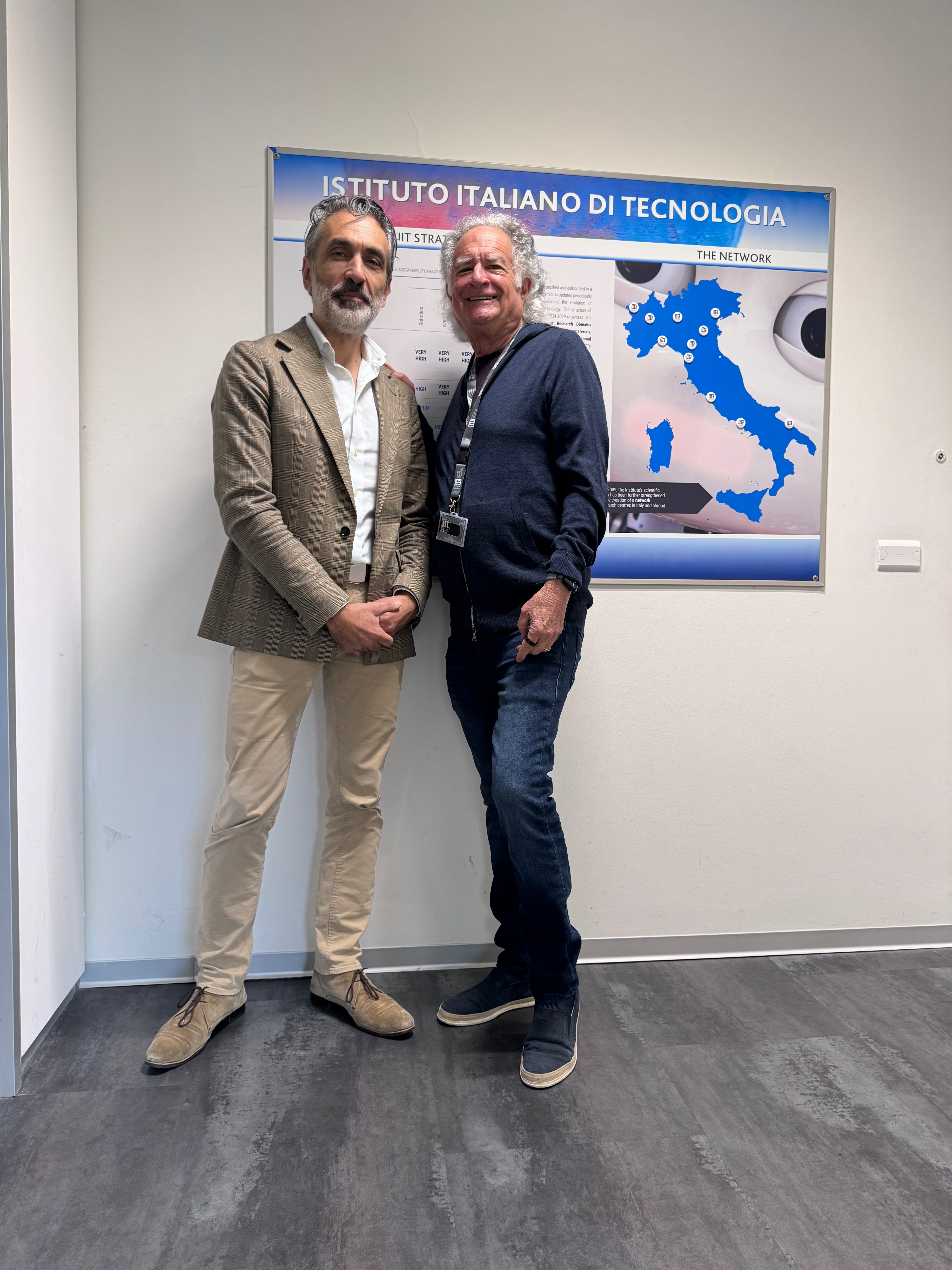
  • Avram Miller Appointed Fellow at the Italian Institute of Technology

    Giorgio Metta, Science Director and Avram Miller

    I am thrilled that I have been appointed as a Fellow at the Italian Institute of Technology (www.iit.it). It is an incredible honor to work alongside the remarkable Giorgio Metta, the Science Director and his team to embracing the future. Exploring their projects promises to be both enlightening and enjoyable, with the exciting possibility of spending time with some of their fascinating robots.


    The Italian Institute of Technology (IIT) is a leading research center based in Genoa, with 15 locations throughout Italy and a community of more than 2,000 people, including scientists, engineers, and technical staff from around the world. It drives innovation through over 80 active research projects spanning robotics, neuroscience, materials science, and artificial intelligence. IIT’s mission is to advance knowledge and technology, transforming scientific discoveries into real-world solutions that foster sustainability, progress, and improved quality of life.

    (more…)
  • Winding Down, Winding Up or Just Winding-The Next Ten Years of my Life 

    When I was diagnosed and treated for prostate cancer in 1996, I made a decision that changed my life forever. Prostate cancer is slow growing, and if the treatment did not work, I would still have at least ten more years to live. In my case, it appeared that the cancer had metastasized (it had not). So I decided to live my life as if I only had ten more years. This happened at a time when my friend, Dave Roux—who was then responsible for Corporate Development and M&A at Oracle and I were working together to create a leveraged buyout firm.

    Having made the decision to live as if I only had ten years, I realized I did not want to spend those years running a private equity firm, and I told that to Dave. He went on to create Silverlake, which became a very successful firm. In the process, he became a billionaire. I assume I would have as well. By the way, Dave is a really good person. His family foundation supports many important projects.

    I took a different path—one that I do not regret. It was no longer tied to any organization and not driven by financial concerns.

    I thought at the time that ten years was long enough to accomplish something like learning a new language, developing new skills, or having a deep and meaningful relationship—but short enough to feel some urgency. Thinking that you only have ten years to live could be considered pessimistic. But now, at the age of 80, I think it is an optimistic way to consider the future.

    I struggle with my age, and I have written about that in this blog. Sometimes I wake up in shock when I realize how old I have become. While about 60% of men live to 80, only about 10% are in excellent health (I appear to be one of those). Ten years later, only about 5% of men are still alive—and those who are, are overwhelmingly in poor health. 

    While I have a good chance of making it to 90, it is not just a question of life span. Health span is the critical question. While I wrote that I am in excellent health, I am starting to notice a decline in my hearing and sight. I wonder, are we as old as our oldest part? I hope not.

    We had left Israel just before October 7, 2023, on a combination vacation and business trip. Having already decided to move from Israel in 2025, we accelerated that decision. I loved living in Israel, but the Israel I had loved was no more. We needed to create a new life. 

    We ended up moving to Amsterdam, where I was engaged in work related to AI and cancer diagnosis. It felt like a rest stop in what had become a very confusing world—still in motion, but catching our breath. Eventually, we chose Italy. I had always said jokingly that in my next life, I’d come back as an Italian—and then I thought, why wait?

    But my 80th birthday weighed heavily on me. I struggled to imagine my future. We desperately wanted to settle into our own home. I missed my piano, which was still sitting in storage in San Francisco. The piano I had in Tel Aviv was sold with that house. We missed our art and the small things that my wife and I had collected over our years together.

    The question of how to use the ten years—likely the last ten years—came into sharper focus recently, as we made a major life decision: we would put down our roots in Italy.

    My anxiety about the future came to a head when we decided to buy a home in Lecce, Italy. I tried to imagine my life living in this city at this age and over the next ten years. It was then that I realized the decision to live as if I only had ten years was no longer a pessimistic view but an optimistic one, and I decided to embrace that optimism. We will live in Lecce in a beautiful palazzo in the heart of the historic center. Lecce is called the Florence of the South. It is a Baroque city located less than 30 minutes from amazing beaches on both the Adriatic and Ionian seas.

    It will be almost essential for me to learn Italian. I am struggling with that. This is the third language I’ve had to learn after English but I am committed to doing it.

    One reason to remain optimistic is the progress I expect we will see in health care because of AI. I am watching this closely and am personally involved in the field as an advisor to the Longevity Center at Sheba Hospital in Israel. I have started to get involved in longevity research in Italy as well. I still want to engage in creating the future and believe I have much to offer. I want not only to live longer and better—but to help others do that as well.

    So whether I am winding down, winding up, or just winding my way through this next chapter, I know one thing for certain: I’m still moving forward—with curiosity, with purpose,  hope and a song in my soul.

  • Why I went back to work

    This week, I accepted a board position and, more significantly, a very intense advisory role in a Nasdaq-listed company called Renovaro (Renb), which is acquiring a medical AI company called GEDi Cube (subject to shareholders’ approval). I will write more about why this combination is so strategic.

    For the last ten years, I have been doing my best to avoid making serious commitments like this. While I was happy to advise early-stage companies, I wanted flexibility.

    I have been helping set up a Longevity Center in Sheba Hospital for over a year. This activity made me think a lot about health span/longevity. I started to realize that I likely had a lot more time ahead than I thought. Since dealing with prostate cancer in 1996, I decided to live my life as if I only had ten years left. I don’t want to spend those years sitting on the couch watching TV. I want to make a difference. For the last ten years, I have gravitated to my first career, using technology for medical care. So, it is not that surprising that I took the leap and made a commitment.

    Health care needs to change. We have been doing the same things the last 100 years, namely treating disease. Because of AI, we now have not only the ability to accelerate that but also make significant advancements in the prevention of disease. It is not enough to live longer; we need to live better longer.

    Working with Renovaro will allow me to make a significant contribution. I also intend to continue as a senior advisor to the Cleveland Clinic and the Sheba Medical Center, as well as helping early-stage med tech companies. Last, I will do what I can to ensure that Sommetrics will cross the finish line and provide an effective, tolerable, and safe treatment for Obstructive Sleep Apnea.

  • Mark Zuckerberg smarter than I thought

    I don’t know Zuckerberg and I have yet to see the movie. My sense of him was that he was rather unsophisticated in financial matters (and certainly legal ones). But now that I understand the “100 million dollar donation”, my opinion has changed.
    First of all before I become to cynical, I want to applaud anyone that does anything to help our young people get a reasonable education. And I also want to acknowledge any wealthy person that gives substantial money to charity.
    So Zuckerberg, is not really giving 100 million dollars. No he is donating the equivalent of 100 million dollars in Facebook Stock. Assuming that FB stock keeps its valuation (I have big doubts about that personally), it will cost him about 30 million dollars. He does not have to pay capital gains on this stock and he will get a deduction from federal and state tax. I believe he is putting this money into a non profit he set up an will control. He is probably requiring Newark to meet certain criteria before they get the money (not sure how he turns the stock into cash). Since he controls the non profit, I think, he can always donate the money someplace else if Newark does not perform. And he locks in about a 100 million dollar donation which will help pay the tax on future sales of stock albeit maybe with a lower valuation. This is a very smart strategy and one that I have personally used but of course at a different scale. He must be getting good tax advice. Of course, maybe FB stock will be worth a lot more in the future but then he has so much more of that. And look at the great free PR.
    Ok, I said I would be cynical. I hope it turns out to a be a win win. Newark actually gets the money and does something with it and Zuckerberg gets to leverage the taxes. One thing is pretty funny, via this method, California is actually giving a 10 million dollar donation to Newark schools.

  • Happy Memorial day! Would you like chicken or steak?

    Please read this op-ed by Bob Herbert.  I could not have said it better.  Frankly, I think we  deserve everything we are about to get but do our children and their children deserve it?  If they survive and I really mean this question, they will  hate us for what we did to their future by our shameful greed, neglect, ignorance and laziness.

    I blame our political leaders a lot whom I think are not much better than a bunch of gangsters but we all of us (me included) are their enablers.  I was misguided in thinking that Barack Obama could lead us out of the mess we are in.  But he is just one more politician.  Yes, better than most I guess not not willing to loose in the short term even of that means that we all loss much more in the long term.  Maybe we would have been better off if McCain had won because then many of us would have been motivated to form some kind of opposition to the madness that is Washington. But then again would it have mattered much.  I guess if we we want to put meat into Earth Day for instance, we have to put meat into Earth Day and have a barbecue.

  • How rich are you?

    This post is about giving.  I just found this site.  It shows you where you stand with respect to the world population. Frankly,  I was shocked.  I kind of knew where I stood with respect to the US population but never new where I stood with respect to the world population.  It certainly gave me pause.
    I believe in the Jewish concept of Tzedakah (charity).  It is an important part of who I am and of my Jewish Heritage but of course giving is not limited to Jews.  The link above hopefully will encourage all of you that read this post to give more than you are comfortable with.  We  all have so much more than most of the people on the earth.  Here are a couple of thought I have about giving.

    • Give more than you feel comfortable giving.
    • Increase you giving in bad economic times knowing that others are cutting back
    • Be proactive.  Don’t just give money in response to being asked but set your own priorities.
    • Distinguishes between helping people and supporting activities.  For instance while I may support some museums and take a tax deduction, I don’t really think of this as charity. I know several very wealthy silicon valley people that think charity is supporting their kids private school.  I don’t.  here are the levels I see:
    1. Helping people out of poverty
    2. Dealing with major world issues like climate change
    3. Support for medical research
    4. Support of arts and education (USA)
    5. Attending fund raising events so I can hang out with people
    6. Religious organizations
    7. Political donations while important are not charity
    • Teach your children to give.  Start early and give them money to give.  Let them decided on where this money should go.
    • Leave a significant part of your estate to charity (like 50%).  If your estate is subject to estate tax, this will be even more significant on a net basis.
    • Be smart about tax deductions so you can give more.  Give appreciate stock.  Set up a family foundation or donor advised funds.  One of the benefits of these are you can control the timing of when you take the tax deduction versus the time you give the donations.  I have a small family foundation. I normally use appreciated stock to fund this foundation.  That way the true cost to me of a donation might be about a 1/3 of that the recipient t gets.  You can even lend money to a family foundation and then give appreciated stock later which can be used to repay the loan.
    • Give of yourself as well as you money.  I believe you can be most effective by giving money to organizations which which you have some personal involvement.  And give of your time even when you can not give money.  Many non profit organizations can really use advice especially management advice I have found.
    • Encourage your friends and family to give.

    Certain kinds of Tzedakah are considered more meritorious than others and are described in the Talmud:

    1. Giving begrudgingly
    2. Giving less that you should, but giving it cheerfully.
    3. Giving after being asked
    4. Giving before being asked
    5. Giving when you do not know the recipient’s identity, but the recipient knows your identity
    6. Giving when you know the recipient’s identity, but the recipient doesn’t know your identity
    7. Giving when neither party knows the other’s identity
    8. Enabling the recipient to become self-reliant
  • My plan for peace in the middle east: Make Jordan a sucess

    It is simple: Make Jordan a great success. Arab’s need a role model of success. While Israel’s economic, scientific and cultural successes should demonstrate what is possible in the region, it in fact does the opposite. So it is simple. Let us all help make Jordan a great success. I have just provided some support to permaculture work in Jordan and in Palestine. I plan to do more. The developed world should join together to build up all aspects of Jordon’s economy from agriculture, industry, education, health etc. I think these will not only have the strategic benefit of demonstrating to Arabs what can be done by Arabs on Arab land and instill a significant measure of pride but it should have a major impact on the Palestinians living next door and also provided work for them in Jordan. The more successful Jordan is economically, the more they will become interested in the success of Palestine and the more they will be able to partner with Israel. My dream is that someday, Israel, Jordan, Palestine and Lebanon will form an economic union.  How powerful would that be!

  • Can I be an honorary woman?

    No I don’t mean that I want to cross dress although I have to say my calves looked pretty good the one time I tried on my wife’s red patent leather pumps and I do think I might be the original metro sexual.  But this post is about something else. There is a Jewish concept called Tikkum Olom. It means healing or repairing the world.  It is a powerful concept because inherent in it is understanding that this is  our mission as human beings .  Actually the concept can be taken much further when applied to the universe as we know it but I won’t go into quantum mechanics and cosmology here.   During the last several years, I have noticed that it is women that are taking on the role of healers and repairs of the world.  Of course there wonderful and caring men, like my dear friend, Larry Brilliant, head of Google.org or even Al Gore  or even my own sons, but more and more I have been seeing women reach other to take action.  A few nights ago, we were invited to a reading by Riane Eisler,  The event was organized by three women.  Riane, talks about the need to move from  “dominator”  societies to “partnership” societies.   And while she did not say it, I thought this about moving from the masculine to the feminine.  It interesting to me that when we talk about the future and the macro changes we can expect, we mostly talk about things such as the continuing impact of technology (for instance, The World is Flat, by Thomas Frieman), the potential of genetic engineering, and  the economic progress of developing countries like India and China as well as issues like Global Warming,  the rise of Islam.  I have not seen much written about the potential of a change from male driven societies to societies lead by women.  But we are starting to see women taking greater and greater roles in the leadership of government and business. The 21st century may be the first century where woman will play the leading role and if that happens, then we can be optimistic about the future of our planet.  I believe that technology can provide the billions of people in this planet with all the basics for survival (food, medicine etc) but only when our business leaders think that it is more important to help others than to buy a bigger jet.  And when our government leaders understand that wining is not someone else loosing. It will not be easy for woman to  assume the leadership role.  Most of women in the world our suffering under the domination of male oriented societies.  So those of us  in the develop world have to lead in freeing them to make their contributions and heal the world.  

  • Bottled Water: A Trumph of Marketing

    It is  time to tap your tap ( Tap your Tap).  My wife and I are trying to get off of bottled water which as you must know cost about three times as much as gas, is terrible for the environment and does nothing special for our bodies that tap water can not do (and maybe better).  In our place in Sonoma, we are doing are best to grow fruits and vegetables for our own consumptions. We do our best to buy local produce and do what we can to reduce our carbon foot print.  But we seemed to be hooked on Fiji Water (which is actually brought from guess where?).  To make matters worse, we have a wonderful well system up here and the tap provides natural spring water which we have had tested (it is perfect).  Anyway, we are trying out best to get off the bottled stuff (we still carry bottles around) which we try to fill from the tap (you would think this would be easy since there are taps everywhere in the house and even outside).  My wife even bought me a special bottle that has an electronic measuring device that keeps track of how much I drink. She thought that just the opportunity to carry around another microprocessor and a battery would be enough to get me off of Fiji Water.