
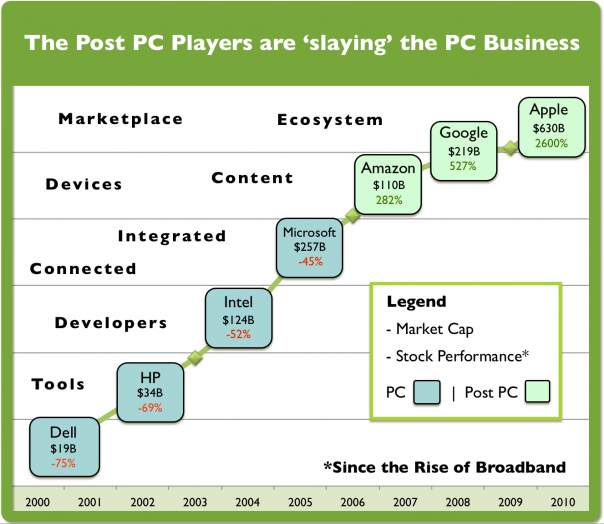
This is an amazing graph from GigaOm (see story here). As readers of my blog know, I played a very significant role in creating residential broadband starting in 1992 and continuing until 1999, when I resigned my position at Intel as Corp. Vice President of Business Development. While I was sure then that the Internet would change everything, I could not have predicted these results. Apple was still struggling after Steve Jobs’ return and had a market capitalization of just eight billion dollars. Amazon had a market cap that was more than twice as high but was basically a book seller. Google had just eight employees and was based in a garage. Microsoft’s market capitalization was about 270 billion. It had the highest market capitalization in the world, a position now occupied by Apple. By the way, Intel’s was about 150 billion. Both of these companies have about the same value now as they had 13 years ago.
The PC Revolution Turns the Computer Industry on its Side
Microsoft, Intel, Dell, Compaq (which became part of HP after first acquiring Digital Equipment Corp a leader of the previous generation of computer companies) were all products of the PC revolution. Apple was not (more on this later). The PC revolution is an example of what happens when two major and to some extent un-correlated technology discontinuities collide. The PC industry happened because an independent semi conductor industry lead by Intel met up with an independent software industry lead by Microsoft, and unleashed by accident by IBM. That flipped the computer industry. Until that time it was pretty much a vertical where the major computer companies developed all their own technology from disks to operating systems. It was a world of proprietary architecture. The leading companies where IBM, Digital Equipment Company and HP. Because both Microsoft and Intel were willing and eager to sell to anyone, many companies were formed such as Compaq and Dell to offer PC products. These companies developed little in the way of unique technology. In fact, to some extent, their innovations were in sales and marketing strategies. I should also give credit to the disk industry which was lead by Seagate in the early days, but this industry did not play a leading role in creating the market. The difference was that both Microsoft and Intel had near monopolies (we were taught not to say that word at Intel) on their segments ,while the disk and memory industry had many players and never generated enough profit to be market leaders. At one time it was thought that Microsoft and Intel had 120% of the profit of the PC industry (meaning many companies participating in the industry actually lost money).
The House of Wintel
While Intel and Microsoft can both take credit for exploiting the opportunity that was created by the collision, neither company had that much to do with the other in the early days of the PC revolution. In fact, each company would have preferred to see the other weakened and would actually take action from time to time to try to accomplish this. I remember that twice Intel had worked with Apple using Intel programers to convert the Mac OS to run on Intel Architecture (x86) during the 90s when the Mac ran on PowerPC chips only to have Steve Jobs decide not move to Intel. Steve probably was just leveraging Intel to put pricing pressure on Motorola who was the main supplier of the Power PC chips. Intel also had an active Unix effort which drove Microsoft nuts. Microsoft would refuse to take advantage of advanced features of Intels’ new microprocessors. Microsoft even invested in a company called MicroUnity whose mission was to create a new microprocessor architecture that could leap over anything Intel was doing. The company made amazing claims but failed to live up to them. Anyway, not all was cozy in the “House of Wintel” as attested to by my friend, Steve McGeady, a former Intel Executive when he testified at the Microsoft Anti-Trust trial in 1998.
The Internet Meets Broadband
Around the middle of 1995 two other technology trends were slated to collide. They were residential broadband and the Internet. The early stage of residential broadband (Cable modems and then DSL) was driven primarily by Intel under my direction. At the time we started the development of cable modem technology in 1992, I was aware of the Internet. Mosaic, the first browser developed at the University of Illinois by a team directed by Marc Andreessen, was released in 1993. Netscape Navigator, the first commercial browser was released towards the end of 1994. I had a chance to invest in Netscape at a pre-money valuation of eighteen million dollars, which I passed on, thinking it was too expensive -one of the greatest mistakes I made as a venture investor. At that time, the internet was mostly used by engineers and academics in universities, businesses and government. Corporations used things like cc:Mail and Lotus Notes. Consumers were just beginning to use email within online services like AOL, Prodigy and CompuServe. But both the business and consumer services were proprietary and it was not possible to communicate between them. However, for a number of reasons, gateways were created to allow email to be sent out of these “email islands” to the internet and from there it was possible to connect to other islands.
Residential Broadband the Child of TV
Residential broadband was build on a platform that was created for Television Transmission. The key ingredient that made broadband possible was the development of Digital Cable Transmission of video. General Instruments, who became Intel’s partners in creating residential broadband for the cable industry, demonstrated the capability to convert analog video to digital in 1989. The cable industry was excited about the potential of this capability and in 1992, John Malone, the CEO of TCI and, at the time, the de facto leader of the Cable Industry, coined the phrase, “the 500 Channel Universe”. I am sure that he never realized at that time he was laying the foundation for the multi million channel universe that is today’s internet.
Coupled with this was the development of High Definition Television which was to use the same underlying technology. I have repeated this story on my blog many times so I will not go into a lot of detail here. Matt Miller, the CTO of General Instruments and I, came to the realization that interactivity would take place in the home via personal computers and not interactive TV’s and very importantly, that we could use the very same infrastructure developed for digital television to create a broadband network for PCs. Our respective technical teams worked together to develop early cable modems and head-end equipment (the equipment that was located at the cable operators site). Intel developed the cable modem communications protocols which we provided to the Cable Labs (the R&D arm of the cable industry). I evangelized the concept of residential broadband, meeting with the CEOs’ of all the major cable companies, and introduced the concept throughout the world. Intel licensed manufacturers of cable modems such as Cisco and HP. The rest is as they say, is “history”.
The Web Evolves as the New Platform for Computing and Business Models Change
After a few years, it was clear that the internet would become the online platform of choice for consumers and that applications would be based in the world wide web (www). From the perspective of Intel and Microsoft, the growth in home computer sales driven in large extent by the availability and acceptance of broadband internet was a good thing. But contained in this good thing was something else. More and more of the value derived from using computers in the home was being transferred to the products and services running on the Internet or as we now say, the cloud. Having a high speed network, wireless access in the home, and a great monitor was more important then having a fast CPU.
Business models were changing. Previously, consumers bought hardware and software. Now, new elements were being introduced into the mix. Consumers were paying monthly subscriptions for access to services like broadband or even music sites. Importantly, advertising started to appear on the internet. At the time, 1994, I said “advertising will be the killer app of the internet”. Companies like Intel, Microsoft and Dell were being left out of these growing segments of revenue. I remember in the mid 90s, speaking to Paul Otellini’s staff at one of their strategy sessions. Paul who is now the CEO of Intel was running the Microprocessor business at Intel then. I shared with Paul and his senior managers, some of my thinking about the future of the computer industry and introduced the concept that companies could subsidize the purchase of consumer products if they could couple them with re-occurring service charges. I said this kind of connection between hardware, software and services could change the business model of the computer industry. It took the iPhone to make this concept happen. Intel was not in a good position to take advantage of the changes that would follow. While the company had a very important position with respect to consumer awareness resulting from the very effective “Intel inside” campaign, it had no direct relationship with consumers. I wanted Intel to start selling peripherals (something that Microsoft did) but frankly that would not have helped much.
The Writing on the Wall for Intel
By the time I left Intel in 1999, the writing was pretty much on the wall. I left partly in frustration that I was not able to get Intel to understand that we were entering a new phase of the computer industry. But frankly, I am not sure I could have made suggestions that would have changed the outcome. I would like to think that had I stayed at Intel, I would have convinced the company to acquire Qualcomm which today has a market cap close to that of Intel, but I am not sure. I think Microsoft was in a better position to bridge the transition but because so much of the value became software based, it would have taken very different leadership than that provided by Bill Gates and Steve Balmer. Even companies like Cisco whose income was primarily derived from selling products to companies that provided internet infrastructure did not take advantage of the transition. Intel needs to find away to couple its primary product, the microprocessor, to the services consumers would be enjoying. About five years, ago, I figured out how to do that and offered my ideas to Intel (without charge). They were not appreciative and never took my suggestions seriously. Probably worked out well for me because I could have gotten sucked back into Intel.
Amazon the Emerges as a Leading Competitor to Apple
Amazon is also on the chart. Amazon is not really a computer company although it is moving quickly in that direction. It is an online retailer. Its’ competition is other retailers including Target and Walmart. It started in the book business and has pretty much succeeded in wiping out traditional brick and mortar book sellers (sadly in some opinions). It is having a major effect on the way all media is distributed. But in my opinion the best is yet to come for Amazon (by the way, I own the stock). Amazon is trading at an all time high as I write this post.
Google from Brilliance to Mediocrity
Google has done an amazing job monitoring the internet via advertising. They are, of course, the leader in internet search. But Google reminds me of of Microsoft. They have a dominate market share and a fantastic financial engine. But their products are mediocre. Their offerings in every segment other than search is not very inspiring. Even hotmail and yahoo have more email users than gmail on the web. Apple has the most email clients on mobile devices. I recently said in a talk that I gave that “Google has the mediocrity of Microsoft without the greed of Bill Gates”. They may be in a good position to take advantage of the next wave of computing which will be described later, but I personally doubt that they will.
Apple the Company I Hate to Love
Finally, I have to talk about Apple the company I loved to hate and now hate to love. As readers of this blog will know, I have a twisted history with Apple. It started with meeting Steve Jobs in 1982 when he was just 25 years old, continued through the lawsuit between Franklin Computer where I was president. Apple pretty much killed the company via litigation. I have written much about Steve Jobs and Apple on this blog (do a search if you want to see those posts). Apple, until recently, belonged to the pre-pc era of computing. While not a totally vertical company, Apple controlled most of the technology in their product. In many ways, Apple reminded me of Digital Equipment Corp., they were the leader in mini computers. Obviously, there are key differences. Apple focused on creative professionals and consumers while Digital focused on Engineers and Scientists. Driven by their respective CEOs Ken Olsen and Steve Jobs, I believe they were building computers that they would want to use themselves.
What has fueled the astounding growth of Apple is that they are riding the next wave of computing. A phrase coined by John Gage, formally of Sun Microcomputer, sums it up: The Network is the Computer. But I want to add another concept: Ubiquitous Computing. This means that everyone and to a lesser degree everything is connected and intelligent. I believe this is actually gives rise to the driving factor of what we now call Cloud Computing. The driver of Cloud Computing is reduction in complexity. There are other benefits I am sure, like reduced cost, but reduction in complexity is the driver in my opinion.
Just take the issue of accessing content. Consumers started ripping music CDs to their computers in 1992. Digital Compression made it possible for us to store a lot of music on our computers. Then small portable music players came our way that allowed us to take this music with us. Most of these devices were pretty poor until Apple applied its amazing design capabilities and created the iPod in 2001. Keeping music synced between a computer and an iPod was not to difficult or complicated. iTunes was developed with this purpose in mind. But as I am sure you have experienced, as you try to involve more and more devices (multiple computers, portable players, and devices to drive home Audio/Visual systems) things get rapidly more complicated.
Eventually, Apple figured out that it is less complicated to store everything in one place “in the cloud” and have every device communicate with the cloud and not directly with each other. But in doing this they are not really utilizing the open platform that is the internet. They are just using the Internet infrastructure much in the way that the cable modem used the Cable TV infrastructure.
Computers and Computing Everywhere
Ubiquitous Computing is driving other key technologies. Most prominent in this is mobile communications and form factors. There is another force that will shape the future of computing and that is security for want of a better word. As we put more and more of our information in the cloud we become more and more concerned about the security of that information. I don’t just mean information theft. I also mean our ability to access information now and in the future.
When Technologies Collide Money is Made
I started this post talking about what happens when technology discontinuities collide. I would like to give my views on the next wave of computing. You can guess that Ubiquitous Computing which will be the driver of Cloud Computing is one of these discontinuities. But what are the others? I think Network Intelligence will be one. What I mean here is the application of data mining to personal interactions. There is evidence of this already with data mining and crowd sourcing. Amazon suggests things that I might be interested in buying from looking at my buying patterns and those of others like me. The same is true for Netflix. Pandora uses Network Intelligent to suggest music I might like. Much of these capabilities are being used to market to us. But this is just a start.
Just think of all the information that a company like Apple will have about us. It will be interesting to see if the regulatory structure can deal with the access such a company will have to our information. I for one am not overly concerned, but maybe I should be. The company that has the most information at the moment is undoubtably Google. But they will have to recast themselves as a Network Intelligence Company.
I have a lot more to say on this topic but that will have to wait for future posts.
Facebook does not Make the Cut…
Finally, you may have noticed that I said nothing about Facebook. This is partly because Facebook was not on the graph but also because I think Facebook is the Yahoo of the next wave. This statement my surprise some of you because of Facebook’s strong position in Social Media. I personally spend a lot of time on Facebook and do believe in the future of Social Media but in the mid 90s I spent a lot of time doing email on AOL. I still spend a lot of time doing email but have not been on AOL in ten years.


Leave a Reply