Two Thirds Done

Thoughts and experiences of an eighty one year old Wild Duck.

Avram Miller by the sea
EN | IT

587 posts since 2006

Tag: Compaq

  • Could Franklin have been Compaq and Apple, Microsoft?

    This is another outtake from my book, The Flight of a Wild Duck.

    In April 1983, I left Digital Equipment Corporation, where I headed the development of that company’s Professional Series Computers to join Franklin Computer as Chief Operating Officer. However, in reality, I function a the CEO. I had considered starting my own company, but Franklin, which was less than a year old, growing faster than Compaq Computer, and about to go public, provided me, I thought, with a platform to build a major computer company.

    Franklin’s founders had realized there was a lot of unmet demand for the Apple II. Many computer resellers were desperate to sell Apple IIs, but Apple had very restrictive policies on distribution. Franklin’s computer, the ACE 1000, ran all the Apple II software and had a better design than the Apple II. Franklin had more than $80 million in sales in its first year of operation; if not for the Apple v. Franklin lawsuit that declared a BIOS effectively subject to copyright, I might have achieved my ambition. We were already developing a clone of the IBM PC. One product under development was able to run both IBM PC and Apple II software natively. I worked on an ad that said, “Franklin can give you what neither IBM nor Apple can, each other.”

    Apple had sued Franklin for copyright infringement. Franklin had indeed copied the BIOS (the firmware between the hardware and the operating system). The lawsuit that followed has been discussed a great deal because it resulted in a finding that firmware can be copyrighted.

    Apple never won the case against Franklin. The appellate court instructed the lower court to rehear the case based on “matters of law” (firmware could be copyrighted). But everyone thought we had lost. Our IPO was pulled, of course. Our bank revoked our line of credit. It was a mess and one for which I was prepared.

    We wanted to settle with Apple and suggested that we could pay them a significant license fee. In addition, we argued that our activities would grow the market for Apple. John Sculley, Apple’s CEO, appeared interested, but Steve Jobs would have none of it. Jobs wanted to maintain control over all aspects of Apple’s products. A year later, Jobs was pushed out of Apple. But that time, Franklin was no longer a factor in the Apple market.

    Apple continues to this day to have a proprietary computer system. Holding about 16% market share when IBM introduced the PC, Apple’s share dropped to about 2% by 2004. While the closed, proprietary approach was unsuccessful in the personal computer market, it worked out very well later with the iPhone.

    Had Apple licensed to Franklin, how would the PC market have turned out? I think IBM and its clones would have still led the market, mainly because of IBM’s substantial sales force. Perhaps Apple would have dominated the home market while IBM kept the business market. IBM had one secret weapon against Apple that significantly impacted the development of the consumer market. In the early days, the software could not be protected, so many people were familiar with PCs at work. When it came time for them to buy a computer for their homes, they purchased an IBM-compatible PC and brought home their software from work to copy without paying for it.

    Even if Apple had licensed its Apple II and later Macintosh operating systems, the IBM PC architecture would likely still have dominated. But Franklin could have become the dominant IBM PC Clone company beating Compaq. In 1998, Compaq Computer acquired Digital Equipment Corporation. I could not help at the time to imagine that if Franklin had prevailed a the appellate court, it could have been Franklin, not Compaq, that acquired Digital Equipment, and I might have found myself the CEO of the combined company.  

  • Factory of broken dreams: Will the Googleplex be next

    Intel Closes Down the Hudson Manufacturing Facility

    IHudsonIntel just announced that it would close the Hudson Manufacturing Facility it acquired from Digital Equipment Corp in 1997.  The press release from Intel  said “the Hudson plant has been used to make a variety of low-end chips found in many electronic devices.”  The closure of this plant will not mean much to people other than the thousand or so people directly affected.  The exception to this are the few pioneers who vision and drive created it in the first place. They dared to dreamed big and lost.  While they understood the potential of semi-conductor technology and large scale integration, like all of us at that time, they did not understand that the computer industry was about to be turned sideway and that companies that were vertically integrated would fail like Digital would fail.

    Imperfect Vision

    It must have been around 1980 when Steve Techier and Roy Moffa proposed to Ken Olsen, the CEO of Digital Equipment Corp and eventually to its board that the company should establish a state of the art semi conductor capability including a manufacturing facility.  At that time, Roy was my boss at Digital. I had joined less than a year earlier.

    Digital was using bipolar chips to constructs it midi computers.  These were not microprocessors – just parts of a computer.

    Both Steve and Roy reported to Dick Clayton who in turned reported to Gordon Bell, Vice President of Engineering and Chief Technologist.  By the way, it was Dick that was responsible for bringing me to Digital from Israel.   I would attend Dick’s staff meeting from time to time and can remember Steve and Roy talking about their proposal for the Hudson facilities.  Frankly, I did not understand much of what they were saying since I had no background in semi-conductor technology. But I remember how inspired and enthusiastic they seemed.  It is strange to note that later I would become a Corporate Officer of the most successful semi-conductor company in the world, Intel Corp, less than ten years later.

    Roy died a few years ago.  I wrote about him here.  Steve is living in Florida. I hear from him on Facebook from time to time.  You can listen to an interesting interview with him here.

    I would like to apologize in advance if any of my “facts” here are wrong and if this post is a bit too technical for most of my readers.

    Avram the Engineer

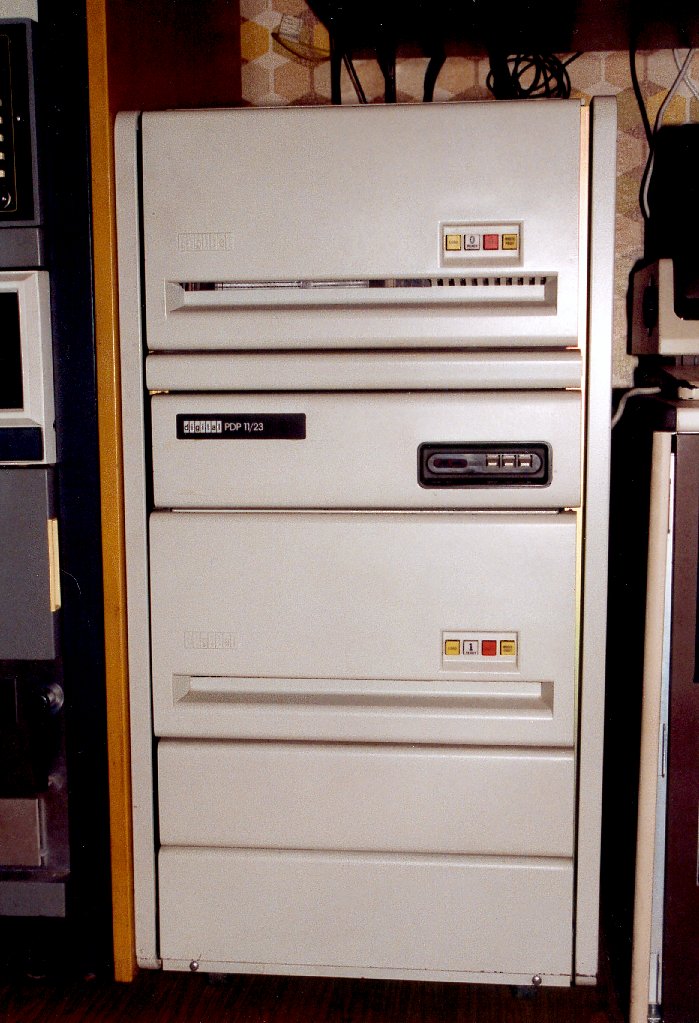
    PDP11-23GAt this time, 19080, I was a senior manager in the Central Engineering organization at Digital, and responsible for small computer hardware.  That included all PDP-11’s using the Q-Bus such as the PDP 11/23 as well as support for PDP-8s including Decmate, Digital’s proprietary word processor.

    Frankly, I was in heaven.  I loved computer technology and design and had used computers extensively for over ten years.  I could design computer hardware and write software even thought  I had no formal engineering education.   Now, I was trilled to be leading a very large group of engineers and making important design decisions for the second largest computer company in the world.  I was 34 years old.

    The PDP 11/23 used four a chip set manufactured for us by Western Digital.  The larger PDP-11‘s managed by other groups at Digital were based on the Unibus architecture.  It is interesting to note that the Central Engineering organization responsibilities were separated by the bus type.    The Unibus could only address 18 bit. One of my first accomplishments at Digital was figuring out how to extend the Q-Bus so it could have a 22 bit physical address making potentially more powerful than it’s big brother, the Unibus. An address space of 16 bits only allows for a memory of 64 kilobytes to be addressed directly.  A number of years later,  Bill Gates is allegedly quoted as saying “.. 64KB ought to be enough for anybody.” This may not be true story but I like it never-the-less.  By extending the address space of the  Qbus to 22 bits, 4 mega byes could be addressed.  Today, the microprocessor use in most desktop computers have an address memory that are millions of times larger than that.

    Digital also had a single chip version of the 11 architecture called the T-11 offered a single board computer.    But the  T-11 (T for Tiny)  was not the first microprocessor the company used.   The Decmate used a CMOS processor manufactured by Harris. It was actually a 6100 12 bit processor which emulated the PDP-8 instruction set. Later, we developed a more advanced chip set called the J-11.

    The T-11 was fabricated in NMOS.  It only contained 13,000 transistors. Today’s desktop microprocessor will have several billions of transistors.  Back then 13,000 transistors seemed like a lot to me.  Just ten years earlier I had been designing medical research equipment using single transistors.  I doubt that many of today’s engineers have ever held a single transistor.

    I was very familiar with the T-11 chip since in my previous position as Director of Medical Computer Systems for Mennen Greatbatch, I used it extensively in embedded patient monitoring systems I designed in Israel.     I loved the T-11 and tried to get Digital to sell it on the open market and make it a standard. I went to the management committee with an  opportunity to license it to Atari, the leading electronic game company but they were not interested.  They did not want to sell the chip outright and probably looked down on the gaming industry.  Later, we develop a more advanced chip set called the J-11.

    Intel introduced the 8088/8086

    A few years earlier, Intel had introduced the 8086 and 8088.  These microprocessors had about 30,000 transistors.  The 8088 which was a 16 bit microprocessor but used only an eight bit memory bus. It was the processor that IBM selected to use in the first IBM PC.  The power of the T-11 was not in transistor count but in the software and tools that were available for it and could have easily become an industry standard.

    My Own lack of Vision

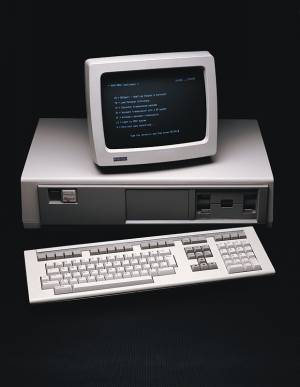
    Pro 350A year later, I was tapped by Ken Olsen to lead Digital’s efforts to create what would later be known as a personal computer.  Our product line was called the Professional Series.  It was based on the F-11 chip set and later utilized the J-11 chip set. We had a very different design objective than the IBM PC which was under development at the same time.  We were trying to build an elegant, easy to use computer system for a professional person with a rich amount of software and the ability to network (remember this was 1981). Ken wanted it to be so easy to use that both his minister and secretary would used it.  I described this as the system for “Clerks and Clerics”.

    We failed at that for a number of reasons that I have discussed before.  Once of those reasons, i have to say, was we over engineered our product. It made it expensive and late to the market.  We did not ship our product until early 1993 more than 18 months after IBM.  We had a proprietary architecture and continued on the vertical integration model including our own sales force and computer stores.  But frankly, I still think the Pro was a beautiful and  amazing product. I still have one.

    The Computer Industry Turns Sideways

    Pro 350During this time, the leading computer companies such as IBM, Digital, HP, Data General and Prime were all vertically integrated.  That is to say they designed all the parts of their computer products from CPUs, Disks, terminals, printers and software. It was at lot of work and was very expensive which resulted in the products and services being expensive.

    The IBM PC was the catalyst that changed everything.  And it was pretty much an accident.  But it was the spark that created the explosion that blew up the computer industry including IBM, the very company that created it.

    The IBM  PC was the first major product of the new era of horizontal structure.  Different companies would provided different parts of the product from disks, processors, operating systems, applications and distribution.  The IBM folks did not realize that they were laying the foundation for the greatest change the computer industry had ever experienced. The IBM team did it because of time to market, limited budget and lower product cost.   But from that moment on, the clock was counting down on the  major computer companies including IBM.

    It was Aug. 1980, when William Lowe the IBM Lab Director of IBM’s entry Systems in Bocca Raton, came meet with IBM’s  corporate management team including the CEO, Frank Cary, to discuss how IBM could participate in the personal computer space which was just beginning to develop with products from Apple, Tandy, Commodore etc.  IBM had learned a lesson about disruptive technology when it failed to comprehend the importance of Mini Computers.   Lowe, propose that he could create a personal computer in 12 months (it usually took this long to get a proposal  agreed to at IBM) if we could go outside the company for critical technologies.

    So project Chess was formed. Lowe took assigned twelve people to the project including Bill Sydnes and Lew Eggebrecht both of who ended up working for me in 1983 when I was President of Franklin Computer Corp. Lowe was promoted and given a different assignment and the late Don Estridge took over the project.   I meet Don at a dinner in 1981 just after the IBM PC was announce. Bill Gates and Steve Jobs were there as well.  I was 35 and they were 25 years old.

    The IBM Chess team had decided to us the Intel 8088 processor.  They thought they would get the Operating System from Digital Research Inc (DRI)  and were looking to Microsoft to get the BASIC programing language.  At that point, Microsoft had 40 employees. The legend has it that Gary Kendall the CEO of DRI wanted to fly his airplane on the day that the IBM PC group wanted to meet and/or Gary’s wife would not sign an NDA.  So when they were meeting with Bill Gates up in Seattle about BASIC, they asked if Microsoft might have an OS.  Bill lied and said he did and told the IBM folks he would send a proposal.  He knew of an OS for  the 8086/8088 called QDOS, written by Tim Patterson at a company called Seattle Computer Products. Bill bought the OS from Patterson for $50,000.  He licensed it to IBM and called PC-DOS.

    Intel did not develop the 8086/8088 for the PC market.  That market did not really exist.  It was developed to be used mostly in embedded applications.   IBM was familiar  with Intel products.  The IBM team considered  Motorola  68000 but it was still in development so they went with Intel.  The decision to use Microsoft’s OS and Intel’s processor where taken without any thought to the long term impact but resulted in creating the most powerful hegemony, ever.  It would be Microsoft and Intel which was sometimes referred to as Wintel that would rule the Personal Computer Industry until Google and Apple changed everything once again.

    Bring in the Clones

    Compaq and a number of other companies were formed to create compatible IBM computers.  At first, they copied PC-DOS.  IBM would send undercover security people to industry shows and ask if the computers being demonstrated were compatible with the IBM PC.  If the company said yes, they would ask if they could test thier program.  The mostly got a yes.  The program they ran, copied checked to see if they were infringing on IBM’s copyrights.  If they were, the company got a letter from IBM. But IBM was reluctant to go after any of these companies because they had spent years dealing with government charges of monopolist behavior.

    Microsoft wisely had secured the ability to modify and license PC-DOS.  They released a version of the OS called MS-DOS and licensed it to everyone that wanted to build a PC clone.   There were a number of compatibility issues in the early years of the PC but they were over come  fairly easily.

    VAX/VMS

    By this time, Digital was going through a major technological transformation from the PDP series of 16 bit computer to the VAX which was its first 32 bit computer.  Gordon Bell, the technologist/Architect of Digital, understood the power of the VAX and wanted to unify the company around it and its operating system, VMS.   That’s when Steve and Roy proposed that Digital develop its own semi conductor capability.  Their first target was a single chip implementation of the VAX architecture called the Micro VAX.  I think it shipped in 1984 but I left Digital in 1983.  Interestingly enough, it used the bus architecture I had developed in my first year at Digital.   The VAX was eventually replaced by Alpha a 64 bit RISC  architecture.

    Palmer,  Angel of Death

    In 1985, Digital hired Robert Palmer to head up its semi-conductor activities.  Since I was long gone, I have no insight into why he was brought in or what really happened.  By 1990, Ken Olsen was slowly loosing control of the business.  He was replaced by Palmer in 1992, probably one of the worst choices for CEO a board could have made. Palmer did not understand Digital’s business and most importantly, he did not understand it values and culture. While, Ken was really no longer able to lead the company, almost anyone would have done a better job than Palmer.   As the company continued to decline, Palmer sold off one part of the company after the other.  Pretty soon there was nothing much left.  Eventually,  Digital was sold to Compaq Computer in 1998, a company who got its start in 1982 with a PC Clone.  It would have been impossible, al least for me, to imagine in 1982 that Compaq would buy Digital just 16 years later.

    Intel Acquires Hudson and a CEO is born

    In 1997, Intel bought the Hudson Facility from Digital as part of a settlement having to do with alleged patent infringements.  Palmer was basically liquidating Digital by selling off all its parts.   The person that Intel sent to manage Hudson then is the current CEO of the company, Brian Krzanich, who got his start as a process engineer.  I have to wonder if the curse of Hudson is over yet?

    What if Digital thought of itself as a Software and Networking Company

    I also wonder what would have happened if Digital had partnered or acquired a company like Intel back in 1980 and eventually turned itself into a software company.  At that time, VMS, the VAX Operating System and DecNET (the most powerful networking software available) were superior to anything else in the market.  Microsoft, was just a small company whose primary source of revenue was selling the BASIC programing language which they had ripped off of Dartmouth University.  They had just bought QDOS which became  PC DOS and eventually MS DOS. Of course, IBM would never have used Digital’s software or processor so I am not sure how Digital would have Digital would have created the standard.

    I certainly would not have taken this approach back then and I can not blame anyone for not recognizing the world was about to change.  By the way, it is an interesting detail to learn that Digital with the fifth company to register an Internet Domain (www.digital.com) in 1985.

    Now of course the same thing is happening to Microsoft and Intel.  The world of computer rotated again and they are falling off.


  • Alta Vista RIP


    Screen Shot 2013-06-30 at 10.19.44 AM

    Evidently, Yahoo will close down Alta Vista on July 8th, the Internet search company it acquired in 2003.  This is the second time Yahoo has killed Alta Vista. Let me explain.

    Internet Search Arrives

    We should pause to remember that today’s internet is less than 20 years old.  I date it from the launch of Netscape in 1994.  Around that time, we see the birth of the early search engines such as Lycos, Webcrawler,   Hotbot (which became Inktomi) and eventually Ask Jeeves.  Prior to this it was very difficult to find internet site other than utilizing  small specialized listing of web sites.    Search has now become such an important part of our lives that it will be difficult for many to imagine life before that, especially the younger of us.


    Alta Vista was started in the  Western R&D labs of Digital Equipment Company, Palo Alto CA (established in 1984), and was launched publicly in December 1995. It was an immediate success.  In 1996, it became the exclusive search provider to Yahoo, who itself had started life as a directory of Internet sites.  This was before the concept of Search.


    Compaq Computer Acquires Digital Equipment and Gets a Surprise

    In 1998, Digital Equipment Corp. was sold to Compaq Computer (a remarkable story in its own right). Rod Schrock  of Compaq was made CEO of Alta Vista.  Compaq may not have even been aware of the existence of Alta Vista when it acquired Digital for $9.6 billion dollars which, at that time , was then the largest acquisition of a computer company.

    Alta Vista was the first search company that had the technology to index the entire Web.  One has to wonder what would have happened if Digital had spun Alta Vista out in 1996 the year that Google was founded.


    CMGI Acquires Alta Vista and I Join the  Board

    In June 1999, 83% of Alta Vista shares where acquired by CMGI from Compaq in return for  2.3 billion dollars of CMGI stock which was worth about 16% of that company. CMGI was founded and led by Dave Wetherell and was the leading Internet conglomerate then.  While at Intel, I had invested in CMGI.  We acquired about 5% of that company’s stock for something like $12 million, I believe.    I became the Intel CMGI board representative.  When I resigned from Intel in April 1999, Wetherell asked me to join the board of CMGI which I did.   CMGI stock rose to a market valuation of $40 billion about a year later.

    I remember that day that CMGI became worth more than the General Motors Corporation. Frankly, I thought that was nuts.  I sold all my vested shares in March of 2000 by the way.   Intel’s position may have been worth a couple of billion dollars at that time.   I am pretty sure that Intel did not sell very much of its positoin and probably was lucky just to get their original investment back (when I was at Intel, I  made sure we took money off the table).


    Alta Vista’s Past Should Have Been Its Future

    As part of the CMGI acquisition of Alta Vista, I joined its board.  Alta Vista under Rod Schrock’s leadership moved from being a Search Company to becoming an Internet Portal.  Basically, Alta Vista had Yahoo envy. At the same time Google had Alta Vista envy.  I think part of the issue for Alta Vista  was not having a vision for how to monetize search (Google would eventually figure this our with ad words and ad sense).  Advertising on the internet was pretty much banner ads at that time. I would like to say that I pushed against this move by Alta Vista but I don’t think I did. The Alta Vista board  knew about Google and considered acquiring it. We  had some discussions with them but they had just raised $25 million from Kleiner Perkins and other key VCs and were really not interested. I think the valuation of Google was about $80 million at that time.  There were probably only 12 or so people at Google then.  While Alta Vista was the most powerful and popular search engine, Larry Page one of the founders of Google had figured out how to make search results more relevant. That combined with Alta Vista move to becoming a Portal, created the opportunity for Google to become the leader in search.


    Alta Vista Almost Went Public

    Alta Vista almost went public.  The company was about to make its IPO ini April of 2000 when the Internet meltdown took place.  This actually was the third time the company almost went public.  Both Digital Equipment and Compaq had flirted with the idea of taking Alta Vista Public.


    Google Overtakes Alta Vista

    Google Alta Vista X

    This graph says it all.

    There were a number of management shake ups after that and Schlock left in October 2000. The company refocused on search but it was too late to overcome Google. Had the company successfully gone public prior to the melt down, it may have had the cash that would had allowed it to buy up many of the relevant Internet Companies including Google. Timing is everything as they say.


    Alta Vista Final Resting Place

    In Feb. 2003, Alta Vista was sold for a third time. This time it was to Overture Services  for $140 million, which in turn was acquired a few months later by Yahoo.  So that is how Alta Vista came to be part of Yahoo, the company it envied.  This was to be Alta Vista’s final resting place. CMGI also saw its stock collapse.  However, It survived, and is now a small internet marketing company called ModusLink Global Solutions (what a catchy name).

    Frankly, I did not know that Alta Vista was still alive.  You can visit it here for sentimental reasons.  Don’t wait too long.


    And What of the Future of Search?

    At one time, I had a reputation as a visionary.  I use to joke when I was at Intel that a Visionary was just a dreamer with a PR department.  So I guess I should say something about the future of search.

    The development of search has been disappointing to me.  It is not personalized enough and does not have enough context.  There have been many improvements like using location information but still I seem to have to work very hard to find the things that interest me.  Google still dominates search but I believe much of their effort goes to monitoring search.  Microsoft is pushing Bing but offers little that Google does not have.  Facebook would love to get into search but my guess is they will do a mediocre job of it and further anger their users.

    My bet is that there are many start ups now looking for at better ways to do search.  Of course they will not be able to compete effectively with Google but there is one company that is barely in the search business that I believe cold create significant competition for Google.  That company is Amazon. Amazon could easily acquire advanced search capabilities from start-ups.  They have a great deal of information about their customers that can help them tailor search.  But most importantly they are in an even better position to monetize search by actually selling products instead of just selling ads.


  • Avram’s Congressional Testimony on HDTV 1998

    It is hard to imagine that just only fifteen years ago, we still had not settled on the HDTV standards let alone deployed HDTV.  Flat panel TV’s were just being introduced.  I got my first a year later.  It was 42 inches and did not have enough resolution to display HDTV and cost close to $5,000.

    The  House Commerce Committee Subcommittee on Telecommunications, Trade and Consumer Protection convened a 2 1/2 hour meeting to discuss HDTV standards and deployment issues on April 24, 1998. I was invited to give testimony.   The panel was made up of a  large group of executives representing the consumer electronics, the television broadcast and the cable industries.  In addition there were two representatives from the computer industry, Bob Stearns from Compaq and me, from Intel.  The chair was Billy Tamzin, a republican who later went on to make a fortune as a lobbyist.  The ranking member from the democrats was Ed Markey (now running for the Senate in MA).   Stearns and I had a couple of objectives.  While most of  the panel saw a TV, we saw a Monitor.  We understood that with that if we could achieve  high resolution and progressive scan, the HDTV set of the future could serve as a monitor for computers.  Just like the  CD and DVD, the consumer industry do the R&D and and manufacturing  of important and innovative products which the computer industry would “highjack” for its own use. Everyone one on the panel had their own agenda and often it was a secret agenda. By the way, the guy who is looking is staring at me in the photos is Chase Carey the current COO of News Corp.

    Here is my testimony followed by my friend, Bob Stearns.


    Digital TV and Compression

     Back then TV transmission was still analog.  The majority of American homes no longer received TV over the air but instead they got TV content via cable including the so called Broadcast Networks. The move to Digital Television which allowed an ever greater number of television channels to be squeezed to a given amount of spectrum (bandwidth) had begun. It  all started when John Malone declared the 500 channel Universe at a cable industry show in 1992.  The bandwidth needed for HDTV required digital compression.  One HDTV channel was the equivalent of four normal resolution channels.  Digital Compression was first introduced by Direct TV who had a needed to get as many channels into their limited spectrum.  The cable industry was looking to eventually distributed HDTV. By using digital compression, they could get between 1-2 HDTV channels in the same 6 meg hertz bandwidth normally used for standard definition analog TV channel.  They soon realized that they could also squeeze between 4-10 standard definition channels into the same space depending on the quality that they would be willing to offer consumers.  This turned out to be very important to Malone because TCI had one of the worst cable plants . This way they could avoid the cost of upgrading the plant by using digital compression to offer more channels with the same old bad quality.

    A six mega hertz channel was converted to what was called 64 Quam.  It was a packet structure and could be used for a combination of HDTV and standard TV.  It was this technology that we hijacked to create the downstream portion of the Cable Modem.  We could turn an analog TV channel into about 30 mbits which between a number of homes.

    Open Set Top Box

    The consumer electronics companies represented on the panel were interested in finding away to let consumers buy set top boxes directly from retail instead of getting them from the cable companies. For instance,  Sony really wanted to be able to offer set top boxes direct to consumers that would integrate capabilities like DVDs.   The cable Companies did not want this top happen.  Even Circuit City was represented at this hearing.

    Cable companies wanted to keep the set top boxes proprietary for a number of reasons.  The charged customers $5-$10 a month for equipment that was not only cheap to make but keep in service for many years.  In fact they are still doing this.  They would claim that they needed to control the set top box to make sure that consumers were not able to access content they had not paid for.  I was amazed to hear the representative from Time Warner Cable say that they were working hard to create an open standard for Set Top Boxes when I knew they  were doing everything they could to prevent it.
    The cable companies are promoting that they would open the set top box market and provide interactivity.  There were only two major manufactures of set top boxes in the USA, the Jerold Division of General Instruments (now owned by Google) and Scientific Atlanta (now owned by Cisco).  They were tightly controlled by the Cable Industry.

    Broadcasters were concerned about the cost of HDTV and the Digital transition.

    The major networks were concerned about the cost of both creating and distributing HD content.  They really wanted to slow things down.  Only PBS seemed to be aggressively pursuing the concept of Digital Channels and HDTV.  But the government wanted to reclaim the spectrum which they provide free of charge to Broadcasters.   It was a battle that went on for more than a decade.

    Interactivity

    I wanted to make sure that nothing would happen to interfere with the possibility of interactivity over cable.  Interactivity required a return channel  (upstream) which was actually the most difficult part of getting cable broadband access done.  While the Cable Industry was buying into the concept of Internet Broadband for home computers, they did not want this to creep into the TV area.  They wanted to be able to control TV interactivity just like they controlled TV content.  By this time, I knew them well enough to know that they were not capable of pulling this off but saw no reason to rub this in.  Instead, during the Q&A session, I gave an example of the kind of interactivity that I thought the cable industry and TV industry would find exciting.  You can view those comments here.

    It is strange that now 15 years later, the kind of interactivity I was referencing still has not happened other then what is now called “second screen” where a companion device like and iPad or iPhone is used in conjunction with the TV.


    Here is a link to the full session.

    This is the formal statement that was entered into the record.  My actual remarks at the hearing are more interesting, in my opinion.

    Statement of Avram Miller Vice President, Business Development Intel Corporation Before the House Commerce Committee Subcommittee on Telecommunications, Trade and Consumer Protection
    April 23, 1998: Hearing on Digital Broadcast Television

    Mr. Chairman, and members of the Committee:

    I thank you for the opportunity to appear before the Committee today to discuss the issues surrounding development and deployment of digital broadcast technology to American households during the next few years. In the interest of brevity, I summarize below the major points I wish to make regarding the promise that this technology holds for consumers of both traditional television programming and interactive data and media services and products.

    We at Intel are persuaded that digital broadcasting win be a key element of growth in the computer industry, worldwide. It will serve as a carrier for enhanced television (video and data) as well as Internet services and products. As such, it will have a significant role to play in making interactive media a widely dispersed facility, available to a broader range of consumers than it is today. Every Internet user will benefit from expanded services — and that is the principal reason we are involved in this effort.

    From the perspective of manufacturers and retailers of computers, digital broadcasting will expand the market for a wide range of computing platforms. It represents new applications for computing technology and a widely expanded base of new users. For Intel in particular, HDTVs high resolution displays will require high performance microprocessors to bring the full benefits of the technology to the screen.

    Intel has fully supported the work of the Advanced Television Systems Committee (ATSC) that has diligently pursued the development of coherent and comprehensive standards for deployable digital broadcasting technology:  

    We have participated in the following ways:

    – Defining technical specifications

    – Integrating All Format Decoding (AFD) protocols into hardware

    – Developing a variety of Intel Architecture based platforms that will be able to receive and decode broadcast video and data in all formats

    – Ensuring the ability of broadcasters to deliver interactive video and data

    – Developing Intercast technology and tools which allow the insertion of data into the broadcast stream (VBI). We have worked closely with broadcasters on this for the past three years.

    We have also been involved in cross-industry efforts designed to facilitate a smooth transition from existing analog technology to the digital formats. Aside from embracing and advocating the AFD protocols, we have also sought to ensure the maximum possible ease of transition for broadcasters in the following ways:

    – Ensuring that broadcasters will be able to exercise “Edge to Edge” screen control (allowing use of the entire screen to display content and brand information).

    – Developing, through the Open Digital Content Initiative, “create once” standards that will allow one iteration of the digital data to be sent through multiple transports (satellite, cable, terrestrial) to play on any platform (desktop, set top box, PC, or TV).

    – Facilitating the migration of existing video and data programs that are interactive from analog to digital formats (which will occur as broadcasters begin to deploy digital television market trials).

    – Working with key broadcasters to facilitate trials. We have recently announced a cooperative program with PBS in which Intel will work to supply technical resources required for trials of digital broadcast of PBS educational content.

    – Working to accelerate deployment of high bandwidth Internet connections through our advocacy of Universal Asynchronous Digital Subscriber Line (ADSL) technology, which allows high speed communications over existing copper telephone fines. ADSL will require specialized modems and switches at the terminus points of the connection, and in the transmission facilities. Telecommunication providers are the key to deploying this technology.

    – Working with the Cable Industry to advance the implementation of these relatively lower cost solutions to the bandwidth problem so that PC’ s connected through cable facilities will be able to process more data than present technology would permit.

    Certainly, difficult issues have at times divided the disparate parties involved in this complex development process. The issue of formats has been particularly mettlesome; the PC industry can support all 18 of the standard formats, but progressive display offers the best balancing of economics and “program acceleration”. It is clear that future digital television market segments will require data-enhanced programming.

    Our goal is to serve the consumer of interactive video and data services. Digital broadcasting is not just a means to give the consumer advanced picture quality; it also presents an unparalleled opportunity to dramatically enhance Internet content and services for the public The key to success in this goal is the cooperative working relationship we are forging between broadcasters, the computing industry, and telecommunications providers.

    To that end, our program has aimed at eliminating uncertainties (technical, product, and business issues) thereby enabling the development of the technology and its market. By serving as a bridge across industries (computing, television broadcast, consumer electronics, telephone and cable) and working diligently to develop “universal” standards that address the complex interoperability problems, we are succeeding in moving digital broadcasting closer to reality.

    Intel has been driven by one objective: providing the consumers – “netizens”, students, parents, and small business owners — with a truly advanced technology which brings together the converging worlds of computing and interactive video and data, and which offers the highest quality of performance achievable, given the need for an orderly are moving steadily transition from existing analog technology. We believe that we toward the accomplishment of that objective.