
Until recently, age was determined by the date you were born, called chronological age. If you were born in 1950 and it is now 2023, you are 73 years old. It was not always this way; before the calendar came about some 5,000 years ago, no one knew your exact age. Even now, there are parts of the world where calendars are not used, mainly in hunter-gatherer civilizations.
I have been thinking about age, partially due to my advancing age. I am now 78. My father’s death a few years back made me the oldest member of my direct family, and recently, my work in helping establish the Sheba Medical Longevity Center has focus me.
When considering age, there are two segments. How long have we lived, which also defines the experiences we had or could have had, and how much time do we have ahead, which will impact our thinking about how we spend our time now and what opportunities we might have in the future?
I suspect before the use of calendars, age was subjective. It would be based on how you looked and behaved.
We have learned that chronological age, while accurate concerning the time spent alive and a good indicator of what you may have experienced, does not tell you the relative age of your body, including your brain. Around 1950, a new term emerged called the Biological Age. It resulted from the realization that we do not all age at the same rate. What’s more, parts of our body also age at different rates. We look at averages when we use chronological age to predict life expectancy. We utilize various statistical methods. Such methods also do not consider changes in health care, for example, that will take place in the future. But it is the best we can do. Life expectancy is increasing by about 1/3 of a year every year presently.
But knowing more about our biological age would allow much better predictions and, importantly, help identify areas where improvements could be made. It is also not about just living longer but living better longer. It is not like you want to stretch out the last year of your life. We want to have every year take more time. For instance, if it takes 14 months to age 12 months, you will get a 16% increase in your life span. We can stay younger longer, not just older longer.
There are several ways to calculate biological age. A search on the internet will reveal tens of biological age calculators. The simplest ones use biographical data. Others use blood markers. Recently, DNA has been added to the mix.
I just did a test with TruDiagnostics. They use blood samples and information from a simple questionnaire.
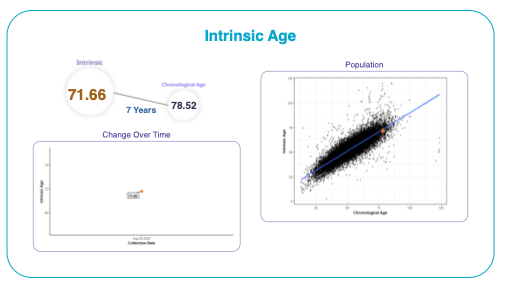
Using DNA, they calculate Intrinsic Age, the natural aging process as determined by our genetics. They also can determine Extrinsic Age, which results from our behavior. While the extrinsic age would often be expected to be older than the intrinsic age, that does not have to be the case. Happily, that is my situation. Changes in lifestyle and medication can improve the extrinsic age, increasing the health span and overall life span. That is the purpose of longevity medicine, in my opinion.
I was born lucky. My intrinsic age is 10% younger than my chronological age. Instead of being 78, I would be 71. But importantly, my extrinsic age is 14 years lower or 20%, which is pretty significant and is likely the result of my lifestyle choices. So, if all these numbers are correct, I could live to be 100. Since my dad died at 97, it is not so surprising.
I should also say that I do not know how accurate TruDiagnostic is. We are just in the very early stages of understanding biological age. I would not rely on these results. It is likely that extrinsic has a high degree of variability. For instance, I suspect that a simple respiritory infection could add years to your age
Now, the question arises: How would the knowledge of being significantly younger or older than one’s chronological age impact one’s life? Would it alter their choices and perspectives? These are questions that, I believe, will become more relevant as we improve our understanding of aging and longevity.
 Two Thirds Done
My mother used to say “work doesn’t kill you, worries do”. I wonder how that enters into these calculations.
LikeLiked by 1 person
Your mom was right. Stress is a major negative factor.
LikeLike
Yes, but I was wondering how that enters into TruDiagnostic calculations.
We have much to gain by paying attention to the common sense acquired over time and to popular wisdom.
LikeLike
It does not impact directly. They measure the effect of stress on your body.
LikeLike