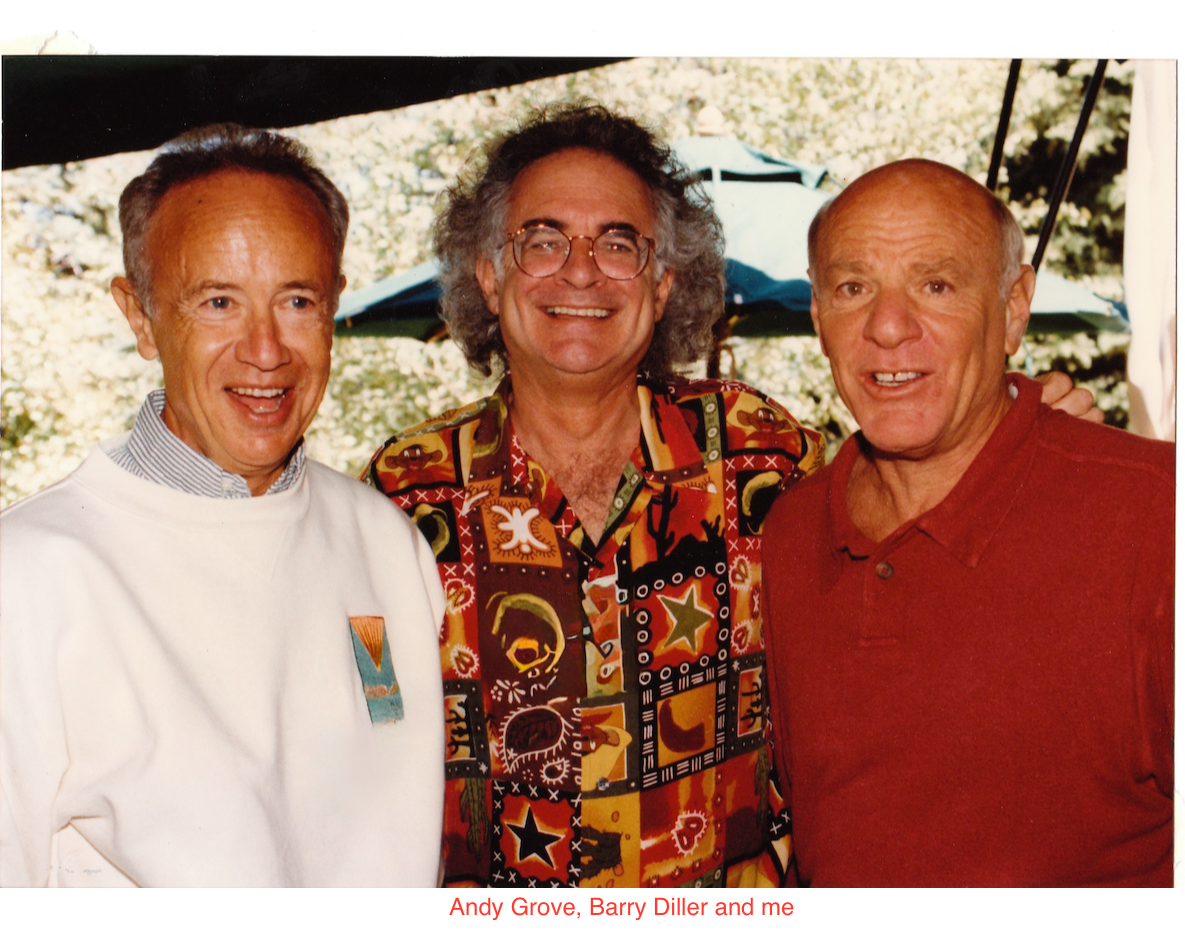
It was early 1993 when Andy Grove asked me to meet his renowned journalist friend, Norm Pearlstine. At that time, Norm was Executive Vice President of Dow Jones, which owned The Wall Street Journal, where Norm had previously worked. He would go on to become Editor-in-Chief of Time Magazine, eventually run the LA Times. Norm is now retired, though still active. That meeting led to an unexpected chain of events involving Barry Diller, QVC, Comcast and the early days of creating the residential broadband network we now enjoy.
The internet as we know it was just beginning to take shape. A young computer science student at the University of Illinois at Urbana-Champaign, 22-year-old Marc Andreessen, along with Eric Bina, was busy developing the first major web browser: Mosaic. Marc and Eric moved to Silicon Valley in 1994 to join the legendary Jim Clark in founding Netscape on April 4, 1994. By the way, I was the only outside person quoted in the announcement of the company, which was originally called Mosaic Communications:
A new medium for content, communications and commerce is born
“We are excited about the possibilities that Mosaic Communications’ products bring to PC users,” said Avram Miller, vice president of corporate business development at Intel. “It’s precisely these kinds of multimedia-rich applications that will take advantage of Pentium processor-based personal computers.”
But back in 1993, I had already grasped the potential of the internet and was working on what would become residential broadband. I was convinced this would lead to a new medium for entertainment, education, commerce, and communication. Mistakenly, I thought that the traditional entertainment industry would drive the development of entertainment on this new medium. I had already begun to develop relationships with “Hollywood.” I used to joke that I had become the technician to the stars but that was not far from the truth.
People in the entertainment industry were interested in interactivity, although at that time, it was widely believed that the TV, not the PC, would be the interactive device in the home. My mission was to make the PC “it.” At that time, Time Warner was busy developing their Full Service Network to provide interactive television. It a total and expensive failure.
Norm wanted to learn more about the internet. Andy knew that I was “user-friendly” and could help Norm appreciate its potential of and how that would benefit the PC industry. This discussion with Pearlstine lead to an introduction to Barry Diller
Norm and I met at his hotel suite in downtown San Francisco and spent about three hours discussing the future of technology and its relationship to media. I enjoyed the conversation, and Norm and I stayed in contact over the years. Toward the end of our discussion, he said I should meet his friend Barry Diller. At that time, Barry was leading the QVC Home Shopping Network, where he had invested $25 million. Barry had previously started Fox Television for Rupert Murdoch and served as its CEO. But after a falling out with Murdoch and driven by a desire to have his own company, he went to QVC, It was not just because of the potential of home shopping but also because he wanted to use it as a platform he could use to make acquisitions.
At that time, purchasing from home involved calling a human being by phone. QVC was partially owned by the cable companies Comcast and TCI. At that time, it was typical for cable companies to invest in content providers to enhance their cable TV offerings.
Barry later made an unsuccessful attempt to acquire Paramount Pictures, which led to a falling out with Comcast and TCI. Eventually, he founded IAC in 1995. Barry’s contributions to the development of today’s online world were not technical but innovative in terms of business concepts. He is, to my mind, the only person who successfully transitioned from traditional entertainment to the new medium: the internet.
I explained to Norm how residential high-speed internet (broadband) could be used for commerce. That’s when he suggested I meet Diller. He was sure Barry would be interested in the potential for QVC. Norm spoke to Barry and then put me in touch with his assistant to organize a visit. I invited Les Vadasz (my boss/partner) to join me. I wanted to include Les in such discussions so that he would support my efforts and also help get Grove on board. Les was always more successful with Andy than I was.
Visit to QVC and Barry makes an introduction
Les and I traveled to QVC, located about 30 miles from Philadelphia, in West Chester. We spent several hours at QVC learning how the business worked, how products were selected, how they were presented on TV, and the nature of the customers (most buying happened at night, likely via a TV and telephone in a bedroom). QVC had revenues of more than a billion dollars at that point and sold over 30 million products a year. Most of their customers were women. It turned out to be critical that the on-air hosts were able to develop an emotional connection with the viewers/customers.
While I could see the long-term potential of online shopping, I didn’t think QVC’s customers would be early adopters of broadband internet. It would be Jeff Bezos, not Barry Diller, who would make internet shopping a reality. Even now, only about 20% of retail purchases are done online, though categories like books and electronics have reached the 50% mark.
Barry and I developed a friendship from that first meeting. I would visit him over the years at his home in Beverly Hills. We discussed potential business ideas. While his ideas weren’t particularly inspiring to me, what I saw in him was drive and passion. I’ve known a few people—mostly men—like Barry. Their strength, tenacity, and willingness to take risks are key ingredients in building major businesses.
Barry and Diane-a love story
Starting in 1993, I was invited to the Allen & Company Sun Valley Conference and attended every year until 1999, which was the last year I received an invitation, though I stayed in touch with Herb Allen for many years after. It was at Sun Valley that Barry introduced me to Diane von Fürstenberg—the love of his life and a force in her own right. It was well know that Barry was gay although he never discussed it. So his relationship to Diane was somewhat of a mystery back then. At that time, they were not married but were a couple. They married in 2001. As Barry recently wrote, “I had many men in my life but only one woman.”
Diane is an extraordinary woman. Like Barry, she is Jewish—although with a name like von Fürstenberg, one might not guess that. She was born in Brussels to a mother that was a holocaust, survivor She was and is a very successful fashion designer and entrepreneur. I believe that shortly after meeting her, she asked me to help get a PC for her daughter, Tatiana which I did
The last time I spoke with Barry and Diane was at a charity event in New York City about ten years ago, I think. They seemed to recognize me, but maybe they were just being polite.
Barry introduces us to the CEO of Comcast
During that meeting with Barry at QVC, I explained my ideas for residential broadband and how the internet could transform the cable industry. He understood and said that Les and I should meet with Ralph and Brian Roberts at Comcast. Ralph was still running the company at the age of 73, and Brian was just 34, and would eventually become CEO.
I was already in discussions with Mark Coblitz, who ran strategic planning at Comcast. We ended up doing a very important consumer trial with Comcast starting in 1993. It was highly successful and pivotal in gaining the support of the cable industry. At the same time, we ran a broadband trial with Viacom, which owned cable properties at the time. That, too, was very successful. We may have gotten Comcast’s support for the trial without Barry’s introduction, but it certainly helped.
Who Knew
I doubt Barry has given much thought to those early days of broadband and his role in getting Comcast on board. But I certainly have—and I like to think that perhaps I had some influence on Barry’s embrace of the internet as the foundation for his many businesse
Barry’s book, “Who Knew” reveled for the first time that he was gay. I am glad for him at 83 that he feels comfortable enough to discuss this aspect of his life. I read excerpt from the book. It shows a sweet side of Barry that I never observed.
His book will be published on May 20th. As I wait to read it, I reflect on how those early conversations helped shape the digital world we now take for granted.
 Two Thirds Done
“Barry Diller Doesn’t Want to Pretend Anymore” – May 6, 2025: https://www.nytimes.com/2025/05/06/style/barry-diller-gay-diane-von-furstenberg.html
LikeLike
And why should he?
LikeLike
Avram,
This is really fascinating.
Best
Michael
LikeLike
Thanks. It was an interesting time in my life. I have many such stories.
LikeLike
Pingback: John Malone – The Master of Sub-Optimization | Two Thirds Done