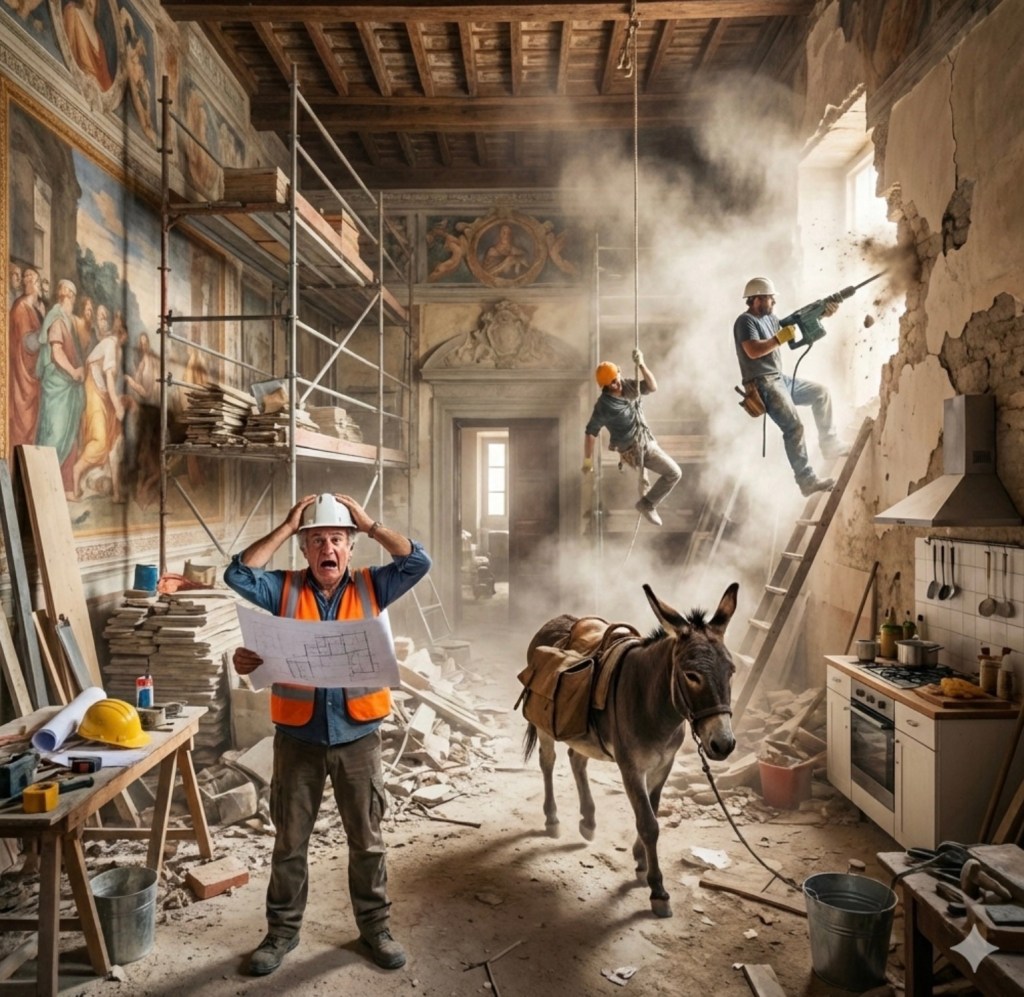
The short answer is yes.
We moved to Italy in February 2025. At first, we settled in Genoa, which is a beautiful and serious city—but after a few months, we realized it wasn’t right for us. Fortunately, we discovered Lecce, in Puglia.
Lecce is often called the Florence of the South. Its historic center is a dense concentration of Baroque architecture, built almost entirely from pale local limestone. The city feels elegant without being heavy, historic without being frozen. The streets are clean, the light is extraordinary, and the scale is humane.
We also liked the people. Puglia, in general, feels warmer—socially as well as climatically—than northern Italy. The food is better, the pace more relaxed, and the costs significantly lower than in places like Milan, Florence, or Rome.
Naturally, we assumed we’d find something ready to move into.
We didn’t.
Eventually, we found a beautiful palazzo in a perfect location. It had been built in 1731. It also needed a serious renovation.
Having built two homes and renovated another, we weren’t entirely naïve. So in July, we decided to buy it and renovate.
We still haven’t started.
First, the Purchase
Buying a home in Italy is not simple, especially in a historic center.
Many properties have been modified over the decades without proper permits. Sometimes rooms that are clearly bedrooms are officially registered as storage spaces. In one apartment we considered, there were four bedrooms, but legally only one. The owner had declared the others as storage to reduce taxes. You would think that a 400 meter sq place with just one bedroom would have been suspicious but he had gotten away with this.
When I asked whether everything was legal, the agent assured me it was and added that the seller was an attorney and would never do anything improper. Sure!
I hired two professionals immediately: an attorney and a geometra (a kind of inspector). It did not take long for us to realized what a mistake we could have made.
A dream or a nightmare
We passed on that apartment and eventually found another property that needed more work but had more potential and not issues, we thought. We checked the documentation carefully, and everything appeared to be properly registered.
We signed a purchase agreement in July, putting down 10% of the price. Closing was scheduled for October 15, to give the sellers time to relocate.
Next, we hired a project manager, who introduced us to an architect we liked immediately. He also recommended a builder with whom he had worked extensively. We checked references. The builder had a reputation for quality work and reliability, though at a premium price.
We agreed to let the sellers remain in the apartment until October 31 and closed on October 10. They did not leave until mid December. Furthermore they stripped the place of many things that belong to us including the kitchens and bathrooms.
Luckily we found a lovely home to rent just a few minutes from the one we purchased. So we were able to move to Lecce and at least start our life here. The experience of living in Lecce has been wonderful so far.
The Vincolo Problem
In Italy, closings are handled by a notary, who performs extensive due diligence on title, permits, and legal status. This is not optional. It is also not cheap.
Roughly 20–30% of buildings in Lecce’s historic center are regulated under Italy’s national cultural heritage law. These properties are known as edifici sottoposti a vincolo.
Another 60–70% of buildings are regulated more lightly, mostly with restrictions affecting façades and visible elements.
We checked carefully. According to municipal records, the agent, and the notary, our building was not subject to the stricter vincolo. That status is explicitly stated in our deed.
And yet.
After the purchase, a disagreement emerged between the Comune and the heritage authority. It appears that an address was misattributed, and our building was incorrectly associated with a protected listing.
Until this is resolved, we cannot begin renovations. We have obtain definite proof but we just have to get the authories to make the correction which is not an easy thing to do.
Renovating (In theory)
In Italy, closings are handled by a notary, who performs extensive due diligence on title, permits, and legal status. This is not optional. It is also not cheap.
Renovation in Italy is itself a highly regulated ecosystem. At this point, our team consists of roughly ten professionals; an architect, a project manager, a lawyer, a geometra, a designer of the climate system, a designer of the electric system and smart home, a “works” director, safety, technical, a site manager.
All of them are competent. All of them are required. But mone of them can move forward until the regulatory issue is resolved.
I am hopeful this will be cleared within the next month. If so, the renovation itself will likely take six to nine months and cost about twice what I originally imagined.
So do you have to be crazy to renovate a historic palazzo in Italy?
Yes.
 Two Thirds Done
When renovating historic buildings one should always expect bad surprises (I should know…). But you are not doing this for yourself only: you are helping preserve a part of Italy’s patrimony and that will be part of your legacy, too.
LikeLike
Oh, Avram, That’s really terrible. I hope things get resolved in your favor soon. Real estate is not known for its simple, honest transactions. Heaven knows, look at the current US president. So you got the boot, huh? Maybe I should say ‘the heel’? Looks like a fantastic place to move. Do post pictures! The central city is quite large; it looks like fun! Gerry was born in Rotterdam and moved here at age 10. I would love to move to Europe. We look at Rotterdam every single morning on YouTube. If you do a search for the Erasmus Bridge webcams, we are often among the watchers. His family lived in South Rotterdam, on the side of the bridge away from the giant, iconic support structure. I wouldn’t mind moving there, but the language is very difficult. Gerry stays in practice by speaking to relatives every now and again. I hope the new house works out beautifully! Cheers, Mary Cole
LikeLike
Avram, I am impressed by your plunging into a new challenge with the renovation of this historic palazzo in Lecce. Having lived for five years in northern Italy, when I was working in Milan, I know that life there can be difficult. Could you write something about the medical facilities and personnel that are in the area of Puglia where you’re living? I’m considering returning to Italy after 18 years in southwest France. The areas that I was considering–Piedmont and Tuscany, are too expensive, and I will spend some time exploring the possibility of living in Lecce.
In bocca al lupo for your new adventure, in the New Year.
LikeLike
Pingback: Italy and Me: A Cultural Struggle | Two Thirds Done