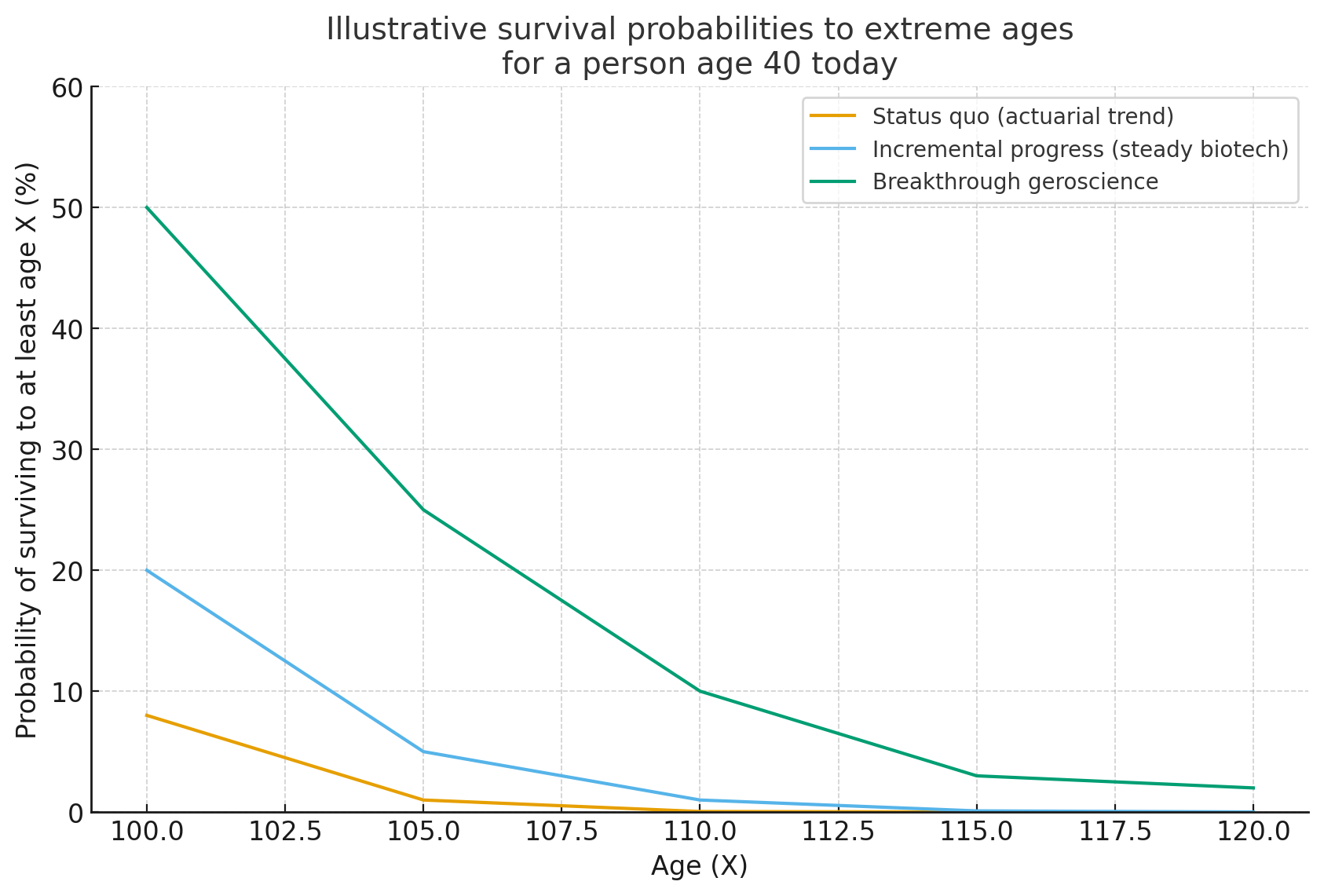
Life expectancy has been increasing worldwide by about 0.2 years every year — roughly two extra years per decade. Even more importantly, health span — the number of years we live in good health — has been rising as well, which is critical.
If you’re 40 today, actuarial tables suggest you’ll live to about 85 on average. With steady medical progress, 95 is realistic for many. Already, the healthiest 20% have good odds of crossing 100. But that does not account for breakthroughs that are likely in the coming decades. Already, drugs like the GLP-1s are transforming metabolic health, and that’s just the beginning. Advances in gene editing, regenerative medicine, and AI-driven drug discovery could push the boundaries even further. I’ll go out on a limb: I believe some of you will live not just to 100 or 110, but to 120.
That is 80 years from now. The world in 2105 will be very different from the world of today — perhaps beyond our imagination.
I am eighty, and fortunately in excellent health. Based on current data, I may have a 25% chance of making it to a hundred. I can’t just sit around for 20 years waiting to die. So I have decided to live my life like I am 60.
Right now, the average age of retirement in the developed world is around 65 years. Meanwhile, we face the inversion of the population pyramid in developed countries. This has profound — and perhaps grave — economic consequences, but also social ones. What are people supposed to do with all these extra years?
We are not prepared for this — individually, culturally, or globally. What will we do with these extra decades of life?
I pride myself on my imagination but I am struggling to image what this all means.
 Two Thirds Done