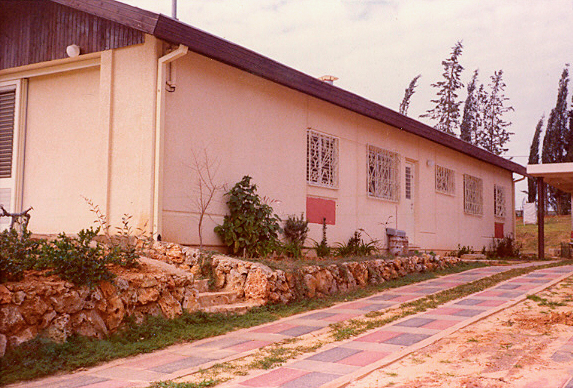
My garden was built by workers from Gaza in 1975
A friend of my wife, a well-known television producer, is visiting Israel. During one of his meetings, he learned that on October 7 thousands of Gazans who were not Hamas fighters followed Hamas into Israel and took part in the atrocities. He was astonished.
The Israeli army later estimated that about 6,000 Gazans crossed the border that day. About 3,800 were Hamas’s elite fighters. The other 2,200 or so were a mix of members of other armed groups and ordinary civilians. It is the civilians I want to talk about. Frankly, I was not surprised when I learned about this a few days after October 7. The civilians of Gaza had been living in what was called by some the “world’s largest open-air prison.” A prison, I have to add, that was run by a gang of inmates, Hamas. I was not surprised; this was the first time they could leave, and the opportunity to take “treasures” like automobiles, TVs and computers must have been so tempting. However, I was shocked to learn about the violence some of them committed against Israelis they found, including murder and rape. I do not want to conclude that these civilians were typical of the people living in Gaza. I do not know. I do know that since the 1990s, they have been systematically taught to hate Israelis.
The Gaza I first knew
I found myself thinking not only about October 7, but about the Gaza I first knew more than fifty years ago. I moved to Israel in 1974. Gaza and the West Bank were under Israeli military occupation, but the physical separation that exists today did not exist in anything like its present form. I lived close to the West Bank, and I regularly drove there to buy vegetables. I didn’t often go to Gaza—it was about forty miles away—but I employed workers from Gaza to help me build my garden. This sounds almost unimaginable today.
I don’t mean to romanticize the occupation at that time. Palestinians and Israelis certainly had grievances against one another then. But the relationship was different. There was human contact. The populations were intertwined economically and physically in ways that have largely disappeared.
Oslo and the two intifadas
This started to change with the first intifada, which began in 1987. Then came the Oslo peace agreement in 1993, and on July 1, 1994, Yasser Arafat returned, first to Gaza and a few days later to Jericho in the West Bank. I believe Israel, under a left-wing government at the time, was serious about a two-state solution, but Arafat was not. I also believe that Arafat stole billions from his own people, and his successor, Abbas, has faced persistent allegations of corruption, but that is another story.
Over the next fifty years, Israel built walls, some physical, some political and some psychological. The government also kept expanding the Jewish settlements on Palestinian land in both the West Bank and Gaza, which had begun after the 1967 war, under the mistaken belief this would make Israel safer.
How did we get from there to here?
One of the decisive moments came in 2005.
Prime Minister Ariel Sharon made the extraordinary decision to remove every Israeli settlement from Gaza and withdraw Israeli forces from inside that territory. Roughly 8,000 Israeli settlers were evacuated, some forcibly by Israeli soldiers and police.
I remember how traumatic this was within Israel. Israelis watched Israeli soldiers carrying other Israelis from their homes.
Whatever one thinks about Sharon’s decision, it created an extraordinary moment. For the first time since 1967, there were no permanent Israeli settlements or military bases inside Gaza. But there was opportunity.
Hamas takes over
What happened next was not what many people hoped for. In January 2006, Hamas defeated Fatah in Palestinian legislative elections. The struggle between the two movements eventually became violent, and in June 2007 Hamas seized control of Gaza. Fatah and the Palestinian Authority remained dominant in the West Bank. Gaza and the West Bank effectively became two different Palestinian political entities.
The open-air prison
Rocket attacks against Israel continued. Israel progressively tightened restrictions around Gaza, particularly after the Hamas takeover, while Egypt also severely restricted movement across its border.
Gaza became increasingly isolated, “the world’s largest open-air prison.” One run by its imates.
Israel controlled most access by land as well as Gaza’s airspace and maritime access. Egypt controlled the other land frontier. There was no functioning airport. Movement of people and goods became highly restricted, although Gazans could sometimes obtain permits to enter Israel for work, medical treatment and other purposes.
There was an undeniable reality behind that phrase: roughly two million people were living in a very small territory from which leaving was extraordinarily difficult. It was a prison of geography, politics, security and history. And Hamas ruled inside it.
A generation grew up behind the fence
This is the part of the story that worries me most. Half the population of Gaza is under 18. They grew up without any knowledge of the world I had known in the 1970s, a world where someone from Gaza could work in my garden. Rather, they knew checkpoints, permits, rockets, Israeli air strikes, Hamas, periodic wars and a border fence separating them from a country they were taught to regard as their enemy.
At the same time, Israelis living near Gaza grew up with rocket shelters, warning sirens and the knowledge that an organization committed to armed struggle against Israel governed just a few kilometers away.
Each side accumulated its own memories. Each generation inherited the fears of the generation before it.
Then came October 7, 2023.
Hamas and other Palestinian armed groups broke through the Israeli defenses and attacked communities, military positions and a music festival. About 1,200 people were killed and roughly 250 were taken hostage.
For Israelis, October 7 changed something fundamental. The border fence had represented security. Suddenly it represented the failure of security. And whatever sympathy many Israelis had once felt for the civilians living on the other side of that fence became much harder to sustain.
The war that followed
The war that then resulted brought death and destruction on an enormous scale to Palestinians. I do not support the actions Israel took and is taking after October 7 in Gaza. I think Israel should have first asked other countries to help it get its hostages back and to participate in disarming Hamas. Instead it acted out of rage. The rage is understandable, but the results were not good. I will not speak here of the ignorance of so many that only see Israel’s actions and do not assign any responsibility to Hamas and its supporters like Iran. Where does this end?
Netanyahu’s responsibility
The government of Netanyahu carries a heavy share of the responsibility for the situation. He has been in power about two-thirds of the time since 1996. He did not just ignore Gaza. For years he allowed Qatar to send money to Hamas there, because a divided Palestinian leadership suited him. What did he think would happen? Israel needed to work with other countries to find a solution for the people that lived there, not just build a bigger fence. The people of Gaza, like all people, deserved a decent life for themselves and their children. When you have nothing to lose, you will risk everything.
My dream for Gaza
I had, and still have, a dream for Gaza. Imagine, for a moment, something radically different.
It starts with both Israel and Egypt offering land to create a “Gaza II” adjacent to the current one, “Gaza I.” Then imagine a massive regional development project involving Israel, Egypt, Palestinians and outside countries willing to finance it. New Palestinian communities would be built with modern infrastructure.
Desalination plants could produce water, as they already do on a massive scale in Israel. Solar installations could produce abundant electricity. Modern agriculture could use some of that water and energy. New cities could be designed rather than improvised. Industry could provide jobs. A functioning port could connect the population with the outside world.
Most importantly, imagine hundreds of thousands of young Palestinians waking up in the morning with someplace to go. A job, a business, a university, farms, and industry. A future!
Can prosperity become part of security?
We have spent decades trying walls, checkpoints, military deterrence, blockades, rockets and wars. They have not produced peace. We need a different way forward.
The West Bank is equally difficult but needs a different solution
I understand why many Israelis fear the creation of a Palestinian state immediately adjacent to Israel’s principal population centers. Israel is extremely narrow in places, and October 7 made territorial security concerns much more visceral.
Palestinians, however, cannot reasonably be expected to live indefinitely without political rights, economic opportunity and control over their own future.
At the same time, there are Israelis who regard the West Bank, Judea and Samaria as an inseparable part of the historical Land of Israel and support permanent Israeli control or annexation.
These positions do not fit neatly together but that is the reality.
I can imagine arrangements that might eventually reconcile Palestinian self-government with Israeli security. I have much more difficulty imagining the political leadership capable of implementing them today. And perhaps that is what saddens me most.
A word about the hatred directed at Israel and at Jews in general
My heart breaks to see how Israel and Jews in general are being treated. I have no problem with people being critical of the Israeli government. I am myself. But unless you think that every American is responsible for Donald Trump, you cannot think that every Israeli is responsible for Netanyahu, let alone non-Israeli Jews. How people can support Hamas is beyond me. I do not understand the stupidity of gay people that support the people that would kill them after cutting off their testicles. Women that support rapists.
The supporters of the Palestinians have accomplished nothing for the Palestinian people. They are not really for Palestinians because they know nothing about them. They are just against Israel and Jews. The result of their actions has only strengthened Israel’s resolve and feeling of isolation, which can lead to the government taking more actions against the Palestinians.
I remember something different
I keep returning to those men from Gaza who helped me build my garden in 1974.
I don’t remember discussing geopolitics with them.
They came to work and I paid them.
We worked together, we smiled. My wife would bring them water. My children would play with them
Then they went home to their wives and children
It was hardly a solution to the Israeli-Palestinian conflict. But it was human contact, and human contact matters. Today a young Israeli and a young Gazan can live perhaps twenty kilometers apart and inhabit completely different universes. Each may know the other primarily as someone dangerous.
Something to lose
I don’t pretend to know how to solve it.
I do believe, however, that security alone cannot be the objective. Nor can Palestinian nationalism, Israeli nationalism, revenge, historical entitlement or military victory by themselves produce a livable future.
People need something to lose and something to love.
They need homes, jobs, education, businesses and families whose futures seem more valuable than the promises offered by extremists.
Maybe that sounds naïve after October 7 and the war that followed. Perhaps it is.
But after watching this conflict for more than fifty years, I find the alternative much harder to believe: that another wall, another generation of hatred and another war will somehow produce a different result.
