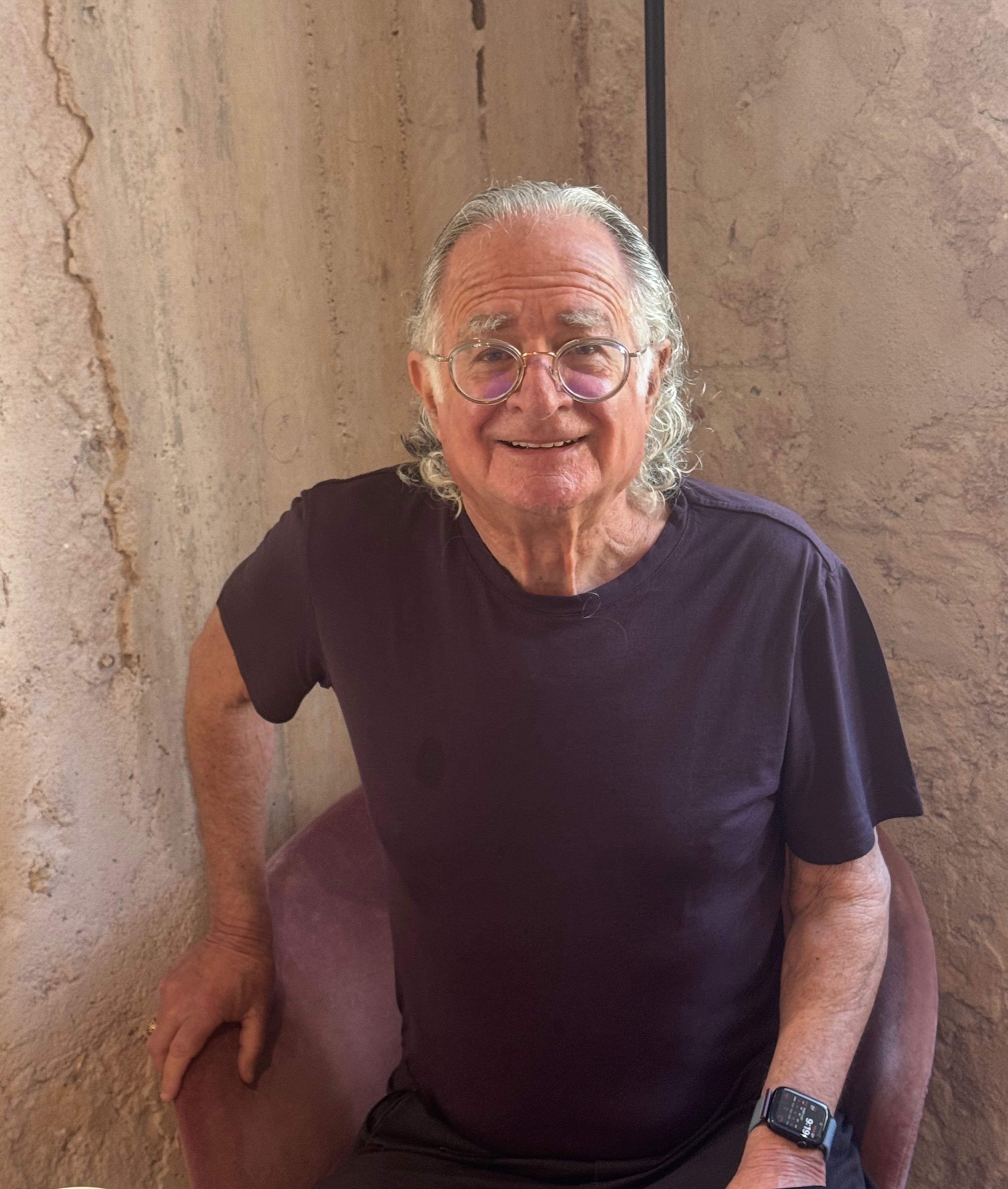
You’re looking at an 80-year-old man born in 1945, on the day Auschwitz was liberated. Realizing how old I am is often a shock. It’s difficult to come to terms with this. For most of my life, I saw myself as the youngest person in the room—even when that was no longer true. I still feel that way sometimes, though I doubt others see me like that now.
Less than 4% of the U.S. population is my age or older. Half of those born in 1945 are no longer alive. Less than a third will survive another ten years. Hopefully, I’ll be one of them.
If you asked someone “Would you like to know how long you have to live?” Some people would say yes; others would prefer not to know. I would very much like to know, because it would surely influence the decisions I make now.
It’s not just about how long we live—but how well. There’s a vast difference between healthspan (the years we’re healthy) and life-span. (total years lived). Simply knowing how many years remain isn’t enough.
Life Span and Health Span
At 80, the average man has 8–9 years ahead, and the average woman has 10–11. But those are averages. What matters to each of us is not the general number, but how long we personally have—and how long we will remain well during that time. While someone might have eight years remaining, they could be sick for half that time. For instance, about 25% of men and 33% of women will develop dementia. It is not just about living longer. It is about living better longer.
The good news is: there’s a lot we can do to extend not just life-span but health-span. Exercise, quality sleep, a healthy diet, weight management, low stress, and strong social connections all make a difference. It also helps to have chosen your parents well—though genetics are estimated to account for only about 25% of longevity outcomes.
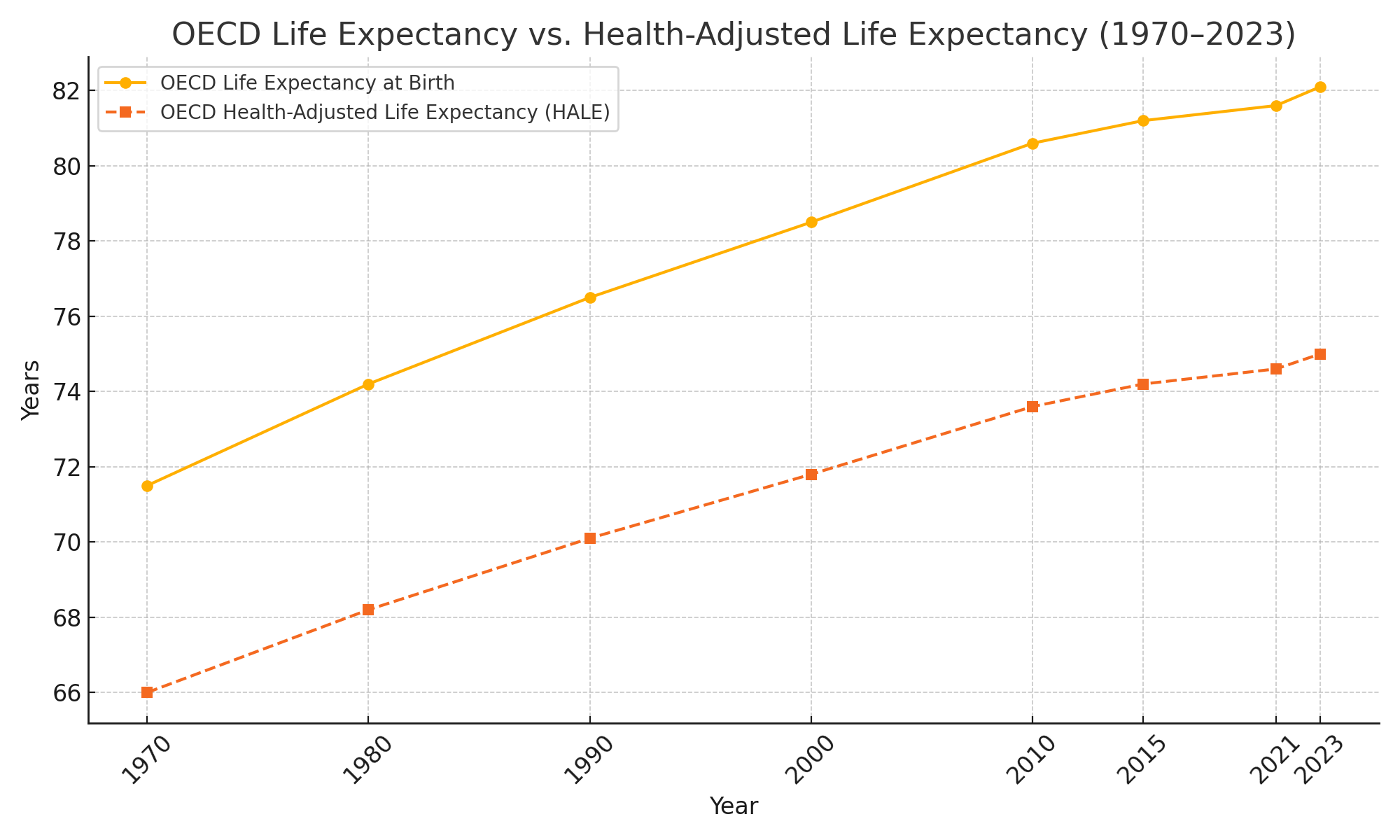
Lifespan in the developed world has increased significantly over the past century, although gains have slowed in recent years (COVID played a role). Life expectancy has risen by about 20% over the last five decades. However, healthy lifespan has increased only about 17%. This widening gap raises real social and economic questions, especially as population growth slows and societies age—leading to an inversion of the population pyramid. I’ll write more about that in another post.
None of these projections account for potential breakthroughs—especially from disruptive technologies like AI—which could radically change the landscape of aging and disease.
Those who are middle-aged today may live well into their 100s. Some believe they may become biologically immortal. I don’t think that opportunity applies to me. And then there’s the question: how long would we want to live, and in what kind of world?
Back to me
I realize this post may seem self-absorbed. But I want to share my thoughts and feelings. I can’t be alone in this. Many of my friends are my age and surely experience these same reflections.
If we knew we had 20 healthy years left at 80, what would we do with them? The economic implications—both personal and societal—are worth serious consideration as well. I’m in a better position than most, but I still ask myself these questions.
When I was diagnosed with prostate cancer in my early 50s—and was told it hade likely metastasized (it hadn’t, though I endured a few scary years)—I decided to live as if I only had ten years left. Now, at 80, I live as if I have just five years ahead. But that’s probably not true.
Recently, I had my biological age assessed by TruDiagnostic. They estimate I’m 15 years younger biologically than my chronological age. I’m not a full believer in this technology, but with such a large gap, I do feel confident that I’m aging well. I also had my brain MRI analyzed by a remarkable company I advise, BrainKey. And I underwent a CT angiogram—my coronary arteries are clear.
Where does this leave me and where does it leave you?
I’m caught between feeling like my life is winding down and believing I might have 20 more years. If I knew how long I had, my choices would probably be different. I am thinking that I should live like I have 20 years more. Perhaps believing that will play a role in making it true. What about you?

Hello Avram,
I belong to the 0.5%.
A British study found that about 10% of the male population over 50 has no white hair, and about 5% of the male population overt 50 has no wrinkles. I have no white hair and no wrinkles. How many of us have no white hair and no wrinkles after 50 years. My guess: 0.5%. It keeps me from wanting to know how long I’m going to live.
So far, I lived 8 months more than my father.
Ciao!
LikeLiked by 1 person
Well, we all know you are exceptional :-).
LikeLike
Pretty courageous to share this kind of sentiments and vulnerabilities. I am only 61, turning 62 early May and I find myself more and more concerned about how many quality years I have left. My wife, who is older, is more concerned obviously and I heard my parents complain about their age as they were getting older. Young people tend to minimize those anxieties until you reach a point when you realize you have less time left than what you already spent. It’s easy to say when you are young that you should enjoy life while you are healthy and financially comfortable and don’t need to worry about daily grind, but you can’t escape biology, even as I am sure you are enjoying life to the fullest. I sense that is because you feel you have more to give, more to discover, more to contribute, more to share, more need to live. For me as an atheist, it is compounded by the fact that at the end, we simply disappear and all ends (I don’t mean to amplify your anxieties by seeding more…).
It’s funny, while I am reading your post, I am thinking why do I keep thriving to do more, have more, be more etc instead of just be. Even while facing tremendous financial instabilities and transformational risks I am taking, I know I am doing lot better than most of my friends, most of my old classmates, I am part of the 3% or whatever. Then why do I still feel that bug of doing more, experiencing more, taking more risks just running after the next challenge? Will it ever be enough? My more “middle class” friends would likely say to chill out or something. Not for me.
I chose to believe that perhaps my growing age anxieties (maybe yours as well, I don’t know. And don’t tell me: you are only 62, what are you worried about), perhaps that reflects an active and healthy mind that will have a persisting contribution to life and that is just the price to pay to keep a balance of age-related anxieties with a drive to make the best of it. I think you are doing pretty well to that effect. For its whatever my small window of knowing you perspective might be.
Anyway, if the goal of your post is to make people reflect and think, that seem to have worked for me….
Ciao!
>
LikeLiked by 1 person
One of the benefits of getting to be old is you don’t care so much about what people think of the things you say you do. For instance, I don’t worry about the impact of my remarks on my career as I do not have one.
I think a concept that is important to me is, “purpose.” I would find it difficult not to feel that there was a purpose, some meaning, to my life.
I realized at 45, the my life was half over. Then soon after turning 60, I started this blog, two thirds done, because I felt I had 30 years ahead of me. Now, I sometimes think to rename it to “Almost Done.”
My goal in creating this post was to get please including myself to reflect. Therefore, I was very much pleased by your comment.
LikeLike
😊
>
LikeLike
Interesting post from a young fella. I’m soon to turn 93 and having lost my wife just over a year ago I’ve moved to an independent living facility. I’m in good health and come from a line of long term survivors. I was a tech guy in the bay area and had my last gig at age 84 (I loved my work).
I was somewhat resigned to just “checking off” my remaining days but content in learning new things for which I never had time. I still design stuff to keep an active mind and for fun. I don’t exercise much and eat for pleasure – if it’s healthy it’s a bonus.
Most importantly I found a new love eight years younger with whom I have a healthy , ahem, relationship.
I think that life long learning to keep the mind active and if possible a loving supportive woman are key to a pleasant terminal phase. Turn off the TV, read a book, enjoy a dram of wine or malt, stay reasonably social, and don’t over-exercise. Doctor Bob’s prescription.
LikeLike
Thanks for your comments Bob. Glad thinks are working out so well for you.
LikeLike
I love you Avram, it is in the surrendering to the “not knowing” that allows me to show up everyday with an open heart and live as if it could be my last day, last hour. Surrendering to the mystery of life offers so much joy and reminds me that it is incumbent on me to choose my thoughts, actions and words. I LOVE my life all of the hard with all of the good. I love the people in my me far and near with a full heart and gratitude. You and Deb are people I LOVE BIG!
LikeLiked by 1 person
I am not very skilled at surrendering or not knowing. We are so different in that way. Deborah and I love you too.
LikeLike